
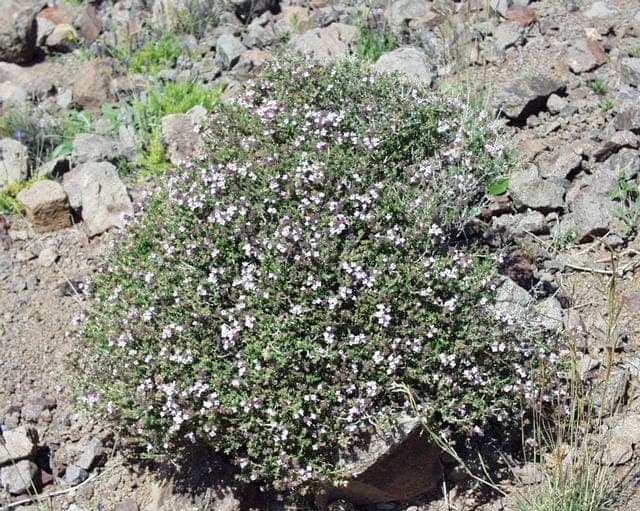
Henry Brisse (upload by user:Abalg) / CC BY-SA 3.0, via Wikimedia Commons
Thyme (Thymus vulgaris): complete guide
Thymus vulgaris
Want to see Thyme (Thymus vulgaris): complete guide in your garden?
1 minute, no credit card
Overview
Thyme (Thymus vulgaris), also known as common thyme or garden thyme, is one of the most versatile and beloved herbs in the world. This evergreen sub-shrub from the mint family (Lamiaceae) combines culinary value, medicinal properties, ornamental beauty, and ecological importance in a way that few other plants can match. At a modest height of just 15-30 cm, thyme may be small in stature, but its impact in the garden and kitchen is immense. The plant releases a warm, spicy aroma at every touch, a fragrance that is the very essence of Mediterranean cooking.
Thymus vulgaris originates from the western Mediterranean basin, where it grows on dry, rocky slopes and in the garrigue - the low, aromatic scrubland so typical of southern France and Spain. On gardenworld.app you can create a garden design where thyme takes a prominent role - as ground cover between paving stones, in a herb garden, along the edge of a sunny path, or as part of a Mediterranean border. The plant flowers from May to July with countless small pink-purple to lilac blooms that attract bees, bumblebees, and butterflies in large numbers. Thyme is therefore not only a culinary hero but also one of the best bee plants for the small garden.
Appearance and bloom cycle
Thyme grows as a compact, densely branched sub-shrub of 15-30 cm height and 20-40 cm width. The stems are woody at the base and become herbaceous towards the top, bearing small, oval leaves of 4-8 mm that sit in opposite pairs along the stem. The foliage is dark green on the upper surface and grey-green beneath, covered with minute glandular hairs that contain the essential oils. In warm weather you can smell the fragrance without even touching the plant.
From May to July the flowers appear: small, two-lipped blooms of 4-6 mm arranged in dense whorls around the stem tips. Flower colour ranges from pale pink and lilac to purple, and in some cultivars white. Despite their tiny size, the flowers are extraordinarily attractive to pollinators - a thyme plant in full bloom literally buzzes with bees. After flowering, small nutlets form that are dispersed by ants. The foliage remains on the plant year-round, making thyme decorative and harvestable even in winter.
Top varieties and cultivars
Common garden thyme (Thymus vulgaris) is the baseline, but numerous varieties and related species each bring their own charm. Standard Thymus vulgaris has the strongest flavour and is the best choice for the kitchen. 'Compactus' is a particularly dense, dome-shaped selection that is ideal for pots and the front of borders.
Other popular species include lemon thyme (Thymus x citriodorus) with a delightful citrus fragrance, wild thyme or creeping thyme (Thymus serpyllum) that grows as ground cover and tolerates light foot traffic, and woolly thyme (Thymus pseudolanuginosus) with silvery-grey, hairy foliage that looks beautiful between paving stones. Well-stocked garden centres carry a wide range of thyme species, from culinary varieties to ornamental thymes for rock gardens.
Ideal location
Thyme demands a warm, sunny position with at least six hours of direct sunlight per day. The plant originates from the Mediterranean and needs comparable conditions in your garden: abundant sun, minimal water, and good air circulation. A south-facing border, a raised bed, the edge of a terrace, or the gaps between paving stones are all ideal locations. Thyme also grows superbly in pots and containers on a sunny balcony or patio.
Avoid shady, damp spots and locations where the soil remains wet in winter. In partial shade thyme will grow, but the foliage becomes longer and floppier, the aroma weakens, and the plant becomes more susceptible to fungal disease. An airy position where the breeze moves freely is ideal - good air circulation prevents powdery mildew and keeps the plant compact and healthy.
Soil requirements
Thyme demands well-drained, lean to moderately fertile soil. The plant hails from chalky, rocky slopes and thrives best in poor, dry ground with a pH of 6.0-8.0. In heavy clay that retains water, thyme will inevitably perish - wet roots lead to root rot, especially in winter.
Improve clay soil by working 30-40 per cent coarse sand or fine gravel into the top 20-30 cm. A layer of gravel or stone chippings around the plant improves drainage and radiates warmth, promoting growth. Do not add compost or manure to the planting spot: overly rich soil produces soft, watery foliage with little flavour. In containers, use a mix of potting compost and perlite or coarse sand (ratio 2:1) with a layer of expanded clay granules at the bottom for drainage.
Watering
Thyme is remarkably drought-tolerant and rarely needs supplementary water once established in the ground. During the first year after planting, water weekly with a small amount (2-3 litres) to help the root system establish. Water only when the top 3-5 cm of soil feels dry. After the first year, supplementary watering in open ground is virtually never necessary - thyme survives weeks of drought without complaint.
Overwatering is the most common cause of death in thyme. The roots are extremely sensitive to prolonged moisture and rot quickly in wet soil. Container-grown thyme requires more attention: check weekly and water only when the growing medium has largely dried out. In winter, halve the watering frequency - water only on frost-free days and allow the soil to dry thoroughly between waterings.
Free design
Want to see Thyme (Thymus vulgaris): complete guide in your garden? Make a free design now.
Pruning and maintenance
Thyme benefits from an annual trim to remain compact and productive. Without pruning, the stems become woody after three to four years and the plant turns bare and unsightly at the base. The best time to prune is immediately after flowering in July-August. Cut the plant back by one-third, but never prune into old, brown wood - no new growth will emerge from it.
Regular harvesting for the kitchen is the best form of maintenance: by continually snipping sprigs you encourage the plant to produce fresh, young foliage. Replace old, woody plants after four to five years with new specimens - thyme is inexpensive and quick to grow from cuttings or seed. Take semi-ripe cuttings of 5-8 cm in July and insert them in moist sand; they root within three to four weeks.
Harvesting and culinary uses
Thyme is one of the most widely used culinary herbs in the world and an indispensable ingredient in French, Italian, Greek, and Middle Eastern cuisine. The leaves contain thymol and carvacrol, essential oils responsible for the characteristic warm, spicy flavour. Harvest throughout the year, but the aroma is strongest just before flowering in May-June.
Use thyme fresh or dried in stews, soups, sauces, marinades, bread dough, and with grilled meat and fish. Thyme is a core component of the French bouquet garni (together with bay and parsley) and of herbes de Provence (together with rosemary, oregano, and savory). For drying, harvest whole sprigs, tie them in bundles, and hang upside down in a dry, airy spot. After one to two weeks the leaves are dry and can be stripped from the stems.
Maintenance calendar
March-April: Remove any frost damage and dead twigs. Check drainage around the plant. Plant new thyme - this is the ideal planting time.
May-June: The plant begins to flower. Harvest leaves and flowering sprigs for the kitchen. Flavour is at its strongest now.
July-August: Immediately after flowering, give the annual trim: cut back one-third of the green growth. Take cuttings for propagation.
September-October: Final harvest before winter. Spread a thin layer of gravel or stone chippings around the plant for winter drainage.
November-February: Thyme is hardy (USDA 5-9) and in most of the UK and Western Europe needs no winter protection. In extreme frost below -15 degrees C, cover the plant with a layer of straw or fleece. Container thyme overwinters best in a sheltered position.
Winter hardiness
Thymus vulgaris is surprisingly hardy for a Mediterranean plant, surviving temperatures down to approximately -15 to -20 degrees C (USDA zones 5-9). Across the British Isles and Western Europe, winter hardiness is not a concern provided the soil drains freely. Wet cold is far more dangerous than dry cold - thyme entering winter with soggy roots faces a much higher risk of dying.
In well-drained soil and a sheltered position, thyme plants overwinter without problems. A layer of gravel around the plant helps shed excess water. Container plants are more vulnerable: move them to a cool, frost-free spot during severe frost or insulate the pot with bubble wrap. Roots in a pot freeze sooner than those in open ground.
Medicinal uses
Thyme has a long history as a medicinal plant and has been used in folk medicine for centuries. Thymol, its primary active compound, has antiseptic, antibacterial, and expectorant properties. Thyme tea (fresh or dried sprigs steeped in hot water) is a time-tested home remedy for coughs, colds, and sore throats.
In aromatherapy, thyme oil is used for respiratory infections and muscle complaints. Note that pure thyme oil is highly concentrated and should never be applied undiluted to the skin. Thyme honey - produced by bees foraging on thyme - is a delicacy with a distinctive flavour that is particularly prized in Greece and Provence.
Companion plants
Thyme is the perfect partner for a Mediterranean or herb garden and combines superbly with other sun-loving, drought-tolerant plants. The classic combination is thyme with lavender (Lavandula angustifolia) and rosemary (Rosmarinus officinalis) - together they form the three pillars of any Provencal herb garden.
Other excellent partners include sage (Salvia nemorosa) for vertical accents, catmint (Nepeta faassenii) for a sea of blue, oregano and marjoram as fellow culinary herbs, and Stipa tenuissima as a graceful grass adding movement. In a rock garden, thyme combines beautifully with houseleek (Sempervivum), stonecrop (Sedum), and cranesbill (Geranium). Between paving stones and in crevices, plant creeping thyme (Thymus serpyllum), which tolerates light foot traffic and releases its fragrance with every step.
Final thoughts
Thyme is a plant that proves bigger is not always better. At just 15-30 cm tall, this sub-shrub makes a disproportionately large contribution to your garden: fragrance, flavour, flowers, pollinators, and evergreen foliage. The secret to success is simple - abundant sun, dry feet, and lean soil. Follow these three rules and you will enjoy this aromatic treasure from the Mediterranean for years.
Choose your thyme from a reputable garden centre - select a plant with compact, grey-green foliage and a strong scent. On gardenworld.app you can create a garden design that combines thyme with lavender, rosemary, and other Mediterranean herbs tailored to your specific garden. Plant a cluster of thyme along your terrace edge this spring and enjoy fresh herbs at arm's length from your kitchen all year long.
Want to see Thyme (Thymus vulgaris): complete guide in your garden? Make a free design now.
Upload a photo, pick a style, and get a photorealistic design with plant list in under a minute.
No credit card required


Similar plants
English Lavender: complete guide
Lavandula angustifolia
Everything about English Lavender (Lavandula angustifolia): planting, pruning, care and overwintering. Practical tips for lush purple blooms.
Rosemary: complete guide
Rosmarinus officinalis
Everything about Rosemary (Rosmarinus officinalis): planting, care, overwintering and culinary use. Practical tips for a healthy, aromatic shrub.
Woodland sage: complete guide
Salvia nemorosa
Everything about Woodland Sage (Salvia nemorosa): planting, care, pruning and combinations. Expert tips for months of blue-violet flower spikes.