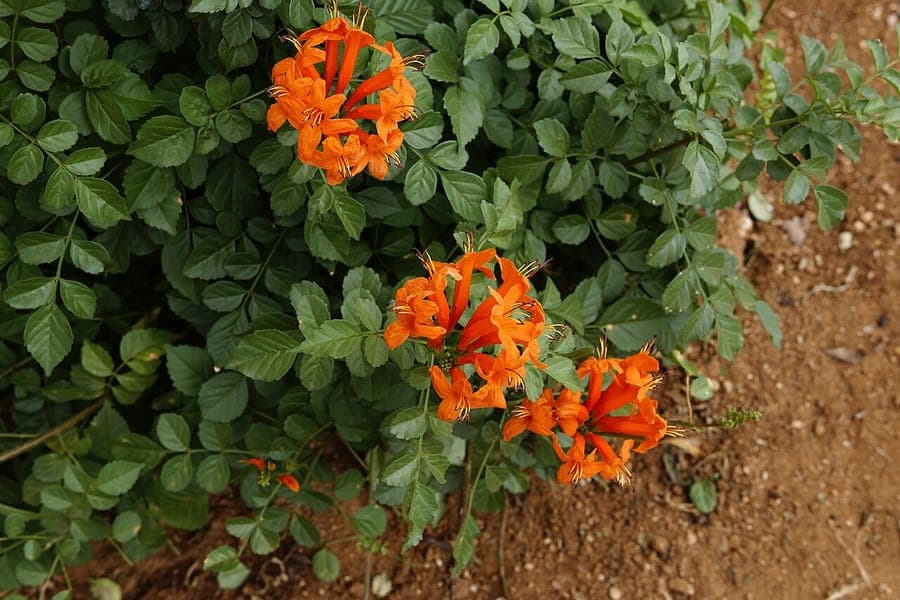
Vengolis / CC BY-SA 4.0, via Wikimedia Commons
Cape Honeysuckle: complete guide
Tecoma capensis
Want to see Cape Honeysuckle: complete guide in your garden?
Full design in HD: €7.99
Look after your Cape Honeysuckle with the GardenWorld app
Identify plants with your camera and get a care calendar with reminders for this plant.


Overview
Cape honeysuckle (Tecoma capensis) is a stunning climbing plant from South Africa, belonging to the Bignoniaceae family. With its brilliant orange-red flowers and vigorous growth habit, this is an excellent choice for gardeners seeking spectacular, tropical effects. The plant is renowned for its profuse flowering, creating masses and garlands that climb walls and pergolas.
This plant offers season-long interest and thrives in warm, sunny environments. With its lush growth and abundant blooms, Cape honeysuckle adds explosive color to vertical garden elements.
Appearance and Bloom
Tecoma capensis exhibits attractive, paired, light-colored leaflets that grow along slender vines. The flower displays, however, are the true highlight: brilliant red to orange flowers appear in numerous clusters, continuously throughout summer and autumn. Each flower has a characteristic funnel or tubular shape with five lobed lips.
The plant climbs vigorously and can rapidly reach 3-4 meters or higher, depending on support. The foliage usually remains green throughout the season, though the plant may shed leaves in cold winters.
Ideal Location
Cape honeysuckle thrives best in very sunny locations. The more sun, the more flowers you will see. The plant loves warm sun-exposed walls, pergolas, or along trellises where it receives full sunlight.
The plant tolerates shade poorly and will flower much less in shady locations. For optimal performance, at least 6-8 hours of direct sunlight is essential. The plant thrives in warm microclimate areas.
Soil
Tecoma capensis is not particularly fussy about soil but grows best in well-draining, moderately fertile ground. A lightly sandy to clay loam is ideal. The plant is less comfortable in very poor material, though it will still grow.
Good drainage is important, especially in rainy seasons. Waterlogging can cause root rot. Mix in some compost when planting to increase soil fertility.
Watering
During the growing season (summer), Cape honeysuckle needs regular watering to bloom well. Water when the top centimeter of soil feels dry. In hot periods, daily watering may be necessary.
In autumn and winter, watering can be reduced significantly, especially in regions with winter rainfall. The plant prefers moderately moist conditions, neither wet nor dry.
Free preview
Want to see Cape Honeysuckle: complete guide in your garden? Make a free preview of your design.
Pruning
Cape honeysuckle grows vigorously and appreciates regular pruning. Prune in late winter (February-March) before growth begins. This stimulates a more compact, fuller plant with more flower buds.
Remove straggling or damaged branches and guide young growth along desired support. Regular pruning also helps keep the plant within bounds and prevents it from becoming too wild.
Maintenance Calendar
Spring (March-May): Pruning complete; begin regular watering. Feed for flowering. Care for new growth.
Summer (June-August): Peak blooming period. Water regularly. Feed biweekly. Train new growth.
Autumn (September-October): Blooming continues. Gradually reduce feeding. Water less frequently as temperatures drop.
Winter (November-February): Minimal watering. Prepare for pruning. Protect from frost in cold regions.
Winter Hardiness
Cape honeysuckle is sensitive to freezing. In regions with severe winters, the plant will only grow in very protected spots or against heated walls. In temperate climates, protection with burlap or straw can be beneficial.
In milder climate zones, the plant grows without problems. The plant won't die back from light frosts but will be severely damaged by prolonged freezing.
Companion Plants
The brilliant red Cape honeysuckle combines beautifully with silver-foliaged plants like dusty miller and artemisia. Cultivated garden association with red and yellow flowering companions delivers a tropical effect.
Low shrubs with contrasting flowers or foliage, such as purple or silver-leaved plants, support the architectural framework.
Closing Words
Cape honeysuckle is a spectacular choice for gardeners wanting to add dramatic color and vigor. With its vibrant orange-red flowers and rapidly climbing vines, this South African plant transforms every vertical element into a flowering masterpiece. Plant in a sunny, protected spot and enjoy a long season of colorful blooms.
For Cape honeysuckle purchase, consult specialized nurseries for advice on local suitability and adapted support structures. Visit gardenworld.app for more planting ideas and garden inspiration.
Frequently asked questions about Cape Honeysuckle
Is Cape Honeysuckle winter hardy?
Cape honeysuckle is sensitive to freezing. In regions with severe winters, the plant will only grow in very protected spots or against heated walls.
When and how do you prune Cape Honeysuckle?
Cape honeysuckle grows vigorously and appreciates regular pruning. Prune in late winter (February-March) before growth begins.
How much water does Cape Honeysuckle need?
During the growing season (summer), Cape honeysuckle needs regular watering to bloom well. Water when the top centimeter of soil feels dry.
Where does Cape Honeysuckle grow best?
Cape honeysuckle thrives best in very sunny locations. The more sun, the more flowers you will see.
What soil does Cape Honeysuckle need?
Tecoma capensis is not particularly fussy about soil but grows best in well-draining, moderately fertile ground. A lightly sandy to clay loam is ideal.

See it in your garden
See Cape Honeysuckle in your garden
One photo of your garden and a few questions. You see the result in about a minute.
Try it with a photoIdentify this plant in your own garden. Identify a plant
Similar plants
Chinese trumpet vine (Campsis grandiflora): complete guide
Campsis grandiflora
Chinese trumpet vine (Campsis grandiflora): large apricot flowers, a warm wall, support for a climber without aerial roots, pruning, skin irritation and frost.
Hybrid trumpet vine (Campsis × tagliabuana): complete guide
Campsis × tagliabuana
Hybrid trumpet vine (Campsis × tagliabuana), such as 'Madame Galen': sturdy support, spur pruning, root suckers, skin irritation and winter hardiness.
Chilean glory flower (Eccremocarpus scaber): complete guide
Eccremocarpus scaber
How to grow Chilean glory flower (Eccremocarpus scaber): sowing, supports, position, watering, pruning and overwintering this fast climber with orange-red tubular flowers.
