Wikimedia Commons / CC BY-SA 2.0, via Wikimedia Commons
Chinese trumpet vine (Campsis grandiflora): complete guide
Campsis grandiflora
Want to see Chinese trumpet vine (Campsis grandiflora): complete guide in your garden?
Full design in HD: €7.99
Look after your Chinese trumpet vine with the GardenWorld app
Identify plants with your camera and get a care calendar with reminders for this plant.


Overview
Chinese trumpet vine (Campsis grandiflora) is the most elegant of the trumpet vines. Its flowers are larger, wider and softer in colour than those of the familiar American species: broad, apricot to orange-red bells that hang in loose clusters from the stems in late summer. If you have a warm, sheltered wall, it can give you a climber with an almost tropical look.
Campsis grandiflora comes from China and has been grown for centuries in Japanese gardens and temple grounds. It is one parent of the popular hybrid Campsis × tagliabuana, the other being the American trumpet vine (Campsis radicans). Compared with those two, the Chinese species is less vigorous, less hardy and forms hardly any aerial roots. On the other hand, it produces far fewer suckers, and its flowers are the finest in the genus.
This is a deciduous woody climber reaching 5 to 8 m, sometimes more in a favourable spot, so it needs a good-sized wall or pergola. At gardenworld.app you can have a garden design drawn up that identifies the warmest spot in your garden, which is exactly where this trumpet vine will do best.
Appearance and bloom cycle
The leaves are pinnate, with 7 to 9 oval, toothed leaflets. Their undersides are smooth, a small difference from the American species, whose leaflets are hairy along the veins. In autumn the foliage turns yellow before it drops.
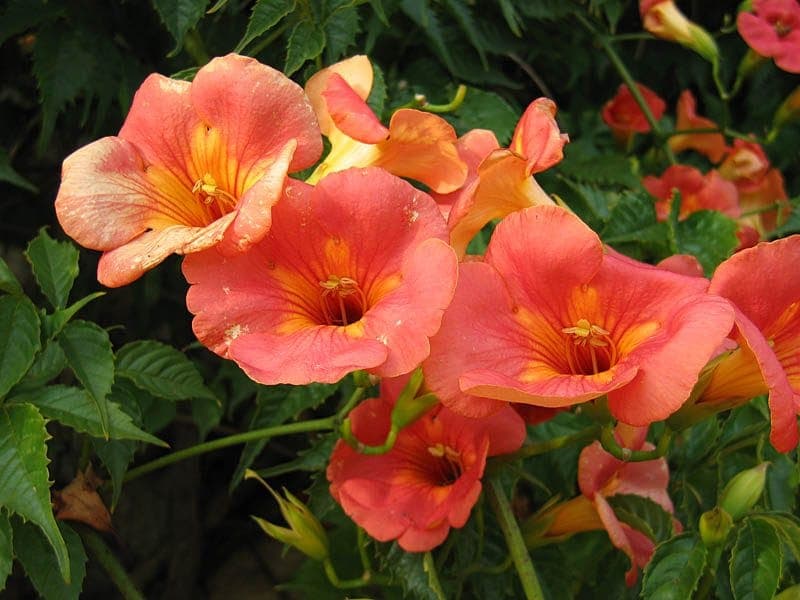
The flowers are the real distinguishing feature. They are carried in loose, drooping panicles at the tips of the new shoots. The tube is short and the corolla opens wide to 6 to 8 cm across, with five rounded lobes in warm apricot, salmon-orange or soft orange-red, and fine darker lines running into the throat. In Campsis radicans the flowers are longer and narrower with a much smaller mouth; in Campsis grandiflora the open, almost saucer-shaped face dominates.
Flowering usually begins in July and continues into September. As with the other trumpet vines, patience is needed: a young plant only flowers well after three to five years, and the hotter the summer, the better the display.
Ideal location
Give this trumpet vine the warmest spot you have: a south- or south-west-facing wall, a courtyard whose walls hold the heat, or a sheltered pergola in full sun. It needs more warmth than Campsis radicans or the hybrid, both to ripen its wood before winter and to flower freely. In a cool, windy position it stays small and barely flowers.
Providing support
Campsis grandiflora makes few or no aerial roots, so it cannot cling to a wall by itself. It climbs by loosely twining its stems around a support, and not always convincingly at that. Support is therefore essential. Fix horizontal wires 30 to 40 cm apart, or put up a strong trellis, and tie the stems in regularly. Tie loosely with soft material and check each spring that nothing is cutting into the bark.
The upside of this weak grip is that the plant leaves no marks on brickwork or render. Even so, keep it away from gutters and roof tiles, as these stems will also work their way into every gap. Choose a structure that can carry the weight of a mature plant in full leaf and flower and stand up to wind.
Soil requirements
A well-drained, fertile, humus-rich soil is ideal. Light sand, loam and lighter clays are all suitable, as long as water does not sit there in winter. Cold, wet soil is even more dangerous for this species than for the other trumpet vines, because it is less hardy.
Plant in April or May, when the soil has warmed up and the risk of hard frost has passed. Dig a generous hole, work in compost and set the plant 30 cm from the wall, angled towards it. On heavy ground put a layer of gravel in the bottom of the hole for extra drainage. A mulch around the base protects the roots in both summer and winter.
Campsis grandiflora produces far fewer suckers than Campsis radicans. If you do see shoots appearing some distance from the plant, simply cut them off. The species is not known to behave invasively in Europe.
Free preview
Want to see Chinese trumpet vine (Campsis grandiflora): complete guide in your garden? Make a free preview of your design.
Watering
For the first two years, give about 10 litres twice a week in dry weather. Against a south wall the soil dries out quickly, even after rain, because the wall blocks much of it. Check a few centimetres down regularly: if the soil is dry, water.
An established plant can handle a dry spell, but during flowering and in heatwaves it needs extra water or it will drop buds. Feed in spring with a handful of organic fertiliser or some compost. Stop feeding after July so the wood can ripen properly before winter.
Pruning
This trumpet vine also flowers on the current year's new shoots, so you can prune every year in late February or March without losing flowers. In colder areas it is better to wait until early April, when it is clear which wood has survived the winter.
The first years. After planting, cut the stems back to about 30 cm. Then choose two to four strong main stems to form the framework and train them in a fan against the wall or along the pergola.
Every year. Cut last year's side shoots back to two or three buds from the framework. Remove frosted and dead growth back to healthy wood. After a hard winter you may need to replace a main stem entirely with a young shoot from the base.
Skin irritation. Wear gloves and long sleeves when pruning and tying in. The sap, leaves and flowers of Campsis can cause redness, itching and slight swelling of the skin in sensitive people. Wash your hands afterwards and do not touch your face with dirty gloves.
Maintenance calendar
February to March: Annual pruning; in colder areas, early April. Check wires and ties.
April to May: Planting time. Feed lightly and mulch the base. Protect young shoots from late frost with horticultural fleece.
June: Tie in new stems; growth is fast now.
July to September: Flowering. Water in dry and hot weather. No feeding after July.
October to November: Leaf fall. Give young plants a thick mulch of bark, straw or leaves around the base.
December to January: Dormant. In hard frost, wrap the lowest metre of young plants in fleece.
Let the plant calendar at gardenworld.app remind you when to prune, tie in and protect the base.
Winter hardiness
Campsis grandiflora is the least hardy of the trumpet vines. Established plants against a warm wall tolerate frost down to about -10 to -12 °C; below that the stems die back, sometimes to the ground. The roots usually survive, especially under a thick mulch, and send up new shoots in May, in which case the plant flowers later or less that year. The RHS rates the species H4.
In southern England, coastal areas and sheltered town gardens it grows well against a protected south wall. In cold, exposed or upland gardens, Campsis × tagliabuana or Campsis radicans are the better choice, as they tolerate more frost.
On toxicity: trumpet vines are regarded as low in toxicity. The main concern is skin irritation from contact with the sap, leaves or flowers. Serious poisoning in pets is not known, but do not let dogs or cats chew on the plant.
Companion plants
The soft apricot of Campsis grandiflora looks lovely next to blue and purple. Agapanthus africanus in a pot or border in front of the wall, lavender (Lavandula angustifolia) and Russian sage (Perovskia atriplicifolia) all flower in the same period and enjoy the same warm spot.
On the same sunny wall, star jasmine (Trachelospermum jasminoides) is a good partner: an evergreen climber that keeps the wall green in winter when the trumpet vine is bare. Give each its own section of wire so the stems do not tangle. In a warm town garden you could add crape myrtle (Lagerstroemia indica), which also flowers in late summer.
Final thoughts
Campsis grandiflora is the trumpet vine for anyone with a genuinely warm wall and a love of large, open flowers in soft shades. It asks for more care than its American relative: proper support, a sheltered spot, a winter mulch and an annual prune with gloves on. In return you get a climber that turns any wall into a little piece of the south every August.
Frequently asked questions about Chinese trumpet vine
Is Chinese trumpet vine winter hardy?
Campsis grandiflora is the least hardy of the trumpet vines. Established plants against a warm wall tolerate frost down to about -10 to -12 °C; below that the stems die back, sometimes to the ground.
When and how do you prune Chinese trumpet vine?
This trumpet vine also flowers on the current year's new shoots, so you can prune every year in late February or March without losing flowers. In colder areas it is better to wait until early April, when it is clear which wood has survived the winter.
How much water does Chinese trumpet vine need?
For the first two years, give about 10 litres twice a week in dry weather. Against a south wall the soil dries out quickly, even after rain, because the wall blocks much of it.
Where does Chinese trumpet vine grow best?
Give this trumpet vine the warmest spot you have: a south- or south-west-facing wall, a courtyard whose walls hold the heat, or a sheltered pergola in full sun. It needs more warmth than Campsis radicans or the hybrid, both to ripen its wood before winter and to flower freely.
What soil does Chinese trumpet vine need?
A well-drained, fertile, humus-rich soil is ideal. Light sand, loam and lighter clays are all suitable, as long as water does not sit there in winter.

See it in your garden
See Chinese trumpet vine in your garden
One photo of your garden and a few questions. You see the result in about a minute.
Try it with a photoIdentify this plant in your own garden. Identify a plant
Similar plants
Trumpet creeper: complete guide
Campsis radicans
Grow Campsis radicans successfully: full sun, moist well-drained soil, hard prune in late winter. Ideal for pergolas, fences, and walls in USDA zones 4–9.
Star jasmine: complete guide
Trachelospermum jasminoides
Everything about Star Jasmine (Trachelospermum jasminoides): planting, care, pruning and winter protection. Expert tips for a fragrant evergreen climber.
Lily-of-the-Nile: complete guide
Agapanthus africanus
Everything you need to grow Agapanthus africanus: ideal conditions, watering, winter care, and companion planting for UK and US gardens.
