
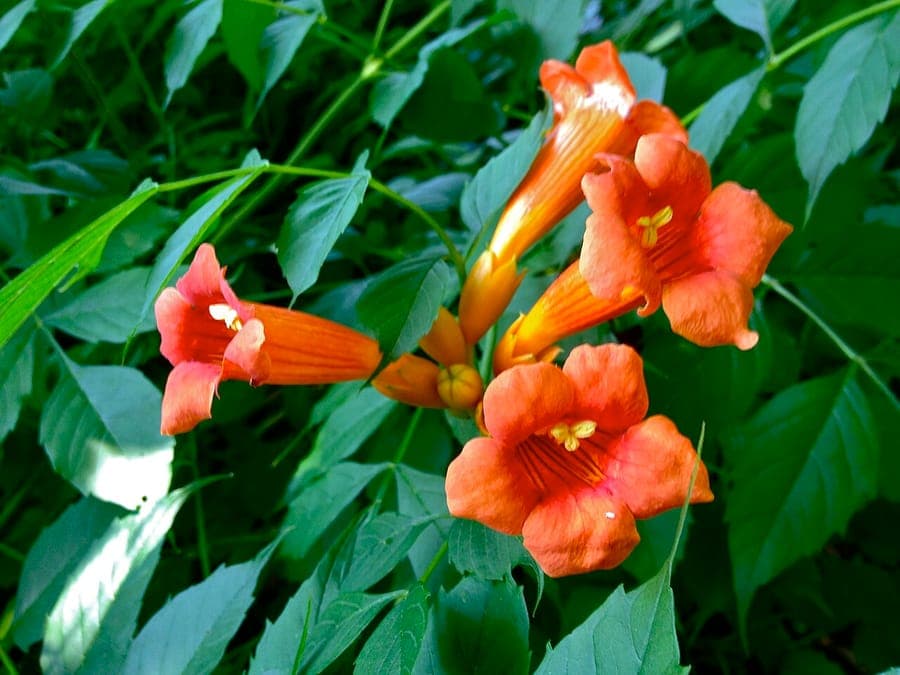
Fritzflohrreynolds / CC BY-SA 3.0, via Wikimedia Commons
Trumpet creeper: complete guide
Campsis radicans
Want to see Trumpet creeper: complete guide in your garden?
1 minute, no credit card
Overview
Trumpet creeper (Campsis radicans) is a bold, fast-growing vine that thrives in hot summers and full sun. Native to the eastern United States, it's proven adaptable in temperate gardens across Europe and North America. This isn't a shy plant-it stakes its claim with vigor. But if you've got the space and love dramatic summer color, it's hard to beat.
One thing many gardeners learn the hard way: trumpet creeper can be aggressive. It spreads through underground runners and self-seeding, and if unchecked, it'll pop up where you least expect it. But with consistent management-especially timely pruning-it's very controllable. On gardenworld.app, you can design a garden layout that works with its energy instead of fighting against it.
Appearance & bloom cycle
The name says it all-trumpet creeper produces striking, tubular flowers shaped like small horns. They're typically deep orange to red, occasionally yellowish, and appear in large clusters from July through September. These blooms are a magnet for hummingbirds, a rare and thrilling sight in many gardens. The leaves are compound, with 7 to 11 lance-shaped leaflets, staying fresh green through summer and turning pale yellow to brown in fall.
This vine can climb 8 to 10 meters using aerial rootlets that cling to walls, fences, or pergolas. Without support, it forms a dense, sprawling shrub. Flowers only develop on new growth, so pruning is critical for good blooming. Left unpruned, it may grow vigorously but rarely bloom.
Ideal location
Trumpet creeper needs full sun-minimum six hours of direct sunlight daily. In shady spots, it survives but won't bloom well. Best locations are south- or southwest-facing walls, fences, or wooden structures where it can climb freely. Avoid stone or masonry walls with lime-based mortar, as the plant's acidic secretions can cause damage over time.
In cooler climates, planting against a sheltered wall adds protection from cold winds. Use a trellis or wire system to guide early growth. With gardenworld.app, you can simulate how this vine will cover your structure over time, helping you plan support systems and spacing.
Soil requirements
This plant isn't fussy about soil fertility but prefers well-drained, humus-rich loam. Heavy clay soils are acceptable as long as they don't stay waterlogged. Sandy soils work too but dry out fast-mulching helps conserve moisture.
pH range: ideal between 5.5 and 7.0. It tolerates slightly acidic to neutral soils. Amend with compost at planting, but avoid high-nitrogen fertilizers-they promote leafy growth at the expense of flowers.
Free design
Want to see Trumpet creeper: complete guide in your garden? Make a free design now.
Watering
During the first growing season, regular watering is crucial. Young plants need deep watering twice a week, especially in dry spells. Focus on soaking the root zone rather than light sprinkling-this encourages deeper roots.
Mature plants are moderately drought-tolerant but flower better with consistent moisture. During prolonged dry periods (over two weeks without rain), supplemental watering is recommended. A 5–8 cm layer of organic mulch helps retain moisture and suppress weeds.
Pruning
Pruning is the key to flowering. Cut back hard in late winter (February to early March), leaving just 20–30 cm of stem above ground or support. This forces new, flower-bearing shoots. Remove any dead or tangled growth.
If you prefer a less drastic approach, try a two-year rotation: prune half the stems hard one year, the other half the next. This maintains some coverage but reduces bloom density.
Never prune in autumn-this can trigger new growth that won't survive winter.
Maintenance calendar
- Jan: inspect stems, plan pruning
- Feb–Mar: perform hard pruning
- Apr: train new shoots to support structure
- May: monitor for root suckers
- Jun: check for aphids or scale insects
- Jul–Sep: peak bloom season-enjoy!
- Oct: remove unwanted runners and seedlings
- Nov–Dec: plant is dormant; watch for self-seeding
Winter hardiness
Trumpet creeper is hardy in USDA zones 4 to 9. That covers most of the US and southern Canada. Top growth may die back in harsh winters, but roots survive and resprout in spring. In zone 4, a 10 cm mulch layer around the base adds extra root protection.
Companion plants
Pair trumpet creeper with late-summer perennials that provide contrast. Try Salvia 'East Friesland' (deep red), Echinacea purpurea (purple), or Persicaria amplexicaulis (rosy-pink). Low-growing plants like Nepeta or Alchemilla mollis help hide the bare base of the vine.
Avoid pairing with other aggressive climbers like Wisteria or rampant Clematis on the same support-competition will stress both plants.
Closing
Trumpet creeper isn't for everyone. It's vigorous, sometimes pushy, but unmatched in summer impact. If you've got space, love heat, and want hummingbirds in your garden, it's a top contender. Plant it where it can climb freely, prune it hard each winter, and you'll be rewarded with months of fiery blooms.
Think carefully about placement-once it's established, it's in for the long haul. Buy trumpet creeper from trusted garden centres like those found across the US, where you'll find healthy young plants. And remember: on gardenworld.app, you can test how this vine fits into your specific garden design before you plant it.
Want to see Trumpet creeper: complete guide in your garden? Make a free design now.
Upload a photo, pick a style, and get a photorealistic design with plant list in under a minute.
No credit card required


Similar plants
Tabebuia pallida: complete guide
Tabebuia pallida
Full growing guide for Tabebuia pallida: location, soil, watering, pruning, hardiness and companion plants for this tropical trumpet tree.
Northern catalpa: complete guide
Catalpa speciosa
Everything about northern catalpa (Catalpa speciosa): bold white flowers, fast growth, and how to grow this striking tree in your garden.
Desert willow: complete guide to Chilopsis linearis
Chilopsis linearis
Complete growing guide for desert willow (Chilopsis linearis): sun, soil, flowering, pruning, and winter care for this spectacular flowering small tree.