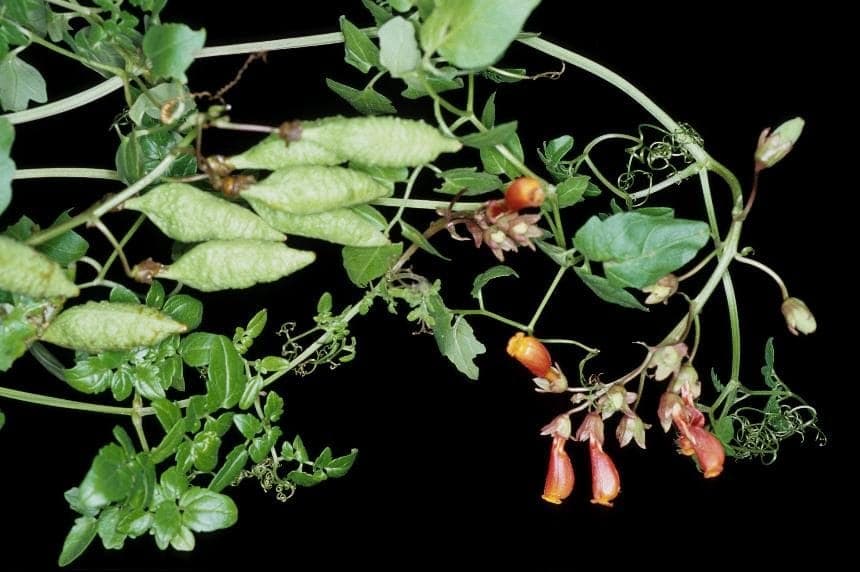
Murray Dawson / CC BY-SA 4.0, via Wikimedia Commons
Chilean glory flower (Eccremocarpus scaber): complete guide
Eccremocarpus scaber
Want to see Chilean glory flower (Eccremocarpus scaber): complete guide in your garden?
Full design in HD: €7.99
Look after your Chilean glory flower with the GardenWorld app
Identify plants with your camera and get a care calendar with reminders for this plant.


Overview
Chilean glory flower (Eccremocarpus scaber) is a fast, airy climber from Chile and western Argentina. In the wild it grows through scrub and along woodland edges, hauling itself up other plants with fine tendrils. In gardens it stands out for its clusters of tubular flowers in fiery orange-red, which hang from the plant from June until autumn. In Chile hummingbirds pollinate them; in Britain bumblebees visit.
It belongs to the trumpet-vine family (Bignoniaceae), like Campsis, but is far finer and lighter in build. Strictly speaking it is a short-lived perennial with a woody base. Because it flowers in its first year and is only borderline hardy, many gardeners grow it as an annual from seed. Against a sheltered, sunny wall it can last several years. In one season it reaches 2 to 3 metres, and an established plant can reach 4 metres. If you are looking for the right spot for a climber like this, you can have a garden design made on gardenworld.app that takes sun, walls and supports into account.
There is no known toxicity to people or pets. In New Zealand and parts of Australia it has escaped into the wild and is regarded as a weed. No problems are known in western Europe, but if you do not want seedlings, cut off the seed pods before they split.
Appearance and bloom cycle
The leaves are bipinnate, fresh green and finely divided into small toothed leaflets. Each leaf ends in a branched tendril that curls like a spring around wire, netting or twigs. The stems are thin, angular and slightly rough to the touch, which is where the name scaber, meaning rough, comes from.
The flowers are carried in loose racemes at the ends of the shoots. Each is a narrow, slightly curved tube 2 to 2.5 cm long with a constricted mouth and small lip. The wild form is orange-red with a yellow tip, but seed mixes such as the Tresco series offer yellow, pink, red and almost crimson flowers too. Flowering starts three to four months after sowing and carries on until October.
After flowering the plant produces striking inflated seed pods 3 to 4 cm long, green and warty at first, later brown and papery. Inside are countless flat seeds with a translucent wing, which drift off on the wind when the pod splits. In a warm spot the plant self-seeds readily as a result.
Ideal location and supports
Chilean glory flower needs full sun and warmth. A south or west-facing wall, a fence on a sheltered patio or a sunny pergola are ideal. The more sun, the better the flowering. Shelter from cold easterly and northerly winds also improves its chances of surviving the winter.
The tendrils can only grip thin supports. Suitable options are:
- tensioned wires 20 to 30 cm apart on a wall;
- plastic mesh or chicken wire on a fence;
- an obelisk with slender rods in a large pot;
- a shrub or climbing rose that it can scramble through.
Guide the first shoots onto the support; after that the plant looks after itself. It is light enough to grow through a shrub or another climber without smothering it, which looks lovely in a mixed border.
Soil requirements
It grows in any well-drained garden soil of moderate fertility. Wet, heavy clay in winter is its biggest enemy, as the roots then rot. Mix some compost and grit into the soil when planting. Very rich soil produces lots of leaf and fewer flowers.
In containers use a peat-free container compost with 20 per cent grit or perlite. A pot of 30 to 40 litres is the minimum for a plant that grows 2 to 3 metres tall. Make sure there is a good drainage hole.
Sowing and raising plants
Sowing is easy. The seeds germinate readily and the plants flower in the same year.
- Sow indoors from February to early April in pots of seed compost.
- Cover the seeds with a very thin layer of compost or vermiculite.
- Keep them moist at 15 to 20 °C. Germination usually takes two to three weeks.
- Prick out the seedlings into 9 cm pots as soon as they are large enough to handle, and keep them bright and cool.
- From early May harden them off outdoors during the day, and plant out once the risk of frost has passed.
A warm, dry spot in the garden often produces its own seedlings, which you can pot up in spring or leave where they are. To save your own seed, collect brown, dry pods in September or October and store the seed in a cool, dry paper envelope.
Free preview
Want to see Chilean glory flower (Eccremocarpus scaber): complete guide in your garden? Make a free preview of your design.
Watering
Water newly planted specimens twice a week for the first few weeks until they are growing well. After that, plants in open ground are fairly drought-tolerant and only need water during long dry spells. In containers, check daily in summer and water as soon as the top few centimetres are dry.
Feed sparingly. A handful of organic fertiliser at planting time is enough in open ground. In pots, give a liquid feed for flowering plants every two to three weeks from June to August. Stop feeding after August so that the shoots can ripen before winter.
Pruning
Grown as an annual, Chilean glory flower needs no pruning. Pinching out the tips of young plants at 10 to 15 cm does give more stems and a fuller plant.
If the plant survives the winter, the top growth is often brown or dead. In April, cut all dead stems back to just above the point where you see new green growth, or to just above ground level if everything has been frosted. Healthy roots will reshoot in May. In summer you can shorten overlong shoots. If you do not want seed, removing spent flower clusters prolongs flowering.
Maintenance calendar
February to March: sow indoors at 15 to 20 °C.
April: prick out and pinch the seedlings. Cut dead stems from overwintered plants.
May: harden off and plant out once frosts are over. Put up supports and guide in the first shoots.
June to September: flowering. Water in dry spells and feed container plants every two to three weeks.
September to October: collect seed from dry pods. Bring container plants under cover in good time.
November: cover the base of plants in open ground with a thick layer of straw, leaves or bark chips. If you would rather not have to remember these moments, the planting calendar on gardenworld.app keeps track of them for you.
December to January: rest. Check the winter covering during hard frost.
Winter hardiness and overwintering
Eccremocarpus scaber is half-hardy. The stems die back after a few degrees of frost, but the roots survive down to about -5 °C, and with a thick mulch in a dry, sheltered spot sometimes rather harder winters. In much of Britain away from the south and west coasts, its survival is a gamble. After a mild winter the plant reshoots in May; after a hard one you simply sow again.
Overwintering in a pot works well. Cut the plant back to 30 cm in October and move it to a cool, bright, frost-free place at 5 to 10 °C, such as an unheated greenhouse or a garage with a window. Water sparingly. In March, repot it and move it somewhere warmer. Protect plants in open ground with a mulch 10 to 15 cm deep over the roots, and if you like a layer of fleece over the lower stems.
Companion plants
The orange flowers suit hot colours and contrast beautifully with purple and blue. Let Chilean glory flower scramble through a deep purple Clematis viticella, or combine it on the same fence with canary creeper (Tropaeolum peregrinum) for a yellow and orange curtain. Against a warm wall, blue passion flower (Passiflora caerulea) makes a good partner.
At the foot of the climber, choose perennials that enjoy the same sun and free-draining soil: red hot poker (Kniphofia uvaria) echoes the orange, and sneezeweed (Helenium autumnale) carries the warm theme into autumn.
Final thoughts
Eccremocarpus scaber is one of the most rewarding climbers you can grow from seed. It germinates readily, grows fast, flowers in its first year and keeps producing orange-red tubes for months. Give it full sun, thin supports and well-drained soil and it asks very little of you. In a warm spot it rewards a mild winter with a second season; if not, you simply sow again, using your own seed.
Start this spring with a packet of seed and a piece of mesh against a sunny wall. In autumn, decide whether to leave the plant under a thick mulch or to collect seed for next year.
Frequently asked questions about Chilean glory flower
Is Chilean glory flower winter hardy?
Eccremocarpus scaber is half-hardy. The stems die back after a few degrees of frost, but the roots survive down to about -5 °C, and with a thick mulch in a dry, sheltered spot sometimes rather harder winters.
When and how do you prune Chilean glory flower?
Grown as an annual, Chilean glory flower needs no pruning. Pinching out the tips of young plants at 10 to 15 cm does give more stems and a fuller plant.
How much water does Chilean glory flower need?
Water newly planted specimens twice a week for the first few weeks until they are growing well. After that, plants in open ground are fairly drought-tolerant and only need water during long dry spells.
Where does Chilean glory flower grow best?
Chilean glory flower needs full sun and warmth. A south or west-facing wall, a fence on a sheltered patio or a sunny pergola are ideal.
What soil does Chilean glory flower need?
It grows in any well-drained garden soil of moderate fertility. Wet, heavy clay in winter is its biggest enemy, as the roots then rot.

See it in your garden
See Chilean glory flower in your garden
One photo of your garden and a few questions. You see the result in about a minute.
Try it with a photoIdentify this plant in your own garden. Identify a plant
Similar plants
Purple clematis: complete guide
Clematis viticella
How to grow Clematis viticella successfully: ideal conditions, pruning, watering, companion plants and design tips for your garden.
Tropaeolum peregrinum: complete guide
Tropaeolum peregrinum
The Canary-creeper (Tropaeolum peregrinum) is a stunning climbing vine with distinctive yellow flowers. A comprehensive care guide for gardeners seeking exotic annual climbers.
Brazilian passionflower: complete guide
Passiflora caerulea
A detailed guide to growing Passiflora caerulea: ideal conditions, soil, watering, pruning, and seasonal care for UK and US gardeners.
