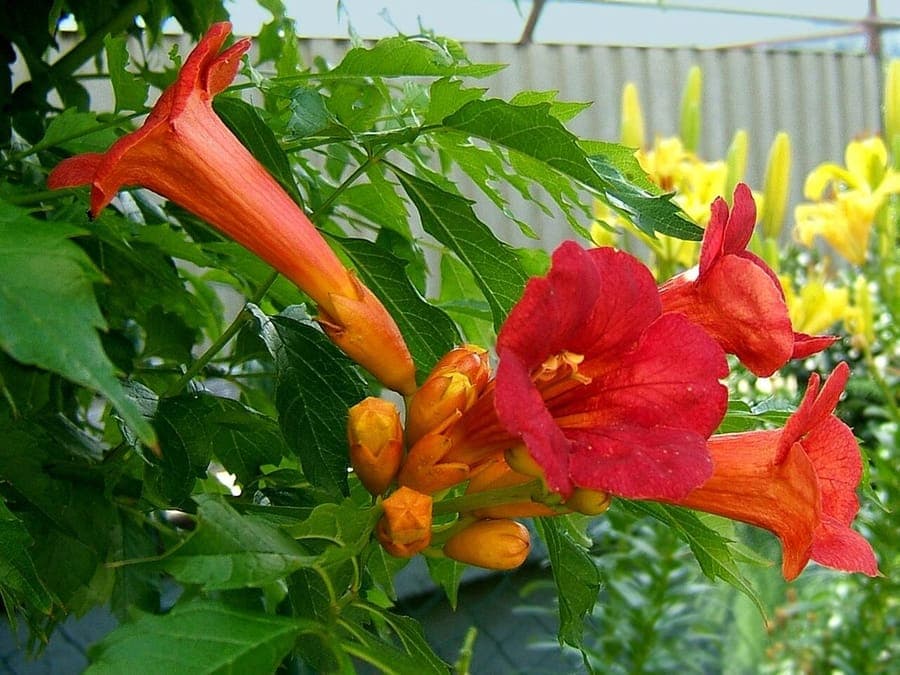
Wildfeuer / CC BY-SA 3.0, via Wikimedia Commons
Hybrid trumpet vine (Campsis × tagliabuana): complete guide
Campsis × tagliabuana
Want to see Hybrid trumpet vine (Campsis × tagliabuana): complete guide in your garden?
Full design in HD: €7.99
Look after your Hybrid trumpet vine with the GardenWorld app
Identify plants with your camera and get a care calendar with reminders for this plant.


Overview
Hybrid trumpet vine (Campsis × tagliabuana) brings a Mediterranean touch to a house wall, pergola or fence in late summer. From July into September it carries clusters of large orange-red trumpets at the tips of its shoots, just when many other climbers have finished.
Campsis × tagliabuana is a cross between the American trumpet vine (Campsis radicans) and the Chinese trumpet vine (Campsis grandiflora). It was raised in northern Italy in the nineteenth century by the nurserymen brothers Tagliabue, after whom it is named. It combines the best of both parents: the vigour and hardiness of the American species and the larger, more open flowers of the Chinese one. The best-known cultivar is 'Madame Galen', with salmon-red to orange-red flowers, and it is the one most garden centres stock.
This is a vigorous deciduous climber that can reach 6 to 10 m. That makes it ideal for a large wall or a sturdy pergola, but far too exuberant for a low fence. At gardenworld.app you can have a garden design drawn up that allows for the space such a climber really needs, so it does not end up in your gutters or your neighbour's garden a few years later.
Appearance and bloom cycle
The leaves are pinnate, with 7 to 11 toothed leaflets on each stalk, fresh green in summer and yellow in autumn before they fall. The stems turn woody quickly and after a few years form a solid, gnarled framework.
The flowers appear in clusters of six to twelve at the ends of the new shoots. Each is a trumpet 6 to 8 cm long, orange outside and salmon to scarlet in the wide, five-lobed mouth, often with yellow streaks in the throat. Flowering usually starts in mid-July and continues into September, or even early October after a warm late summer.
Do not expect flowers in the first year. Young trumpet vines put their energy into roots and stems first; three to five years after planting is normal for a good display. After that, it improves every year.
Ideal location
Trumpet vines want sun and warmth: the more sun, the better the flowering. A south- or west-facing wall, a garden wall that holds the day's heat, or a pergola in full sun is ideal. In partial shade the plant grows well, but you tend to get plenty of leaves and few flowers.
Providing support
Campsis × tagliabuana produces aerial roots like its American parent, but fewer and weaker ones. On rough brickwork it partly clings on its own, but it needs support, certainly in its early years. Fix horizontal wires 40 to 50 cm apart, or put up a strong trellis or pergola, and tie the young stems in loosely. Later it is enough to secure the main stems at a few points. Use soft ties and check each spring that nothing is cutting into the bark.
Make the structure strong enough. A mature trumpet vine is a heavy woody plant that catches a lot of wind when in leaf and flower, and a light bamboo frame or a wobbly fence panel will not hold it for long. Keep it away from gutters, roof tiles, shutters and air vents: the stems work their way into every gap and are hard to remove.
Soil requirements
Trumpet vines are not fussy. Any ordinary, well-drained garden soil will do, from sand to clay, and a fertile, humus-rich soil gives a faster start. Waterlogged roots in winter are the only real problem.
Plant preferably in April or May, once the soil has warmed up. A young plant set out in spring has a whole season to root before its first winter. Dig a generous hole, mix in compost and plant at least 30 cm away from the wall, where the soil is less dry, angling the plant towards the wall.
Be aware that trumpet vines produce root suckers. This hybrid does so less than Campsis radicans, but shoots can still appear a metre or more from the plant, even between paving slabs. Pull or cut them off straight away. If you want to avoid suckers, sink a 50 cm deep root barrier around the planting spot. The American parent has escaped into the wild in parts of southern Europe; this hybrid also belongs in the garden, not in the countryside.
Free preview
Want to see Hybrid trumpet vine (Campsis × tagliabuana): complete guide in your garden? Make a free preview of your design.
Watering
In its first two years a trumpet vine needs regular watering, especially against a wall where the soil dries out quickly. In dry weather give 10 litres twice a week. A mulch around the base keeps the roots cool and moist.
An established plant is fairly drought-tolerant thanks to its deep roots, but during a long heatwave give it a thorough soak or it may drop buds. Feeding is rarely necessary; a handful of organic fertiliser in spring is enough, as too much nitrogen gives long stems and few flowers.
Pruning
Trumpet vines flower on the current year's growth, at the tips of new shoots. You can therefore prune firmly without losing flowers, and you should: an unpruned plant turns into a tangled mass with all its flowers high up out of sight.
Formative pruning in the first years. After planting, cut all stems back to 20 to 30 cm. Over the next years select two to four strong main stems and train them in a fan or along the pergola. Remove everything else.
Annual pruning. Once the framework is in place, prune every year in late February or March, before the buds break. Cut all of last year's side shoots back to two or three buds from the old wood, much as you would a grapevine. These buds produce the new shoots that carry the flowers.
Skin irritation. Wear gloves and long sleeves when pruning. The sap, leaves and flowers of Campsis can cause redness, itching and slight swelling of the skin in sensitive people. It usually passes quickly, but if you handle the plant a lot you will notice it. Wash your hands afterwards and do not rub your eyes.
Maintenance calendar
February to March: Annual pruning, with side shoots cut back to two or three buds. Check ties and wires.
April to May: Best planting time. Young shoots are sensitive to late frost. Give a handful of organic fertiliser and mulch the base.
June: Tie in new stems. Remove suckers.
July to September: Full flowering. Water in dry spells. Shorten stems heading for gutters or windows.
October to November: Leaves turn yellow and fall. Protect the base of young plants with a thick mulch.
December to January: Dormant. Nothing to do except check the fixings after a severe storm.
The plant calendar at gardenworld.app reminds you of the late-February pruning and the other fixed moments in the year.
Winter hardiness
Campsis × tagliabuana is reliably hardy enough for most of Britain and the Low Countries. Established plants generally cope with frost down to about -15 °C. After an exceptionally hard winter the youngest stems may die back, but the plant usually regrows from the old wood or the base. The RHS cautiously rates the hybrid H4, and there is some truth in that: young plants are clearly more vulnerable.
So give young plants a thick mulch or straw around the base for their first two winters and plant them against a warm wall. Late frosts in April and May can damage freshly emerged shoots; the plant will regrow, but flower later.
On toxicity: trumpet vine is regarded as low in toxicity, and the main risk is skin irritation on contact. Serious poisoning in pets is not known, but do not let dogs or cats chew the stems or seed pods.
Companion plants
A trumpet vine on a pergola or wall calls for warm colours in the border below. Daylilies (Hemerocallis fulva) and Agapanthus africanus flower at the same time and enjoy the same sunny spot. Lavender (Lavandula angustifolia) and Russian sage (Perovskia atriplicifolia) add blue and violet, which make the orange glow even more.
Nearby, Hibiscus syriacus also flowers in late summer. On a large pergola you can add a Clematis viticella, which is pruned low in February in the same way.
Do not grow a second vigorous climber such as Chinese wisteria (Wisteria sinensis) on the same structure: both are powerful growers and quickly twist into an impenetrable tangle.
Final thoughts
Campsis × tagliabuana is a plant for gardeners with patience and a sunny wall. The first years are about roots, support and formative pruning; after that you get weeks of orange-red trumpets every summer. Give it a strong structure, prune it short every spring, keep an eye on suckers and wear gloves while you work, and you will have a climber that makes the whole street look up in August.
Frequently asked questions about Hybrid trumpet vine
Is Hybrid trumpet vine winter hardy?
Campsis × tagliabuana is reliably hardy enough for most of Britain and the Low Countries. Established plants generally cope with frost down to about -15 °C.
When and how do you prune Hybrid trumpet vine?
Trumpet vines flower on the current year's growth, at the tips of new shoots. You can therefore prune firmly without losing flowers, and you should: an unpruned plant turns into a tangled mass with all its flowers high up out of sight.
How much water does Hybrid trumpet vine need?
In its first two years a trumpet vine needs regular watering, especially against a wall where the soil dries out quickly. In dry weather give 10 litres twice a week.
Where does Hybrid trumpet vine grow best?
Trumpet vines want sun and warmth: the more sun, the better the flowering. A south- or west-facing wall, a garden wall that holds the day's heat, or a pergola in full sun is ideal.
What soil does Hybrid trumpet vine need?
Trumpet vines are not fussy. Any ordinary, well-drained garden soil will do, from sand to clay, and a fertile, humus-rich soil gives a faster start.

See it in your garden
See Hybrid trumpet vine in your garden
One photo of your garden and a few questions. You see the result in about a minute.
Try it with a photoIdentify this plant in your own garden. Identify a plant
Similar plants
Trumpet creeper: complete guide
Campsis radicans
Grow Campsis radicans successfully: full sun, moist well-drained soil, hard prune in late winter. Ideal for pergolas, fences, and walls in USDA zones 4–9.
Fulvous day-lily: complete guide
Hemerocallis fulva
The fulvous day-lily (Hemerocallis fulva) is a hardy, clumping perennial that thrives in full sun to partial shade. Long blooming season from June to August, low maintenance.
Lily-of-the-Nile: complete guide
Agapanthus africanus
Everything you need to grow Agapanthus africanus: ideal conditions, watering, winter care, and companion planting for UK and US gardens.
