
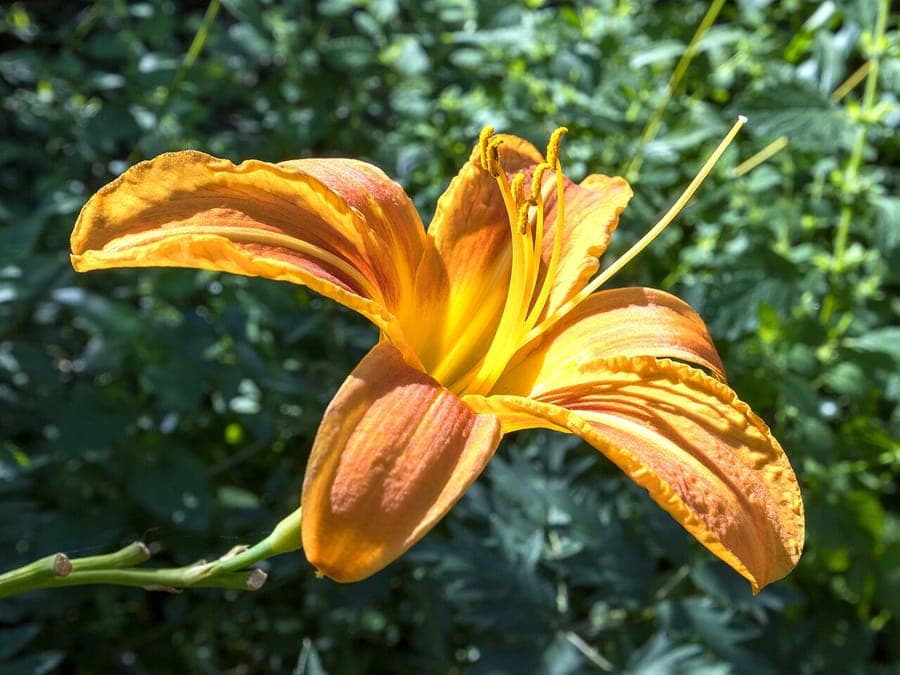
JackyM59 / CC BY-SA 4.0, via Wikimedia Commons
Fulvous day-lily: complete guide
Hemerocallis fulva
Want to see Fulvous day-lily: complete guide in your garden?
1 minute, no credit card
Overview
Hemerocallis fulva, commonly known as the fulvous day-lily, is a vigorous, spreading perennial native to East Asia. Unlike true lilies, it grows from fleshy orange roots and forms dense clumps over time. This plant is a staple in cottage gardens, roadside plantings, and low-maintenance borders thanks to its resilience and long flowering season. It's not fussy, but it does take space - its rhizomatous roots can spread up to 60 cm in a single season if left unchecked.
On gardenworld.app, you can plan a garden layout that accounts for the plant's spread, ensuring it complements rather than overwhelms neighbouring perennials.
Appearance & bloom cycle
The fulvous day-lily reaches 90–120 cm in height with arching green foliage that forms a vase-like mound. The flowers are funnel-shaped, orange-yellow with a reddish-brown throat, and measure about 8–10 cm across. Each bloom lasts just one day - hence the name 'day-lily' - but the plant produces so many buds that flowering continues from June through August with minimal gaps.
New buds open each morning, often closing by late afternoon. The foliage stays green through most of the season, turning straw-yellow in autumn after frost. While the leaves die back in winter, new shoots emerge reliably in April.
Ideal location
This day-lily thrives in full sun (light level 8–10), though it tolerates light shade. For best flowering, aim for at least 6 hours of direct sunlight daily. In deep shade, blooms become sparse and stems may flop. A south- or west-facing border works well.
Plant at least 50 cm apart to allow for spread. It's ideal for naturalistic planting schemes, cottage gardens, and erosion control on slopes. Avoid planting near delicate alpines or slow-growing perennials - this one will outcompete them quickly.
Soil requirements
Hemerocallis fulva adapts to a wide pH range (4.8–8), from acidic to slightly alkaline. It prefers moist, well-drained soil but handles clay and sandy soils equally well as long as drainage is adequate. Avoid waterlogged conditions - root rot can occur if roots sit in water for more than a few days.
If your soil is heavy clay, amend with grit or compost to improve structure. In sandy soils, a 5 cm mulch of compost in spring helps retain moisture and nutrients. Upload a soil sample to gardenworld.app to get custom amendment recommendations based on your garden's conditions.
Free design
Want to see Fulvous day-lily: complete guide in your garden? Make a free design now.
Watering
Once established, the fulvous day-lily is drought-tolerant and rarely needs supplemental watering. During the first growing season, water weekly if rainfall is below 2.5 cm. After that, it survives dry spells but blooms better with occasional deep watering every 10–14 days in prolonged drought.
Use soaker hoses or water at the base to avoid wetting foliage, which can encourage fungal diseases. Morning watering is best - it allows leaves to dry before nightfall.
Pruning
Deadheading isn't essential but improves appearance. Snip off spent flower stalks just above the foliage line to prevent seed set and encourage more buds. In late autumn or early spring, cut back dead foliage to 5–10 cm above ground.
Divide clumps every 3–5 years in early spring or autumn if they become too dense or start lifting out of the soil. Use a sharp spade to split roots into sections with 3–5 fans each, then replant or share with other gardeners.
Maintenance calendar
- january – february: Dormant. Check for heaved crowns after frost.
- march: Cut back old foliage. Watch for new shoots.
- april: Apply compost mulch. Divide if needed.
- may: Monitor for aphids. Water in dry spells.
- june – august: Peak bloom. Deadhead daily. Water deeply in drought.
- september: Reduce watering. Let late stalks stand.
- october – december: Cut back or leave for winter texture. Mulch in exposed sites.
Winter hardiness
Hardy in USDA zones 3–9, Hemerocallis fulva withstands temperatures down to -35°C. The crown survives under snow cover, and new growth emerges in spring even after harsh winters. No winter protection is required, though a light mulch in zone 3 helps prevent frost heaving.
Companion plants
Pair with upright perennials like Echinacea purpurea, Rudbeckia fulgida, or Salvia nemorosa for contrast. The warm tones of the day-lily blend well with purple, blue, and silver foliage plants. Avoid overcrowding - give it breathing room.
Low-growers like Nepeta faassenii or creeping thyme (Thymus serpyllum) work well as ground cover to hide the bare lower stems. Ornamental grasses like Panicum virgatum add movement and structure without competing for resources.
Closing
The fulvous day-lily is a reliable workhorse in the garden - tough, long-blooming, and forgiving of neglect. It's perfect for beginner gardeners and ideal for filling challenging spots. Just remember: it spreads. Plant it where it has room, or be prepared to divide regularly. Available at most garden centres in spring, often as potted plants or bare-root divisions. With the right spot and a little planning, it'll reward you with years of cheerful summer colour.
Want to see Fulvous day-lily: complete guide in your garden? Make a free design now.
Upload a photo, pick a style, and get a photorealistic design with plant list in under a minute.
No credit card required


Similar plants
Aloe castanea: complete guide
Aloe castanea
Discover Chestnut aloe, a South African succulent. Growth, nutrition, and garden integration for warm climates and container culture.
Aloe pratensis: complete guide
Aloe pratensis
Learn how to grow Meadow aloe, a South African succulent. Nutrition, propagation, and front yard integration for warm climates or containers.
Pretoria aloe: complete guide
Aloe pretoriensis
Discover Aloe pretoriensis, an elegant South African succulent with striking red blooms. Learn care tips, ideal conditions, and companion planting for this hardy, drought-tolerant plant.