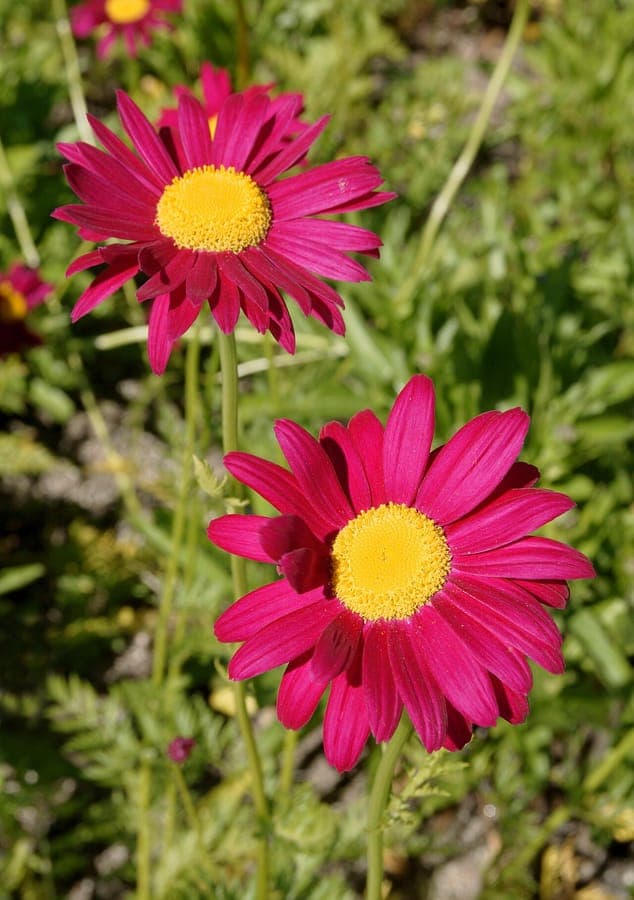
kallerna / CC BY-SA 3.0, via Wikimedia Commons
Tanacetum coccineum: complete guide
Tanacetum coccineum
Want to see Tanacetum coccineum: complete guide in your garden?
Full design in HD: €7.99
Look after your Tanacetum coccineum with the GardenWorld app
Identify plants with your camera and get a care calendar with reminders for this plant.


Overview
Persian Daisy (Tanacetum coccineum), also called Painted Daisy or Pyrethrum, is a robust perennial from the Asteraceae family native to mountains of Eastern Europe through Iran and Central Asia. This plant distinguishes itself through beautiful red to pink flowers rising above finely-textured feathery foliage. With compact growth habit and extended flowering period, Tanacetum coccineum proves an excellent choice for borders and cutting gardens alike.
As a garden plant, this grows extraordinarily well in temperate climates. The plant reaches 60 to 80 centimetres in height forming dense, well-defined flower clusters. Furthermore, Persian Daisy proves hardier than many other daisy species, making it ideal for virtually every average garden.
Appearance & bloom
Persian Daisy grows as a perennial featuring finely-divided, feathery foliage that proves exceptionally decorative. Leaves display bright green colouration with intricate division, giving the plant an airy appearance.
Flowers emerge in May-June (early to mid-summer) in red, pink or white (depending on cultivar), often with yellow centres. Flowers occur as single or double forms depending on variety. Regular deadheading encourages continued flowering through autumn. The plant makes an excellent cut flower.
Ideal location
Persian Daisy performs best in sunny positions: minimum 6 hours direct sun. In semi-shade the plant flowers adequately, though less abundantly. A site with good air circulation prevents fungal problems.
This plant accommodates virtually all garden conditions. It tolerates wind exposure, making it suitable for exposed borders. In very hot climates, light afternoon shade proves welcome.
Soil
Persian Daisy proves undemanding and grows in virtually any soil type. However, well-draining soil promotes better growth and disease prevention. The plant tolerates heavy clay, though adding sand and compost improves conditions substantially.
Soil pH proves non-critical (5.5-7.5 proves equally fine). The plant adapts to poor soils but prefers good nutrition. For borders, incorporate compost or aged manure for markedly improved results.
Free preview
Want to see Tanacetum coccineum: complete guide in your garden? Make a free preview of your design.
Watering
Once established (after several months), supplemental water proves rarely necessary. Water when the top soil layer feels dry. During the first growing season, provide regular moisture for good establishment.
Excessive moisture promotes fungal disease and poor growth. During dry spells, provide thorough deep watering, especially for full flowering. The plant proves more drought-tolerant than many other flowering perennials.
Pruning
Persian Daisy responds well to regular deadheading. This stimulates continuous flower production throughout the season. Following early June flowering, gentle trimming encourages second blooming in autumn.
In early spring, remove weak or dead shoots. In autumn, trim the plant back after final flowering for winter dormancy.
Maintenance calendar
January-February: Dormancy, remove dead leaves. March-April: Growth beginning, apply fertilizer, early pruning. May-June: Flowering period, deadhead for more blooms. July-August: Continuous flowering, water during dry periods. September-October: Second flowering flush, continue deadheading. November-December: Flowering decrease, dormancy preparation.
Winter hardiness
Persian Daisy proves very winter-hardy and suitable for USDA zone 3 (-40 to -34 degrees Celsius). The plant withstands severe winters excellently. Winter protection rarely becomes necessary. In very wet winters, good drainage prevents rotting.
Companion plants
Flowers attract numerous pollinators: bees, butterflies and bumblebees. This plant proves highly valuable for ecological gardens and insect borders. The fine foliage also provides shelter for tiny insects.
Closing remarks
Persian Daisy represents a classic garden plant never going out of favour. With modest care, this beautiful plant thrives and delivers years of full colour. Source this plant at Intratuin and Gamma, where expert advice supports cultivar selection and colour preferences.
Learn more on gardenworld.app. Discover additional red-flowering perennials for colourful borders.
Frequently asked questions about Tanacetum coccineum
Is Tanacetum coccineum winter hardy?
Persian Daisy proves very winter-hardy and suitable for USDA zone 3 (-40 to -34 degrees Celsius). The plant withstands severe winters excellently.
When and how do you prune Tanacetum coccineum?
Persian Daisy responds well to regular deadheading. This stimulates continuous flower production throughout the season.
How much water does Tanacetum coccineum need?
Once established (after several months), supplemental water proves rarely necessary. Water when the top soil layer feels dry.
Where does Tanacetum coccineum grow best?
Persian Daisy performs best in sunny positions: minimum 6 hours direct sun. In semi-shade the plant flowers adequately, though less abundantly.
What soil does Tanacetum coccineum need?
Persian Daisy proves undemanding and grows in virtually any soil type. However, well-draining soil promotes better growth and disease prevention.

See it in your garden
See Tanacetum coccineum in your garden
One photo of your garden and a few questions. You see the result in about a minute.
Try it with a photoIdentify this plant in your own garden. Identify a plant
Similar plants
Frikart's aster (Aster × frikartii): complete guide
Aster × frikartii
Everything about Frikart's aster (Aster × frikartii): position, soil, pruning and hardiness of the aster that flowers lavender-blue from July to October.
False aster (Boltonia asteroides): complete guide
Boltonia asteroides
False aster (Boltonia asteroides) covers itself in white daisies from late August to October. How to plant, cut back and combine this tough, tall perennial.
Daisy bush (Brachyglottis greyi): care guide
Brachyglottis greyi
Brachyglottis greyi, formerly Senecio greyi, pairs silver felted leaves with yellow summer daisies. Advice on position, soil, pruning, hardiness and companions.
