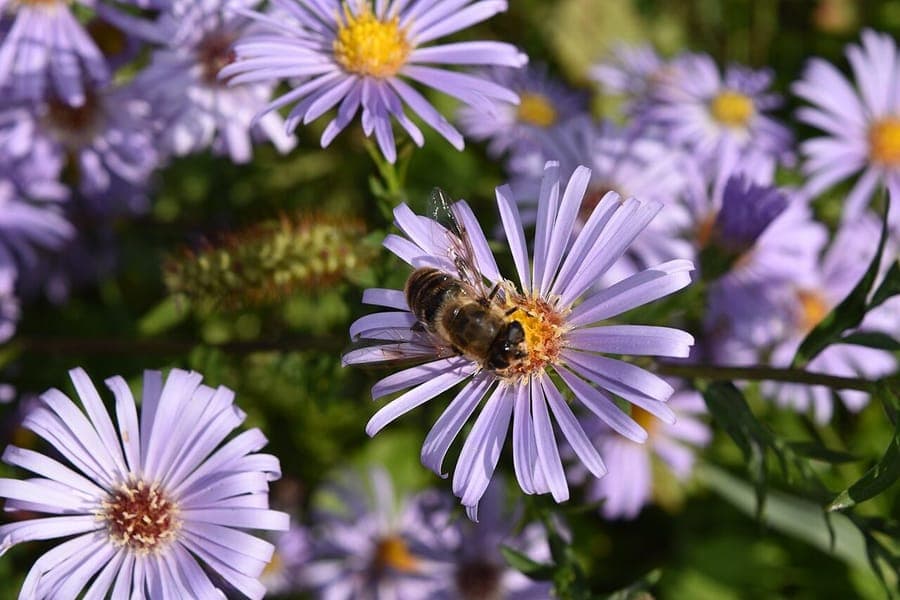
MarcoC80 / CC BY-SA 4.0, via Wikimedia Commons
Frikart's aster (Aster × frikartii): complete guide
Aster × frikartii
Want to see Frikart's aster (Aster × frikartii): complete guide in your garden?
Full design in HD: €7.99
Look after your Frikart's aster with the GardenWorld app
Identify plants with your camera and get a care calendar with reminders for this plant.


Overview
If there is one aster that garden designers recommend time and again, it is Aster × frikartii. No other aster flowers so early, for so long and so tirelessly: from July until well into October it produces lavender-blue daisies with a golden centre. If you want a border that does not slump in late summer, this plant is a dependable workhorse.
Aster × frikartii is a cross between the European Italian aster (Aster amellus) and Aster thomsonii from the western Himalaya. The Swiss nurseryman Carl Ludwig Frikart made the cross around 1918 at his nursery in Stäfa, on Lake Zurich. From it came a handful of selections that he named after the famous peaks of the Bernese Oberland: 'Mönch', 'Jungfrau' and 'Eiger', plus 'Wunder von Stäfa' after his home village. 'Mönch' and 'Wunder von Stäfa' in particular have remained classics and are still stocked by every good perennial nursery. 'Mönch' holds the Royal Horticultural Society's Award of Garden Merit, and the great plantsman Graham Stuart Thomas counted it among the finest perennials of all.
The plant belongs to the daisy family (Asteraceae). Unlike the American Michaelmas daisies, which have been moved to the genus Symphyotrichum, this hybrid remains a true Aster, like its European and Asian parents. It grows 70 to 90 cm tall and 40 to 50 cm wide. Asters are not toxic to people or pets, and the plant is not invasive anywhere.
Appearance and bloom cycle
The flowers are 5 to 7 cm across, large for an aster. Narrow, slightly loosely arranged ray petals in soft lavender-blue surround a yellow centre. 'Mönch' is a little brighter in colour and holds its stems more firmly upright; 'Wunder von Stäfa' is somewhat taller, paler blue and more inclined to flop. The centres turn orange-brown as the flowers age, so a plant in full bloom always shows a pleasing mix of tones.
The leaves are oblong, matt green and slightly rough to the touch. The stems branch in their upper half, giving the plant a loose, rounded shape studded with flowers. Flowering starts in late June or July and lasts until the first hard frost. Bees, bumblebees and butterflies, including red admirals and peacocks, still find plenty of nectar in September and October, when many other flowers have finished.
A big advantage: Aster × frikartii is rarely troubled by powdery mildew, the fungus that turns so many Michaelmas daisies grey in August.
Ideal location
Plant it in full sun or very light shade. With at least six hours of sun a day it flowers most freely and the stems stay sturdy. In too much shade the stems grow long and lax and flowering suffers.
An open, airy position is ideal; in a stuffy corner the leaves stay wet for longer and the risk of fungal problems rises. Space plants 40 to 50 cm apart, in groups of three or five for a full effect. It suits the middle of a border, a cottage garden, a large container or a naturalistic scheme among grasses, where it forms the bridge between summer and autumn.
Soil requirements
Aster × frikartii wants fertile, well-drained soil that does not dry out completely in summer. Ordinary, humus-rich garden soil is fine. Heavy clay that stays wet in winter is its greatest threat, as the roots can rot there. In that case work in coarse grit and compost, or plant on a slightly raised spot.
The pH is not critical; neutral to slightly alkaline is ideal, as it is for its parent Aster amellus. Add some compost at planting time and, if you like, a thin compost mulch in spring. Too much nitrogen makes the stems floppy, so keep feeding modest.
Plant in spring if possible, in April or May. Autumn planting is riskier with this aster, because the young roots have too little time to establish before the wet winter.
Free preview
Want to see Frikart's aster (Aster × frikartii): complete guide in your garden? Make a free preview of your design.
Watering
Water young plants regularly in dry weather during their first year, roughly once a week. An established plant copes with a short dry spell but flowers best if the soil stays slightly moist in summer. In prolonged drought water thoroughly at the base of the plant, ideally in the morning, so the leaves stay dry.
Containers dry out quickly; check them every two or three days in summer. In winter a pot needs very little water, so make sure it drains freely.
Pruning
Do not cut Aster × frikartii back in autumn. That is the single most important thing to know about this plant. Leave the spent stems standing all winter: they protect the crown from frost and wet, and the fluffy seed heads give the border an attractive winter outline. Cut them down to a few centimetres above the ground only in March or early April, when the new shoots appear.
During flowering you can remove faded blooms to keep the plant tidy, but it is not essential. Stems that are knocked over by wind or rain can be supported in June with a few twiggy sticks or a ring support. Every four or five years you can divide the clump in spring to rejuvenate it. Never do this in autumn.
Maintenance calendar
March-April: Cut old stems down to just above the new shoots. Divide older clumps if needed. Best time to plant.
May: Apply a thin layer of compost. Protect young shoots from slugs.
June: Support taller plants if necessary. Water in dry spells.
July-August: Flowering begins. Water during prolonged drought.
September-October: Peak flowering, the highlight of the year.
November: Leave the stems standing. Do not cut back.
December-February: Dormant. Make sure no water collects around the crown.
On gardenworld.app you will find a plant calendar that brings these jobs together month by month for your own garden.
Winter hardiness
Aster × frikartii is hardy to around -20 °C to -25 °C and is given the RHS's top hardiness rating, H7. In practice, plants in Britain and northern Europe are not killed by cold but by a wet winter on heavy soil, often combined with an autumn cut back.
Two rules keep the plant healthy: prune only in spring, and plant in soil that lets water drain away. No winter covering is needed. Stand container plants against a sheltered wall and raise them on pot feet so water can escape.
Companion plants
The lavender-blue of this aster combines beautifully with warm yellow and orange. Black-eyed Susan (Rudbeckia fulgida) is a classic neighbour: both flower for a long time and at the same time, and their colours enhance each other. Purple coneflower (Echinacea purpurea) adds pink tones in the same daisy shape.
Ice plant (Hylotelephium spectabile), with its flat pink heads, makes a calm lower layer. Grasses such as Calamagrostis × acutiflora add vertical lines and stand well through winter beside the old aster stems. For an all-blue border, pair it with Aster amellus, one of its parents, and with woodland sage (Salvia nemorosa) for early summer.
Final thoughts
Aster × frikartii is one of the finest perennials for late summer: more than a century after it was raised in Stäfa, it is still a garden staple. It flowers for months, draws in butterflies and bees and asks for little, as long as you remember two things: plant in spring and do not prune until March.
Group a few plants in the middle of your border, surround them with yellow rudbeckias and grasses, and you will have a spot that keeps flowering until the first frosts. If you want to see how that would work in your own garden, have a garden design made on gardenworld.app that takes your soil and aspect into account.
Frequently asked questions about Frikart's aster
Is Frikart's aster winter hardy?
Aster × frikartii is hardy to around -20 °C to -25 °C and is given the RHS's top hardiness rating, H7. In practice, plants in Britain and northern Europe are not killed by cold but by a wet winter on heavy soil, often combined with an autumn cut back.
When and how do you prune Frikart's aster?
Do not cut Aster × frikartii back in autumn. That is the single most important thing to know about this plant.
How much water does Frikart's aster need?
Water young plants regularly in dry weather during their first year, roughly once a week. An established plant copes with a short dry spell but flowers best if the soil stays slightly moist in summer.
Where does Frikart's aster grow best?
Plant it in full sun or very light shade. With at least six hours of sun a day it flowers most freely and the stems stay sturdy.
What soil does Frikart's aster need?
Aster × frikartii wants fertile, well-drained soil that does not dry out completely in summer. Ordinary, humus-rich garden soil is fine.

See it in your garden
See Frikart's aster in your garden
One photo of your garden and a few questions. You see the result in about a minute.
Try it with a photoIdentify this plant in your own garden. Identify a plant
Similar plants
Orange Coneflower: complete guide
Rudbeckia fulgida
Everything about Rudbeckia fulgida (orange coneflower): planting, care, combinations and bloom time. Practical tips for months of golden-yellow flowers.
Showy stonecrop: complete guide
Hylotelephium spectabile
Everything about Showy stonecrop (Hylotelephium spectabile): flowering, cultivation and care. Tips for successful frost resistance, drought tolerance and maintenance in borders and containers.
Purple coneflower: complete guide
Echinacea purpurea
Everything about Purple Coneflower (Echinacea purpurea): planting, care, pruning and combinations. Expert tips for a thriving prairie-style garden.
