
Jerzy Opioła (Poland) / CC BY-SA 3.0, via Wikimedia Commons
Orange Coneflower: complete guide
Rudbeckia fulgida
Want to see Orange Coneflower: complete guide in your garden?
1 minute, no credit card
Overview
Rudbeckia fulgida - commonly known as the orange coneflower or perennial coneflower - is one of the most rewarding perennials you can plant in a garden border. From July through to late October, this plant produces an unrelenting stream of golden-yellow, daisy-like flowers with a striking dark brown central cone. It is the plant that transforms a summer border from pleasant to spectacular, and it is still flowering when most other perennials have long since finished.
The species originates from the eastern United States, where it grows in open woodlands, along roadsides, and on prairies. In European, Australian, and South African gardens, Rudbeckia fulgida has proven itself as a rock-solid performer that tolerates both heat and cold. On gardenworld.app you can create a garden design where rudbeckia forms the golden backbone of your late-summer border, combined with ornamental grasses, salvia, and echinacea. The most widely planted cultivar is undoubtedly 'Goldsturm' (var. sullivantii 'Goldsturm'), considered one of the best-selling perennials in the world, and recipient of the Perennial Plant of the Year award.
Appearance and bloom
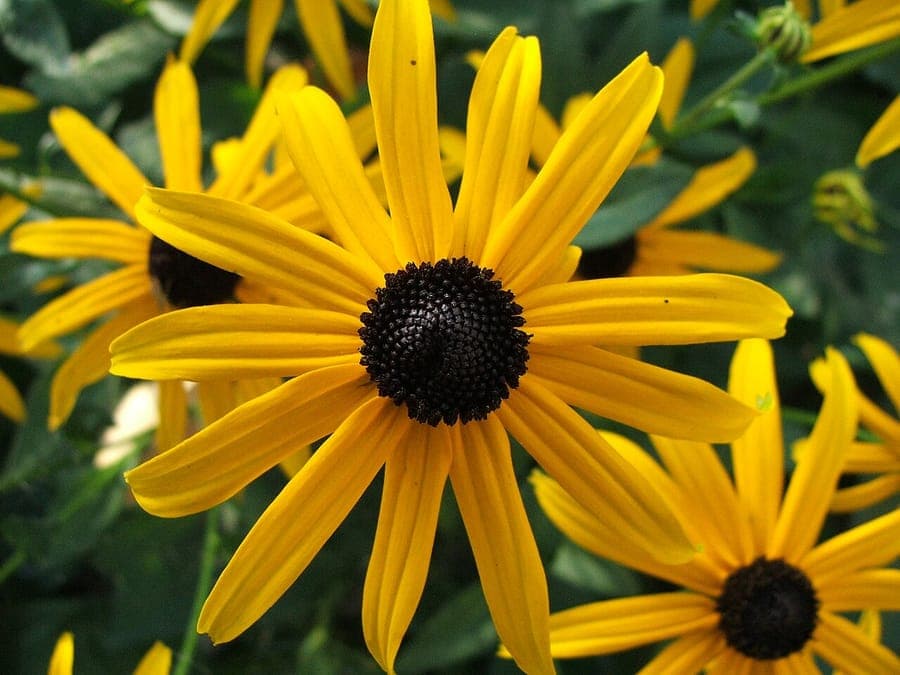
Rudbeckia fulgida grows as a sturdy clump 60 to 90 cm tall and 45 to 60 cm wide. The dark green, lance-shaped leaves form a compact rosette from which strong, branching flower stems rise. Each flower head measures 6 to 8 cm across and consists of 10 to 16 golden-yellow ray florets that droop slightly around a prominent, cone-shaped dark brown disc of tubular florets.
The flowering period is exceptionally long: from early July to late October, sometimes continuing until the first hard frost in November. Each plant produces dozens of flowers that open in succession over weeks. If you deadhead spent blooms, new ones follow more quickly; if you leave them, the seed heads that develop are so decorative that many gardeners keep them intentionally for winter interest.
After flowering, the dark brown cones mature into near-black seed heads that persist on the stems until February. Frosted or dusted with snow, they are among the most beautiful winter features in the garden. The seeds are a favourite food of goldfinches, siskins, and titmice, which feed at the seed heads through winter. Leaving the seed heads in place combines winter decoration with a bird feeding station.
Ideal location
Rudbeckia fulgida is a confirmed sun-lover. Plant it in a position with at least six hours of direct sun per day - full sun is ideal. In light partial shade, the plant still flowers reasonably, but the stems grow longer and floppier, and the bloom is less abundant. In genuine shade, there is no point planting rudbeckia.
The plant thrives in borders, prairie-style plantings, large containers, and along paths. In a border, plant rudbeckia in groups of at least three, ideally five to seven, spaced 40 cm apart. In groups, the golden effect is strongest. Rudbeckia also excels as a cut flower - the blooms last two weeks in a vase.
On windy sites, the plant may lean slightly, but the 'Goldsturm' cultivar is more compact and sturdier than the wild species. Neighbouring ornamental grasses or taller perennials provide natural support and eliminate any flopping.
Soil requirements
Rudbeckia fulgida is remarkably tolerant of soil type. The plant grows in clay, sand, loam, and everything in between. The ideal soil is moisture-retentive but well-drained and moderately fertile. In heavy clay, rudbeckia performs well provided there is no permanent waterlogging.
The plant handles drought surprisingly well once established. This makes rudbeckia suitable for urban gardens where the ground dries out quickly in summer. On very poor sandy soil, improve water retention by working some compost into the planting hole.
The ideal soil pH ranges from 5.5 to 7.5 - rudbeckia is not fussy about acidity. Feeding is barely necessary: an annual top-dressing of 3 to 5 cm of compost in spring is sufficient. Too much fertiliser produces lush foliage at the expense of flowers - and softer stems that flop.
Watering
During the first growing season after planting, rudbeckia needs weekly watering in dry spells - approximately 5 litres per plant. The shallow roots establish quickly, and after the first year, the plant is reasonably drought-tolerant. Always water at the base, not over the foliage.
Established plants survive weeks of drought without difficulty, though bloom may diminish slightly during prolonged dry periods. In extreme heat (above 35°C), rudbeckia appreciates an extra watering per week. No watering is needed in winter - the plant is fully dormant.
Rudbeckia in containers dries out faster and needs watering every other day in summer. Ensure adequate drainage in the pot to prevent root rot.
Free design
Want to see Orange Coneflower: complete guide in your garden? Make a free design now.
Pruning
Pruning rudbeckia boils down to a single choice: do you leave the seed heads for winter interest, or cut them after flowering?
The most naturalistic approach: leave the seed heads standing until February or early March. They provide winter structure in the border, feed birds, and insulate the crown against frost. In early spring (February–March), cut all old stems back to 5 to 10 cm above ground level. New foliage appears shortly afterwards from the rootstock.
Gardeners who prefer a tidy winter garden can cut the stems back immediately after flowering in November. In that case, cover the crown with a layer of leaves or straw as frost protection.
Every three to four years, a rudbeckia clump benefits from being lifted and divided. Replant the younger, outer portions and discard the older, less vigorous centre. Division is best done in early spring (March–April). This rejuvenates the plant and prevents the gradual decline in flowering that happens as the clump ages.
Maintenance calendar
March–April: Cut old stems back to 5–10 cm. Divide clumps older than three years. Apply a layer of compost.
May–June: New foliage appears and the plant builds volume rapidly. Water first-year plants during dry spells. Watch for slugs - young rudbeckia shoots are a favourite target.
July: First flowers appear. The beginning of a months-long display.
August–September: Peak bloom. Cut the occasional bunch for a vase. Give extra water during extreme drought.
October–November: Flowering wanes but often continues until the first frost. Leave seed heads for winter interest and birds.
December–February: The near-black seed heads stand decoratively in the winter border. Goldfinches and titmice visit the seed heads. Order new plants for spring.
Winter hardiness
Rudbeckia fulgida is outstandingly winter-hardy, tolerating temperatures down to -30°C or lower (USDA zones 3 to 9). Across the UK, continental Europe, and the cooler parts of North America, the plant overwinters without any difficulty. The above-ground parts die back after the first frost, but the rootstock survives effortlessly and pushes vigorous new growth in spring.
Special winter protection is unnecessary. On very wet, heavy clay where water pools in winter, the rootstock may rot - improve drainage by working coarse grit into the soil at planting. An autumn mulch of leaf mould provides extra insulation but is not strictly necessary.
In warmer climates (southern USA, lowland Australia, coastal South Africa), rudbeckia performs well provided it receives adequate moisture during summer.
Companion plants
Rudbeckia fulgida is the star of the New Perennial planting style and combines brilliantly with ornamental grasses and other late-summer perennials. The classic pairing is rudbeckia with feather reed grass (Calamagrostis x acutiflora 'Karl Foerster') or switchgrass (Panicum virgatum) - the gold of the rudbeckia against the airy green-gold of the grasses is a combination that has become a modern classic in public and private gardens alike.
Other excellent partners include purple coneflower (Echinacea purpurea) for colour contrast, sage (Salvia nemorosa) as a blue complement that finishes just before the rudbeckia starts, sedum (Hylotelephium) for autumn interest, and mountain fleece (Persicaria amplexicaulis) for height variation. In a cottage garden, pair rudbeckia with catmint (Nepeta faassenii) and lavender (Lavandula angustifolia) for a trio of blue, purple, and gold.
Avoid pairing rudbeckia with shade plants such as hosta or astilbe - their requirements for sun and soil are fundamentally different.
Closing
Rudbeckia fulgida is the perennial you should have planted years ago. It flowers for months, asks for almost nothing, attracts bees and butterflies in summer and birds in winter, and manages to look good even in death. The cultivar 'Goldsturm' is one of the world's best-selling perennials for a reason - it delivers, every single year.
Most garden centres stock 'Goldsturm' throughout the growing season. On gardenworld.app you can create a garden design where rudbeckia forms the heart of your late-summer border, combined with ornamental grasses and perennials suited to your garden. Plant three or five this spring - the golden reward follows in the very first summer.
Want to see Orange Coneflower: complete guide in your garden? Make a free design now.
Upload a photo, pick a style, and get a photorealistic design with plant list in under a minute.
No credit card required


Similar plants
Purple coneflower: complete guide
Echinacea purpurea
Everything about Purple Coneflower (Echinacea purpurea): planting, care, pruning and combinations. Expert tips for a thriving prairie-style garden.
Woodland sage: complete guide
Salvia nemorosa
Everything about Woodland Sage (Salvia nemorosa): planting, care, pruning and combinations. Expert tips for months of blue-violet flower spikes.
English Lavender: complete guide
Lavandula angustifolia
Everything about English Lavender (Lavandula angustifolia): planting, pruning, care and overwintering. Practical tips for lush purple blooms.