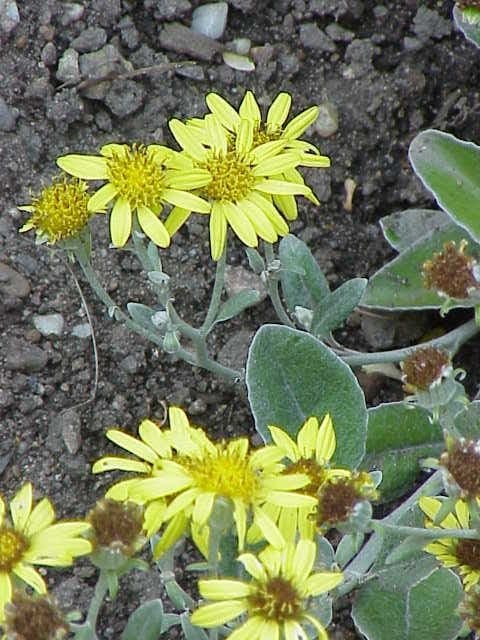
Kurt Stüber [1] / CC BY-SA 3.0, via Wikimedia Commons
Daisy bush (Brachyglottis greyi): care guide
Brachyglottis greyi
Want to see Daisy bush (Brachyglottis greyi): care guide in your garden?
Full design in HD: €7.99
Look after your Daisy bush with the GardenWorld app
Identify plants with your camera and get a care calendar with reminders for this plant.


Overview
Brachyglottis greyi is an evergreen, silver-grey shrub from New Zealand that covers itself in bright yellow daisies in summer. For a long time it was known as Senecio greyi, and that old name still turns up on plant labels and in older gardening books. Botanists later moved it, together with a group of other New Zealand species, into the genus Brachyglottis in the daisy family (Asteraceae). In English it is usually called daisy bush, a name it shares with several relatives.
In the wild the species grows only on the North Island of New Zealand, on rocky sites, often close to the coast, and it is listed there as declining. In gardens it is valued for its calm grey foliage, its tolerance of wind and salt, and its long flowering season. It grows roughly 1 to 2 m tall and often wider than high.
There is one source of confusion worth knowing about. Much of what is sold as Senecio greyi or Brachyglottis greyi is in fact the hybrid Brachyglottis (Dunedin Group) 'Sunshine'. This cross between B. greyi, B. compacta and B. laxifolia arose in cultivation in the twentieth century, stays somewhat lower and is far more common in the trade. The true species has slightly larger, broader leaves and grows more vigorously. For care purposes the difference is small: both want sun, free-draining soil and an annual trim. If you would like to see how a silver shrub like this fits into your own garden, gardenworld.app can create a garden design for you.
Appearance and bloom cycle
The leaves are oval to oblong, 4 to 10 cm long, thick and slightly leathery. When young they are covered on both sides in a soft, white felt; later the upper surface turns grey-green while the underside and the margin stay white and woolly. The young shoots and leaf stalks are densely white-hairy too, so the whole shrub looks silvery, especially in sun and dry weather.
In Europe it flowers from June to August. Loose, open clusters appear at the shoot tips, carrying numerous flower heads about 2.5 to 3 cm across. Each head has bright yellow ray florets around a yellow centre, like a small daisy. The buds and the bracts beneath each head are white-felted, which sets off the yellow nicely. Bees, hoverflies and butterflies visit the flowers readily. Fluffy seed heads follow, but the plant rarely self-seeds in European gardens. The photo shows the typical picture: yellow daisies above grey, felted leaves.
Ideal location
Brachyglottis greyi is a sun lover. Give it a spot in full sun, where it stays compact and the leaves keep their silver tone. It will grow in partial shade, but becomes looser and flowers less. Wind barely bothers it and it copes very well with salt spray, which is why it is a classic in seaside gardens as a specimen, low hedge or windbreak.
Inland, choose a sheltered, warm position, for instance in front of a south-facing wall or in a gravel garden. Allow plenty of room, since a mature plant easily reaches 1.5 to 2 m across. A spacing of around 1 m is enough for an informal hedge.
Soil requirements
Good drainage matters most. Sand, gritty loam or stony ground are ideal. Heavy, wet clay, especially where water lies in winter, suits it poorly: roots die back and the shrub becomes more vulnerable to frost. On heavy ground, work coarse grit into the planting area or plant on a slightly raised bed.
pH is not critical; anything from slightly acidic to chalky is fine. Poor to moderately fertile soil gives the best, most compact plants. Feeding is rarely needed, though a thin layer of compost in spring does no harm.
Free preview
Want to see Daisy bush (Brachyglottis greyi): care guide in your garden? Make a free preview of your design.
Watering
Once established, Brachyglottis greyi is fairly drought tolerant. Its felted leaves cut down water loss, as in many other silver-leaved plants. In the first year after planting, water regularly, roughly once a week in dry weather, so the roots can grow deep.
After that, extra water is only needed during long summer droughts. Water rarely but thoroughly when you do. Watering too often, particularly on heavy soil, does the plant more harm than a dry week. In a large container, which works well for this shrub, check every few days in summer and let the compost dry out a little between waterings.
Pruning
Left unpruned, Brachyglottis greyi becomes open, bare at the base and rather untidy after a few years. An annual trim keeps it compact. The best time is April, once the worst frosts are over. Cut the shoots back by about a third and remove any frosted or dead wood.
You can also remove the faded flower clusters straight after flowering and lightly reshape the plant. Some gardeners snip off the flower buds altogether because they grow it mainly for its silver foliage; that is a matter of taste. An old, leggy shrub can be cut back hard in spring and usually regrows well, but if in doubt spread the work over two years.
Maintenance calendar
March and April: Cut the plant back by a third and remove frost damage. Plant new specimens once the soil is workable.
May: Spread a thin layer of compost if you like. Water young plants in dry weather.
June to August: Flowering time. Enjoy the yellow daisies and the insects they attract. Water only in prolonged drought.
September: Remove spent flower clusters and give a light shaping trim. Take semi-ripe cuttings if you want more plants.
October and November: Leave the plant alone. Make sure water does not collect around the base.
December to February: Protect young plants with fleece during hard frost. Shake heavy, wet snow off the branches.
To have jobs like these flagged at the right moment, use the plant calendar on gardenworld.app.
Winter hardiness
Brachyglottis greyi is reasonably hardy. The RHS rates it H4, which corresponds to roughly -10 to -5 °C and means hardy through most of the UK. In practice an established plant in a dry, sheltered spot survives short cold spells down to around -10 °C. Harder or prolonged frost can damage leaves and young shoots, though the plant usually regrows from lower down. Wet soil in winter makes it far more vulnerable.
It does well in coastal areas and towns across most of Britain. In colder districts, plant it against a warm wall and protect young plants with fleece for their first winters. The hybrid 'Sunshine' has similar hardiness in practice.
No reliable data exist on its toxicity to people or animals. Related ragworts (Senecio) do contain toxic pyrrolizidine alkaloids, so keep horses, sheep and other grazing animals away from it and teach children not to eat it. The species is not known to be invasive in Europe.
Companion plants
The silver leaves of Brachyglottis greyi suit Mediterranean and coastal planting schemes perfectly. Pair it with lavender (Lavandula angustifolia), cotton lavender (Santolina chamaecyparissus) and lamb's ears (Stachys byzantina) for a harmony of greys, or with Phormium tenax for a bold New Zealand look.
For more colour contrast, place purple-flowered plants nearby, such as catmint or salvias; the yellow daisies look especially bright beside them. As a hedge or windbreak in a seaside garden it makes a good team with Olearia macrodonta and escallonias. A low edging of blue fescue (Festuca glauca) rounds it all off.
Final thoughts
Brachyglottis greyi, formerly Senecio greyi, is a tough shrub for sunny, dry spots and gardens by the sea. Its silver foliage brings light to a border all year, and in summer it produces a cheerful cloud of yellow daisies that draws in pollinators. Give it free-draining soil, little water and a spring trim each year, and it will stay compact and healthy for many years. Check the label when buying: you will often get the hybrid 'Sunshine', which looks very similar and is just as easy.
Frequently asked questions about Daisy bush
Is Daisy bush winter hardy?
Brachyglottis greyi is reasonably hardy. The RHS rates it H4, which corresponds to roughly -10 to -5 °C and means hardy through most of the UK.
When and how do you prune Daisy bush?
Left unpruned, Brachyglottis greyi becomes open, bare at the base and rather untidy after a few years. An annual trim keeps it compact.
How much water does Daisy bush need?
Once established, Brachyglottis greyi is fairly drought tolerant. Its felted leaves cut down water loss, as in many other silver-leaved plants.
Where does Daisy bush grow best?
Brachyglottis greyi is a sun lover. Give it a spot in full sun, where it stays compact and the leaves keep their silver tone.
What soil does Daisy bush need?
Good drainage matters most. Sand, gritty loam or stony ground are ideal.

See it in your garden
See Daisy bush in your garden
One photo of your garden and a few questions. You see the result in about a minute.
Try it with a photoIdentify this plant in your own garden. Identify a plant
Similar plants
English Lavender: complete guide
Lavandula angustifolia
Everything about English Lavender (Lavandula angustifolia): planting, pruning, care and overwintering. Practical tips for lush purple blooms.
Lavender cotton: complete guide
Santolina chamaecyparissus
Lavender cotton (Santolina chamaecyparissus) is a beautiful gray-green shrub from the Asteraceae family. This Mediterranean plant offers fragrance and refined appearance for dry gardens.
Lamb's-ear: complete guide
Stachys byzantina
Stachys byzantina, known as lamb's-ear or lamb's-tongue, is a hardy perennial from the mint family. This popular plant is especially valued for its soft, silvery-white hairy foliage and purple flowers.
