Wikimedia Commons / Public domain, via Wikimedia Commons
False aster (Boltonia asteroides): complete guide
Boltonia asteroides
Want to see False aster (Boltonia asteroides): complete guide in your garden?
Full design in HD: €7.99
Look after your False aster with the GardenWorld app
Identify plants with your camera and get a care calendar with reminders for this plant.


Overview
False aster (Boltonia asteroides) is a tall, free-flowering North American perennial that covers itself in thousands of small white daisies from late August into October. It is also known as white doll's daisy, and at first glance it looks very much like an aster, hence the common name. In nurseries it is usually sold simply as Boltonia, most often as the cultivar 'Snowbank'.
In the wild it grows in damp meadows, along riverbanks and on floodplains in the eastern and central United States. It is therefore used to rich, moist soil and fluctuating water levels, yet once established it also copes with a dry summer. In the garden it bridges the gap between the summer perennials and the true autumn asters, bringing light to a border that in September is otherwise mostly yellow and brown. On gardenworld.app you can have a garden design made in which Boltonia forms an airy white screen at the back of the border, with lower late bloomers in front.
The wild species reaches 1 to 2 metres tall and about 1 metre across. 'Snowbank' is the best-known selection: at 1.2 to 1.5 metres it stays a little shorter, has sturdier stems and pure white flowers. 'Pink Beauty' has soft lilac-pink flowers and a looser habit. The variety latisquama carries slightly larger flower heads with a lilac tint and is also available as the compact form 'Nana', at around 90 cm.
Appearance and bloom cycle
Boltonia forms an upright, gently spreading clump of straight stems that branch freely towards the top. The leaves are narrow and lance-shaped, up to 12 cm long and blue-green to grey-green. They are smooth and hairless, lacking the rough texture of many asters, which gives the plant a fine, almost willowy look. As a result it looks neat even before it flowers.
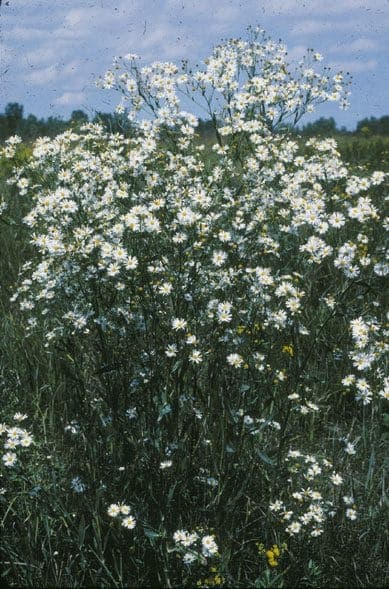
Flowering begins in late August and lasts until mid-October. The flower heads are just 2 to 2.5 cm across, with white, sometimes lilac- or pink-tinged rays around a yellow, slightly domed centre. They appear in broad, loose sprays and completely cover the top half of the plant, as the photo shows: a tall clump studded with white stars in a sunny meadow. Bees, hoverflies and butterflies visit the flowers constantly.
After flowering, small flat seeds remain. The stems fade to straw yellow and stay upright for a while, until the first autumn gales knock them over.
Ideal location
Plant Boltonia in full sun. In shade the stems become long and weak, the plant flops and flowering is sparse. An open sunny border, a prairie-style planting, the edge of a pond or a damp wild corner all suit it. Because it grows tall, it belongs at the back of a border or in the middle of an island bed.
Allow 60 to 90 cm between plants. The clump spreads slowly by short rhizomes but does not run. On a windy site the wild species may lean, so choose 'Snowbank' there, or plant it among sturdy neighbours such as grasses or Joe Pye weed that lend support. It is really too big for a pot unless you use a very generous tub.
Soil requirements
Boltonia asteroides grows in almost any ordinary garden soil. Loam, clay and humus-rich sand are all suitable. Unlike many prairie plants it also tolerates heavy clay that is wet for part of the year, which makes it useful for lower, damp parts of the garden or the margins of a wildlife pond.
Moderately fertile soil is ideal. On very rich, heavily fed ground the stems grow long and soft. A slightly acid to slightly alkaline pH is fine. A layer of compost at planting time is enough; after that, add a little compost in spring every other year at most.
Free preview
Want to see False aster (Boltonia asteroides): complete guide in your garden? Make a free preview of your design.
Watering
During the first growing season, keep the soil evenly moist. In dry weather, water once or twice a week with a full can, about 5 to 8 litres per plant. Once the plant is well established, it gets through a dry summer without trouble, although it will grow a little shorter and shed its lower leaves sooner.
On a moist site you will hardly ever need to water. On sandy soil, a mulch of compost or shredded leaves helps to retain moisture. Water in the morning at the base of the plant where possible.
Pruning
Leave the faded stems standing in autumn for as long as they look good, as they shelter insects. Cut them down to just above ground level by March at the latest, before new shoots appear.
Boltonia responds very well to an early cut, often called the Chelsea chop. In late May or early June, cut all the stems back by about half. The plant will then stay 30 to 50 cm shorter, branch more freely, stand more firmly and flower a few weeks later. You can also cut only the front stems to create a staggered display. We advise against cutting after mid-June.
Every three to four years, divide the clump in spring. The centre becomes less floriferous over time, while the young outer pieces quickly establish again.
Maintenance calendar
March: Cut back the old stems. Clear dead foliage from around the base.
April: Plant new specimens or divide old clumps. Add a little compost if needed.
Late May to early June: Cut stems back by half for a shorter, sturdier plant.
July to August: Water during prolonged drought, especially on sandy soil. Put in plant supports for the wild species if necessary.
September to October: Peak flowering. Cut a few sprays for a relaxed autumn arrangement indoors.
November to February: Leave the stems standing for as long as they stay upright.
To keep everything on track, the plant calendar on gardenworld.app shows the right tasks each month for this and the other plants in your garden.
Winter hardiness
Boltonia asteroides is fully hardy to around -35 °C (USDA zones 3 to 9). In the UK and the Low Countries it needs no winter protection at all, even in wet soil. That makes it more reliable than many other tall late-flowering perennials.
The plant is not known to be toxic to people, dogs or cats. It is healthy and rarely troubled by powdery mildew or slugs. It is not invasive in Europe and self-seeds only modestly in gardens.
Companion plants
As a tall white screen, Boltonia combines beautifully with other tall, naturalistic late bloomers. The dusky pink heads of spotted Joe Pye weed (Eutrochium maculatum) and the deep purple flowers of New York ironweed (Vernonia noveboracensis) provide a rich contrast. The purple and pink daisies of New England aster (Symphyotrichum novae-angliae) flower at the same time and are a perfect match.
For structure, add Chinese silver grass (Miscanthus sinensis) or switchgrass (Panicum virgatum). In the middle of the border, black-eyed Susan (Rudbeckia fulgida) adds warm yellow and orange that stand out against the white cloud. Lower perennials such as lady's mantle or sedum work well at the front.
Final thoughts
Boltonia asteroides is a strong, healthy and surprisingly easy perennial that lights up the border in September and October. Give it sun, ordinary garden soil and a single trim in June, and it will return reliably for years. Plant it at the back of the border beside grasses and purple asters, and you will have an autumn garden that glows until the first frost.
Frequently asked questions about False aster
Is False aster winter hardy?
Boltonia asteroides is fully hardy to around -35 °C (USDA zones 3 to 9). In the UK and the Low Countries it needs no winter protection at all, even in wet soil.
When and how do you prune False aster?
Leave the faded stems standing in autumn for as long as they look good, as they shelter insects. Cut them down to just above ground level by March at the latest, before new shoots appear.
How much water does False aster need?
During the first growing season, keep the soil evenly moist. In dry weather, water once or twice a week with a full can, about 5 to 8 litres per plant.
Where does False aster grow best?
Plant Boltonia in full sun. In shade the stems become long and weak, the plant flops and flowering is sparse.
What soil does False aster need?
Boltonia asteroides grows in almost any ordinary garden soil. Loam, clay and humus-rich sand are all suitable.

See it in your garden
See False aster in your garden
One photo of your garden and a few questions. You see the result in about a minute.
Try it with a photoIdentify this plant in your own garden. Identify a plant
Similar plants
New England aster: complete guide
Symphyotrichum novae-angliae
Learn all about New England aster (Symphyotrichum novae-angliae), a stunning fall-blooming perennial.
Spotted Joe-Pye weed: complete guide
Eutrochium maculatum
Everything about spotted Joe-Pye weed (Eutrochium maculatum): cultivation, location, soil requirements and care for this majestic moisture-loving perennial.
Chinese Silver Grass: complete guide
Miscanthus sinensis
Everything about Chinese Silver Grass (Miscanthus sinensis): planting, cutting back, cultivars and winter silhouette. Expert tips for a spectacular ornamental grass.
