
Cody Hough / CC BY-SA 3.0, via Wikimedia Commons
Spotted Joe-Pye weed: complete guide
Eutrochium maculatum
Want to see Spotted Joe-Pye weed: complete guide in your garden?
1 minute, no credit card
Overview
Eutrochium maculatum, commonly known as spotted Joe-Pye weed, is a tall, majestic perennial in the Asteraceae family native to eastern North America. Its native range extends from Newfoundland and Quebec in Canada south through the northeastern and north-central United States to North Carolina, Missouri, Wyoming, and Utah. Formerly classified as Eupatorium maculatum, the species was reclassified into the genus Eutrochium in 2004 by botanist Elizabeth Lamont, separating it from the broader Eupatorium complex.
The plant inhabits wet to moist environments: streambanks, wet meadows, marshy areas, lakeshores, and moist forest edges. It is one of several Joe-Pye weed species (along with Eutrochium purpureum and Eutrochium fistulosum) that have gained enormous popularity in naturalistic and wildlife-oriented garden design over the past two decades. The large, domed to flat-topped clusters of rose-pink to purple flowers are borne from August through October on tall purple-spotted stems, creating an imposing backdrop in the late summer and autumn garden.
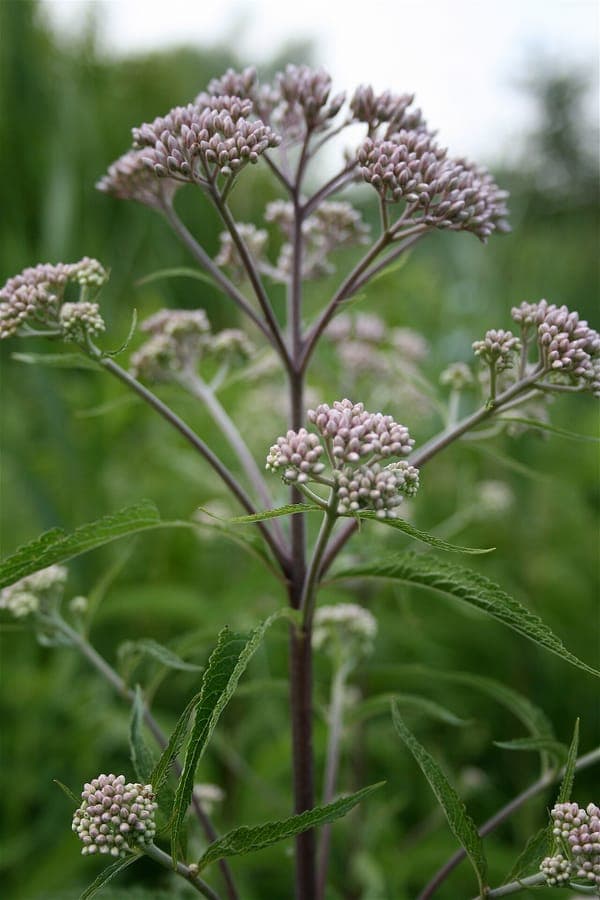
The species name 'maculatum' (spotted) refers to the characteristic purple spotting or flushing of the stems - a reliable identification feature that distinguishes it from the related Eutrochium purpureum, in which only the stem nodes are purple. Mature plants can reach 120 to 180 cm in height, making this one of the tallest and most architectural of all late-blooming perennials available for garden use. At gardenworld.app, you can explore planting design tools that help you place tall structural perennials like spotted Joe-Pye weed for maximum impact.
For wildlife gardeners, the appeal of this plant is extraordinary. Studies from North America have identified over 40 species of butterflies, moths, bees, and other insects using spotted Joe-Pye weed for nectar during its late-season bloom. The monarch butterfly, red admiral, painted lady, and eastern tiger swallowtail are among the most frequently observed visitors. In European gardens the same pattern holds: the large flower heads are a magnet for late-season butterflies, bumblebees, and hoverflies.
Appearance & bloom cycle
Spotted Joe-Pye weed is a plant of strong character. The stems are thick, hollow, and architecturally upright, sometimes reaching 1.5–1.8 m or more under ideal conditions. The characteristic purple spotting or uniform purple colouration of the stems is visible from early in the season and persists through the winter as the dried skeleton of the plant provides structural interest.
The leaves are large, rough-textured, lance-shaped to elliptic, and arranged in distinctive whorls of three to five around the stem. Each leaf measures 10–20 cm in length with finely toothed margins. The rough texture (described as 'coarse' in botanical assessments) adds tactile interest and the whorled arrangement creates a bold, tiered effect when the plant is viewed from below in flower.
Flowering begins in August and peaks in September, with some plants continuing to bloom into October. The flower heads consist of 8–20 disc florets each (no ray florets), in shades of rose-pink to light purple. These heads are packed into large, domed to flat-topped compound corymbs measuring 15–30 cm across. The combined effect is a soft, feathery cloud of warm pink-purple that is instantly recognisable in the late-season garden.
Recommended cultivars include 'Gateway' (more compact at 120–150 cm, slightly darker flowers, widely available at specialist nurseries), and the rarer 'Bartered Bride' (creamy white flowers). After flowering, the seed heads develop silky white to beige pappus, which provides structural winter interest and attracts seed-eating birds including siskins and goldfinches.
Ideal location
Spotted Joe-Pye weed performs best in full sun to partial shade. Full sun maximises flower production and stem rigidity. In partially shaded positions (up to 40–50% shade), the plant blooms adequately but stems may require staking if they lean toward the light source. Deep shade results in poor flowering and flopping stems.
The plant's natural streambank and wet meadow habitats make its preference for moist to wet conditions unambiguous. Ideal garden positions include pond margins, streambanks, low-lying areas that collect rainwater, rain gardens, and the back of wide moist borders. The plant tolerates periodic flooding (2–4 weeks) without lasting harm but performs best where roots are consistently moist without permanent waterlogging of the crown.
Given its height, position spotted Joe-Pye weed at the back of a border or as a central specimen in a large wet area. Allow at least 60–80 cm from the nearest path edge. As a single specimen beside a pond it makes a majestic statement; in groups of three to five it creates an unforgettable mass of late-season colour.
Soil requirements
Eutrochium maculatum thrives in moist to wet, moderately fertile soils with a pH of 5.5 to 7.0. Heavy clay and clay loam soils that remain naturally moist are excellent; incorporate 10–15 cm of well-rotted compost at planting to improve structure. Sandy soils need substantial organic matter enrichment (20–25 cm of humus or leafmould) and diligent watering.
The plant has moderate fertility requirements. On overly rich soils, lush but floppy growth results; annual topdressing with 5–7 cm of compost is sufficient. On alkaline soils above pH 7.5, iron or manganese chlorosis may develop; correct by acidifying with sulphur. Plant at 60–90 cm spacing for individual specimens; for group plantings, 70 cm spacing allows each plant room to develop while filling in within two seasons. Mulch with 7–10 cm of bark chippings to retain moisture.
Free design
Want to see Spotted Joe-Pye weed: complete guide in your garden? Make a free design now.
Watering
Eutrochium maculatum is not drought-tolerant and needs consistently moist soil throughout the growing season (April to October). In the absence of at least 20–25 mm of rainfall per week during summer, supplement with deep watering. A general guideline for established plants in a conventional border is 20–30 litres per plant per week during normal summer conditions, increasing to 50 litres during heat waves.
Drip irrigation delivering water directly to the root zone is the most efficient approach and avoids the wet foliage conditions that can encourage powdery mildew. Water in the early morning when possible. During the bloom period (August–October), adequate soil moisture directly influences flower longevity; drought stress at this stage causes premature browning of flower heads and a shorter display season.
At pond margins or streambanks with naturally high water tables, supplemental watering is usually unnecessary. Check only that roots are not permanently submerged, as crown rot can occur in waterlogged conditions.
Pruning
Spotted Joe-Pye weed needs minimal pruning. Cut back dead stems to ground level in late February to early April, once you have enjoyed the winter skeleton - the dried stems and seed heads provide structural interest through the coldest months and are attractive to seed-eating birds.
In early to mid-June, the optional 'Chelsea chop' (cutting all stems back by half) reduces the ultimate height by 30–40 cm and produces a sturdier, less floppy plant with a slight delay in bloom time (by 2–3 weeks) but a denser, more floriferous display. Do not prune after early July.
Divide congested clumps every four to six years in early spring. Dig up the entire root mass, divide with a sharp spade into sections of three to five stems each, and replant at 70–90 cm spacing. This rejuvenates older clumps and increases plant vigour and flowering.
Maintenance calendar
January–February: Leave standing stems for structural interest and birds. Check mulch layer is intact.
March: Cut down last year's stems to ground level. Dress around the plant with compost. Divide congested clumps if needed.
April–May: Monitor emerging growth - red-tipped shoots appear early. Remove weeds. Begin watering in dry periods.
June: Optional Chelsea chop at half height for more compact growth. Refresh mulch.
July–August: Water regularly and deeply. Flower buds develop on the characteristic spotted stems.
September–October: Peak flowering. Exceptional butterfly spectacle. Outstanding in combination with grasses and late-season companions.
November: Silky seed heads attractive to birds. Leave stems standing as long as possible.
December: Minimal care. Top up mulch around the root zone if prolonged hard frost without snow is forecast.
Winter hardiness
Eutrochium maculatum is highly cold hardy, rated USDA zones 4–9. It withstands temperatures to -30 °C without damage, as the above-ground stems die back completely in autumn while the root stock overwinters safely in the soil. No winter protection is needed in the Netherlands, Belgium, the UK, Germany, or France.
In unusually harsh continental winters with extended dry frost and no snow cover - for example in the Baltic states or eastern Poland - a 10–15 cm mulch layer over the crown provides insurance, but in Atlantic European climates this is entirely unnecessary. Early spring growth is vigorous: the distinctive red-tipped shoots emerge as soon as soil temperatures reach 5 °C, typically mid-March in northwest Europe, and grow rapidly to their full height within the season.
The rapid growth rate noted in botanical records is clearly apparent in cultivation: plants established in spring may reach 120 cm or more in their very first summer.
Companion plants
Spotted Joe-Pye weed pairs beautifully with other late-season perennials and moisture-tolerant grasses. Outstanding combinations available at specialist garden centres include:
- Miscanthus sinensis 'Gracillimus' or 'Flamingo': the fine, airy habit of this ornamental grass provides transparent contrast to the bold flower heads of Eutrochium maculatum; both enjoy moist conditions.
- Rudbeckia fulgida 'Goldsturm' (black-eyed Susan): the golden yellow, ray-flowered coneflower provides vivid colour contrast against the purple-pink of Joe-Pye weed.
- Lobelia cardinalis (cardinal flower): the scarlet spikes harmonise with the moist conditions Joe-Pye weed requires and provide vertical contrast.
- Thalictrum 'Elin' (meadow rue): the airy blue flower clusters and elegant foliage of this giant meadow rue offer textural contrast in the autumn border.
- Vernonia fasciculata (ironweed): another late North American native with vivid purple flowers that creates a harmonious colour pairing.
- Persicaria amplexicaulis 'Firedance': blooms simultaneously, prefers similar moist conditions; the red flower spikes and pink-purple Joe-Pye weed create a richly coloured late-season combination.
For best effect, plant in groups of five to seven at 70 cm spacing in a moist, open border position with full sun exposure.
Closing
Spotted Joe-Pye weed is one of the most magnificent late-blooming perennials for the moist border and wildlife garden. Its towering height, abundant rose-purple flowers, exceptional value for butterflies and pollinators, and reliable winter hardiness make it a plant of rare combined qualities.
To design a garden that makes the most of structural late-bloomers like Eutrochium maculatum, visit gardenworld.app for professional garden design tools tailored to your garden's specific conditions, size, and planting style.
Want to see Spotted Joe-Pye weed: complete guide in your garden? Make a free design now.
Upload a photo, pick a style, and get a photorealistic design with plant list in under a minute.
10,000+ gardens designed already
No credit card required


Similar plants
Calendula stellata: complete guide
Calendula stellata
Complete guide to Calendula stellata, the star-flowered marigold from Sicily: location, soil, watering and companion planting tips.
Korean chrysanthemum: complete guide
Chrysanthemum x rubellum
Chrysanthemum x rubellum is a hardy autumn perennial with single pink to copper flowers from August to November. Care and combinations.
Helianthus divaricatus: complete guide
Helianthus divaricatus
Helianthus divaricatus is a North American woodland sunflower with yellow summer blooms, ideal for naturalistic borders and shady edges.