
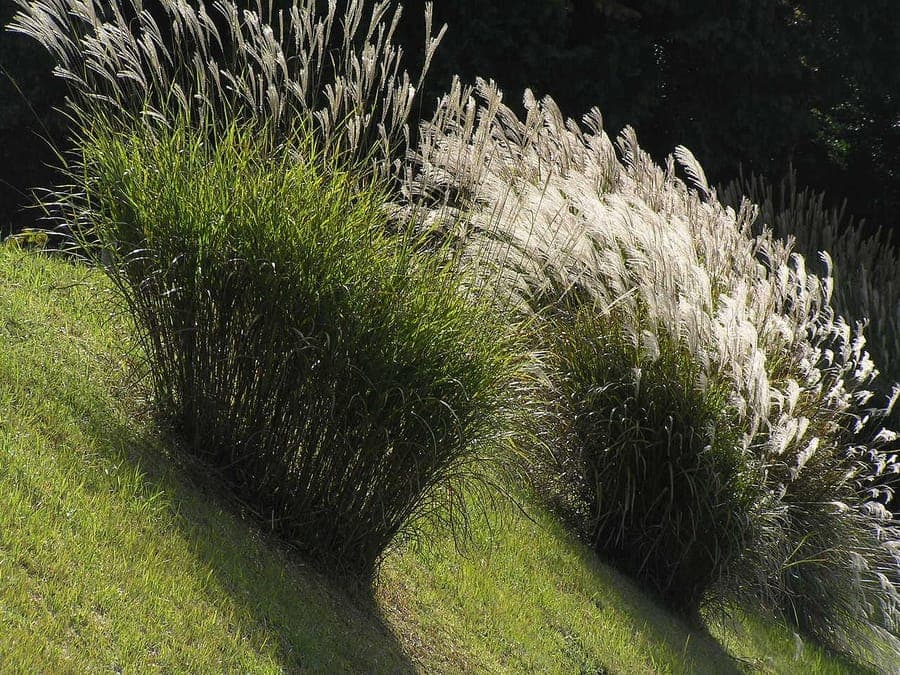
松岡明芳 / CC BY 3.0, via Wikimedia Commons
Chinese Silver Grass: complete guide
Miscanthus sinensis
Want to see Chinese Silver Grass: complete guide in your garden?
1 minute, no credit card
Overview
Chinese Silver Grass (Miscanthus sinensis) is the undisputed flagship of ornamental grasses for the temperate garden. This vigorous deciduous grass clump from East Asia combines architectural stature, months of ornamental interest, and near-total ease of maintenance in a way that few other garden plants can match. From the first plumes in August to the golden-blonde winter stems that stand proud into March, Miscanthus offers more than half a year of visual drama.
At heights of 1.5 to 3 metres depending on the cultivar, Miscanthus functions as a living architectural element: as a windbreak, a privacy screen, a standalone focal point, or a rhythmically repeated accent in a deep border. On gardenworld.app you can create a garden design where ornamental grasses provide the vertical dimension - as a backdrop for lower perennials, as a frame for a terrace, or as a natural boundary that sways and rustles in the breeze. The plant forms sturdy clumps that slowly increase in girth but never become invasive.
Appearance and bloom
The leaves of Miscanthus sinensis are long, narrow (1–2 cm wide), and elegantly arching, with a distinctive white or silvery midrib that gives the blade a striped appearance. Leaf colour varies by cultivar from pure green to blue-green, and some cultivars feature horizontal yellow bands ('Zebrinus') or narrow white margins ('Morning Light').
The plumes emerge from August to October, depending on cultivar and climate. They begin as compact, often reddish or silvery feathers that gradually unfurl into airy, silken plumes. Backlit by low sun - especially in the late afternoon - the plumes appear to glow, an effect that fascinates photographers and garden designers alike. In autumn the foliage turns golden yellow to coppery brown. Through winter, the bleached stems and plumes remain standing, forming a beautiful silhouette laced with frost or dusted with snow.
Popular cultivars include 'Gracillimus' (narrow leaves, graceful arch, 1.5–1.8 m), 'Morning Light' (silvery leaf margins, compact, 1.5 m), 'Zebrinus' (horizontal yellow bands, 2 m), 'Malepartus' (early, large red-tinted plumes, 2–2.5 m), and 'Kleine Silberspinne' (fine-leaved, compact, 1.2 m, ideal for smaller gardens).
Ideal location
Miscanthus is a sun-loving plant that performs best in a warm, open position in full sun. A minimum of six hours of direct sunlight daily is needed for good plume development and sturdy, upright growth. In partial shade the plant grows but the stems become lax and the plumes smaller and later.
An exposed, windy spot is no problem - quite the opposite. Miscanthus dances and rustles in the wind, and that movement is a major part of its charm. Plant it where you can see it from the house: beside the patio, along the drive, or as the backdrop to a border visible from the living room. A row of three to five clumps at regular intervals (1 to 1.5 metres apart) creates an impressive green screen in summer and an elegant winter silhouette. In the UK, Miscanthus is equally at home in a Cotswolds cottage garden and a modern London courtyard. In the USA, it thrives from the Mid-Atlantic states through the Midwest.
Soil requirements
Miscanthus sinensis is unfussy about soil and grows in sand, clay, loam, and everything in between. The one firm requirement is adequate drainage: prolonged waterlogging leads to root rot. In heavy clay it performs well provided water can drain away in winter.
The ideal soil pH ranges from 5.5 to 7.5. When planting, work a spadeful of compost into the planting hole to enrich the soil and improve moisture retention. Feeding is rarely necessary: an annual application of organic general fertiliser in April is ample. Avoid excessive nitrogen fertilisation - it produces floppy foliage and fewer plumes. A wide range of Miscanthus cultivars is available at garden centres across the UK, the USA, Australia, and South Africa.
Watering
Newly planted Miscanthus needs regular watering during the first growing season to establish well. Give 10 to 15 litres per clump weekly, especially in dry weather. Ensure the water soaks deep into the ground. After the first season, Miscanthus is surprisingly drought tolerant and manages without supplementary water in most years.
During extreme drought (more than three weeks without rain) you may water, but do not overdo it: a slightly stressed Miscanthus actually produces sturdier stems and deeper roots. Miscanthus in large containers (minimum 40 litres) dries out faster and needs water two to three times per week in summer. A 5 centimetre mulch layer of composted bark around the clump helps with moisture retention.
Free design
Want to see Chinese Silver Grass: complete guide in your garden? Make a free design now.
Pruning
The pruning regime for Miscanthus is wonderfully simple and consists of exactly one operation per year: cut the entire clump back to 10 to 15 centimetres above ground level in March, just before new shoots appear. Use sturdy hedge shears, a powered hedge trimmer, or - for large clumps - a chainsaw or reciprocating saw.
Do not cut Miscanthus back in autumn or early winter, however tempting that may be during the garden tidy-up. The standing stems and plumes form the winter silhouette that makes this plant so valuable, and the dead above-ground structure insulates the crown against frost. Wait until the first signs of green appear at the base (usually mid-March) - then it is time to cut. Wear heavy gloves when cutting: the leaf margins of Miscanthus are sharp enough to cause cuts.
After eight to ten years, the centre of the clump may become bare. That is the signal to lift, divide, and replant - the best moment for rejuvenation is April.
Maintenance calendar
March: The most important task of the year. Cut the clump back to 10–15 cm. Divide ageing clumps if needed.
April: New shoots emerge. Apply a handful of organic fertiliser. Plant new clumps.
May–June: Vigorous growth. The foliage reaches full height. Provide supplementary water in dry spells.
July: Flower stems begin to form in early cultivars.
August–September: Flowering period. The plumes appear and colour from silver or red to cream.
October: Autumn colour develops, foliage turning gold and copper.
November–February: Winter silhouette. Leave the stems and plumes standing for ornamental value and frost protection. Enjoy the frosted plumes on cold mornings.
Winter hardiness
Miscanthus sinensis is hardy to approximately -20°C to -25°C (USDA zones 5–9) and survives winters across the UK, much of the USA, and comparable climates without any difficulty. The underground root mass withstands frost well, provided the ground is not permanently waterlogged.
The principal risk factor is not cold itself but cutting back the above-ground stems too early. The dead foliage and stems function as natural insulation for the heart of the clump. Leave them in place until March. Young plants (first winter) are slightly more vulnerable; an extra layer of mulch or leaves around the clump provides adequate protection. In severe winters, frost on the plumes creates one of the most beautiful sights the winter garden has to offer.
Companion plants
Miscanthus is the ideal backdrop plant for flowering borders. The tall, airy stems form a neutral screen against which the colours of lower perennials show up brilliantly. Roses (Rosa rugosa or shrub roses) combined with Miscanthus create a classic picture: warm rose tones against the cool green and silver of the grass.
Lavender (Lavandula angustifolia) as a low foreground provides colour and fragrance. Sage (Salvia nemorosa), yarrow (Achillea), and coneflowers (Echinacea purpurea and Rudbeckia) are excellent bloomers in the same period as the Miscanthus plumes. Hydrangeas (Hydrangea macrophylla) work well as mid-height interplanting. For a modern, minimalist garden, combine Miscanthus with box spheres and gravel. Avoid planting low grasses directly at the foot of Miscanthus - they will be overshadowed and decline.
Closing
Miscanthus is one of those rare garden plants that gives pleasure throughout the year: from the fresh green shoots in April through the dancing plumes of autumn to the frosted winter silhouette. The maintenance burden is minimal - one cut-back per year and that is it. No spraying, no special feeding, no particular attention. Just sun, space, and a little patience.
Purchase your Miscanthus from a garden centre and choose a cultivar that suits the available space: 'Gracillimus' or 'Kleine Silberspinne' for smaller gardens, 'Malepartus' or 'Zebrinus' for larger borders. On gardenworld.app you can create a garden design where ornamental grasses provide the vertical accent - as a windbreak, a privacy screen, or a swaying backdrop for your flower border. Plant a clump of Miscanthus this spring and let the beauty of movement transform your garden.
Want to see Chinese Silver Grass: complete guide in your garden? Make a free design now.
Upload a photo, pick a style, and get a photorealistic design with plant list in under a minute.
No credit card required


Similar plants
English Lavender: complete guide
Lavandula angustifolia
Everything about English Lavender (Lavandula angustifolia): planting, pruning, care and overwintering. Practical tips for lush purple blooms.
Rugosa Rose: complete guide
Rosa rugosa
Everything about the Rugosa Rose (Rosa rugosa): planting, pruning, care and winter hardiness. Practical tips for abundant blooms in your garden.
Bigleaf Hydrangea: complete guide
Hydrangea macrophylla
Everything about the Bigleaf Hydrangea (Hydrangea macrophylla): planting, pruning, flower colour control and winter protection. Practical tips for lush blooms.