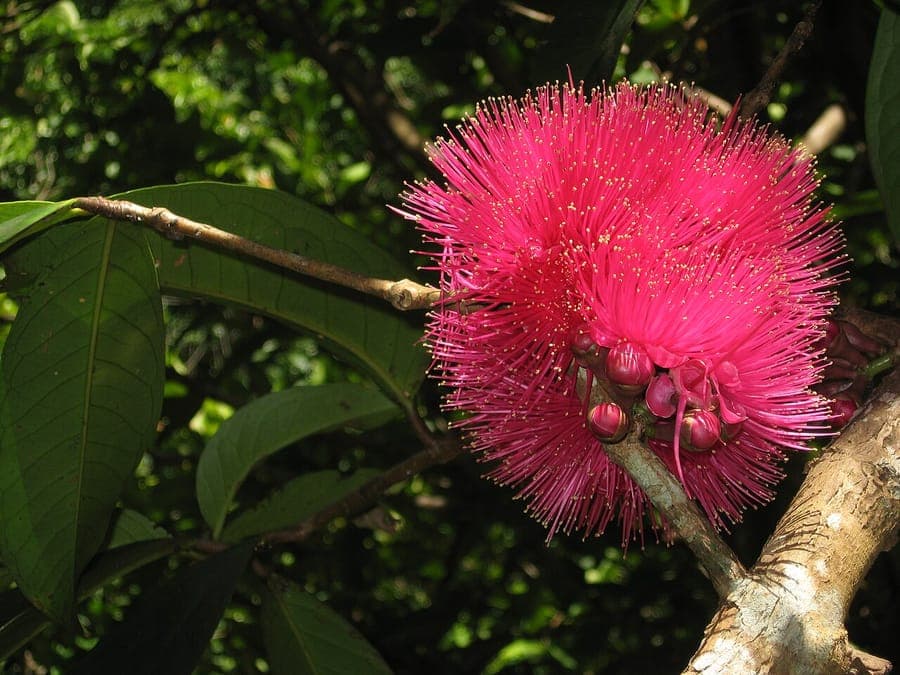
Crisco 1492 / CC BY-SA 3.0, via Wikimedia Commons
Syzygium malaccense: complete guide
Syzygium malaccense
Want to see Syzygium malaccense: complete guide in your garden?
Full design in HD: €7.99
Look after your Syzygium malaccense with the GardenWorld app
Identify plants with your camera and get a care calendar with reminders for this plant.


Overview
Syzygium malaccense, commonly known as the Malay apple, pomerac, or rose-apple, is a fascinating fruit tree native to Southeast Asia. This subtropical tree grows wild from Malaysia to Vanuatu and produces delicate rosy blooms followed by nutritious red fruits. With its elegant growth pattern and ornamental bark, Syzygium malaccense creates a spectacular addition to warmer gardens.
The tree belongs to the Myrtaceae family, the same family as eugenias and guavas. The fruits are not only beautiful but also delicious, with a subtle watermelon-like flavor.
Appearance and Bloom
Syzygium malaccense reaches heights of 10 to 15 meters when mature, though in containers or with pruning remains much more compact. The tree has large, lance-shaped, glossy green leaves with prominent veins. Blooms are rosy to red, approximately 2-3 centimeters in diameter, and grow in dense clusters directly on trunk and branches.
Blooming time depends on local climate but usually occurs in spring or early summer. Fruits appear several months after blooming, bell-shaped, approximately 5-6 centimeters in diameter, deep red to crimson.
Ideal Location
Syzygium malaccense thrives best in warm climates (minimum 15-20 degrees Celsius). In northern Europe, it's only possible as a container plant protected over winter or in heated greenhouses. Provide full sun to partial shade with at least 5-6 hours of direct sunlight.
The tree suits Mediterranean-style gardens, patio containers, and greenhouse gardens. Protected, south-facing locations may allow overwintering in very mild winters.
Soil Requirements
Ideal soil for Syzygium malaccense is well-draining, slightly acidic to neutral, and rich in organic matter. A pH between 5.5 and 7.0 is ideal. Heavy clay must be improved with sand, gravel, and compost. The tree tolerates no waterlogging and prefers consistently moist but not saturated soil.
Free preview
Want to see Syzygium malaccense: complete guide in your garden? Make a free preview of your design.
Watering
Syzygium malaccense needs regular water, especially during growing season and fruit set. Water until water runs from drainage holes, but allow soil to dry somewhat between waterings. In winter, reduce watering significantly.
Mulching helps retain moisture and stabilize soil temperature. In containers, the tree requires more frequent watering than in open ground.
Maintenance
Minimal pruning is needed. In containers, the tree can be pruned or shaped for compact growth. Remove poorly placed or crossing branches. Seed viability can be maintained by checking for damaged tissue.
Avoid chemical pesticides-the tree is sensitive. Instead, hand-pick pest insects or use natural controls.
Maintenance Calendar
FEBRUARY-MARCH: Prune past season, apply feeding, repot if needed. APRIL-MAY: Growing period, regular watering, monitor for pests. JUNE-JULY: Possible blooming period, regular watering, lighter feeding. AUGUST-OCTOBER: Fruit set, regular watering, no feeding. NOVEMBER-JANUARY: Rest period, reduced watering, frost protection in containers.
Winter Hardiness
Syzygium malaccense is not hardy and tolerates temperatures below 10-15 degrees Celsius poorly. In cold regions, it must be overwintered in protected greenhouses or indoors on a sunny windowsill. Container trees can be placed against south walls for maximum warmth.
Frost-damaged tips can be removed in spring and the tree will usually regrow.
Companion Plants
In warmer gardens, Syzygium malaccense combines beautifully with other subtropical fruit trees like citrus, avocados, and mangoes. For surrounding plants, use other Mediterranean-loving plants like lavender, rosemary, and agapanthus. In containers, use tropical flowering plants for dramatic contrast.
Closing Thoughts
Syzygium malaccense is an unusual choice for gardeners in temperate climates but promises exciting challenges and rewards. With careful overwintering care in cold regions, gardeners can enjoy rosy blooms and nutritious fruits. Explore gardenworld.app for more exotic fruit tree inspiration.
Frequently asked questions about Syzygium malaccense
Is Syzygium malaccense winter hardy?
Syzygium malaccense is not hardy and tolerates temperatures below 10-15 degrees Celsius poorly. In cold regions, it must be overwintered in protected greenhouses or indoors on a sunny windowsill.
How much water does Syzygium malaccense need?
Syzygium malaccense needs regular water, especially during growing season and fruit set. Water until water runs from drainage holes, but allow soil to dry somewhat between waterings.
Where does Syzygium malaccense grow best?
Syzygium malaccense thrives best in warm climates (minimum 15-20 degrees Celsius). In northern Europe, it's only possible as a container plant protected over winter or in heated greenhouses.
What soil does Syzygium malaccense need?
Ideal soil for Syzygium malaccense is well-draining, slightly acidic to neutral, and rich in organic matter. A pH between 5.5 and 7.0 is ideal.

See it in your garden
See Syzygium malaccense in your garden
One photo of your garden and a few questions. You see the result in about a minute.
Try it with a photoIdentify this plant in your own garden. Identify a plant
Similar plants
Feijoa (Acca sellowiana): growing pineapple guava
Acca sellowiana
The feijoa or pineapple guava (Acca sellowiana) is an evergreen shrub with red-tufted flowers and aromatic fruit. Site, hardiness, pollination and harvest explained.
Crimson bottlebrush (Callistemon citrinus): care and overwintering
Callistemon citrinus
Growing crimson bottlebrush (Callistemon citrinus, now Melaleuca citrina): position, compost, watering, pruning and overwintering this tough Australian shrub.
Weeping bottlebrush (Callistemon viminalis): care and 'Little John'
Callistemon viminalis
Weeping bottlebrush (Callistemon viminalis, now Melaleuca viminalis): growing it in containers, the dwarf 'Little John', pruning and frost-free overwintering.
