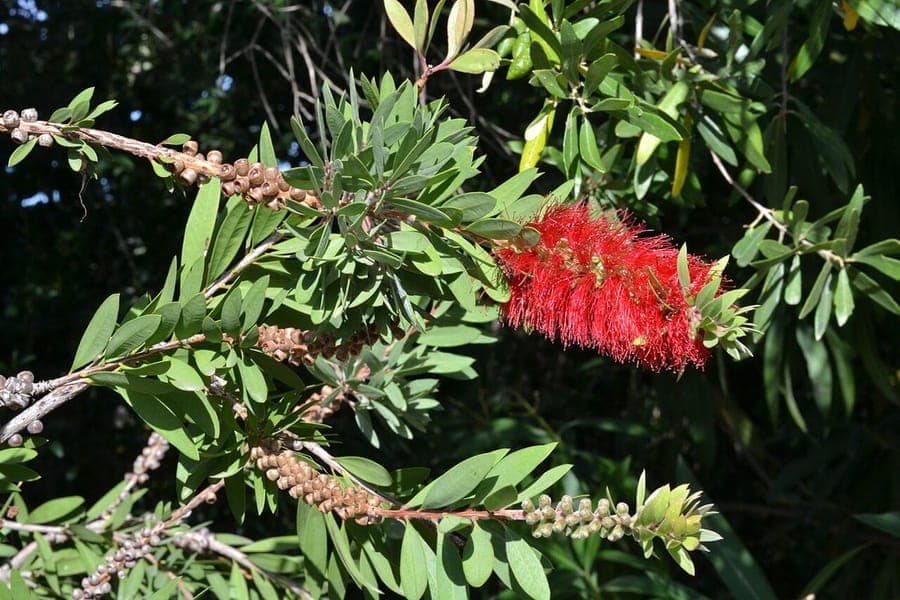
DirkHoffmann / CC BY-SA 3.0, via Wikimedia Commons
Crimson bottlebrush (Callistemon citrinus): care and overwintering
Callistemon citrinus
Want to see Crimson bottlebrush (Callistemon citrinus): care and overwintering in your garden?
Full design in HD: €7.99
Look after your Crimson bottlebrush with the GardenWorld app
Identify plants with your camera and get a care calendar with reminders for this plant.


Overview
Crimson bottlebrush (Callistemon citrinus), also known as lemon bottlebrush, is the bottlebrush you are most likely to find in a garden centre. This evergreen shrub comes from eastern Australia, where it grows along creeks and in damp hollows in Queensland, New South Wales and Victoria. The common name says it all: its bright red flower spikes look exactly like the brushes once used to clean bottles and lamp glasses.
The botanical name has moved on. Following a revision published in 2006, many botanists, particularly in Australia, now include all bottlebrushes in the genus Melaleuca, and this species is called Melaleuca citrina. Nurseries and labels still mostly use Callistemon citrinus, so you will see both names for the same plant.
The epithet citrinus refers not to the flower colour but to the scent: crush a leaf and you will smell lemon. That is also a handy way to tell it apart from weeping bottlebrush (Callistemon viminalis), which has narrower, softer leaves, drooping branches and less tolerance of frost. Callistemon citrinus grows stiffly upright and is the tougher of the two.
In Australia the shrub reaches 2 to 4 m. In a container it usually stays between 1 and 2 m, and it is often sold as a standard on a clear stem. To see how a container shrub like this would work on your patio, among your other pots and seating, you can have a garden design created on gardenworld.app that also considers where the plant will spend the winter.
Appearance and bloom cycle
The leaves are lance-shaped, 3 to 7 cm long and 5 to 8 mm wide, stiff and leathery with a sharp tip. Hold one up to the light and you will see tiny oil glands as pale dots. New shoots are a striking pink or bronze and covered in silky hairs, which adds a lovely extra touch in spring.
The flower spikes are 6 to 10 cm long and 4 to 7 cm across. What you see are not petals, which are small and fall early, but hundreds of long crimson stamens tipped with dark red anthers. Unusually, the shoot keeps growing from the tip of the spike once flowering is over. That leaves rings of woody seed capsules along the stems, and they can stay there for years. In the wild many only open after a bushfire.
Outdoors in north-west Europe, Callistemon citrinus flowers mainly from May to July, and after a warm summer there is often a smaller second flush in August or September. Bees and bumblebees love the nectar-rich flowers. The best-known cultivar is 'Splendens', with especially vivid scarlet spikes and good flowering even on young plants.
Bottlebrush is not known to be toxic to people, cats or dogs. The leaves do contain aromatic oils, so it is still best to stop pets from chewing them.
Ideal location: container or open ground
Full sun is the key to good flowering. From May to October, give the plant the sunniest spot on your patio, ideally with six to eight hours of direct sun. A position against a south or west-facing wall, sheltered from cold winds, is perfect. In partial shade the shrub will grow but flower far less.
In most inland gardens it is best kept in a container. Planting out is realistic only in the mildest places: coastal gardens in Cornwall, south-west Ireland or Brittany, walled town gardens and warm house walls, and even there a severe winter carries some risk.
Choose a sturdy pot that is not oversized; one size larger than the root ball is enough. An oversized pot stays wet and reduces flowering. Repot every two or three years in March or April. With older plants in large tubs you can simply replace the top layer of compost instead.
Soil requirements and compost
Callistemon citrinus wants an open, well-drained compost that is neutral to slightly acidic. Use a good loam-based compost for container plants and mix in about a quarter ericaceous compost plus some grit or clay granules. That keeps the structure open and the pH slightly low. Add a drainage layer at the bottom of the pot.
This species copes with lime a little better than many Australian shrubs, but with chalky soil and hard tap water the young leaves turn yellow with green veins, a sign of iron deficiency. Switch to rainwater for a while and give an iron chelate if needed.
Free preview
Want to see Crimson bottlebrush (Callistemon citrinus): care and overwintering in your garden? Make a free preview of your design.
Watering and feeding
In the wild Callistemon citrinus often grows in damp places, and it shows. During the growing season it needs plenty of water: from April to September keep the root ball slightly moist at all times and water generously in hot weather. A bottlebrush that is kept too dry quickly sheds its flower spikes and sets fewer new buds.
Even so, never leave water standing in the saucer. Water thoroughly twice a week rather than a little every day. Rainwater is preferable.
Feed every two weeks from April to mid-August with a liquid fertiliser for flowering container plants or citrus. A feed that is low in phosphorus is the safest choice for Australian plants. Stop in the second half of August so that new shoots can harden off.
Pruning
Prune right after flowering. Cut off each faded spike just below the lowest ring of seed capsules, or leave them if you like the look of the woody rings. Shortening the tips encourages branching and gives you more spikes the following year.
Callistemon citrinus takes pruning well, far better than manuka, for example. A shrub that has become too large or bare at the base can be cut back hard into older wood in spring; it usually reshoots, although you will lose that year's flowers. On a standard, simply remove any shoots that appear on the stem or below the head.
While pruning, look for scale insects and mealybugs. Indoors in dry winter air, red spider mite can also strike: fine webbing and yellow-speckled leaves. Cool winter quarters and an occasional misting of the foliage help a lot.
Maintenance calendar
March-April: Repot if needed. Move the plant outdoors once hard night frosts are over.
May-July: Main flowering. Water generously and feed every two weeks.
July-August: Remove faded spikes. Stop feeding by mid-August.
September: Often a second flush of flowers. Keep watering.
October-November: The plant can stay outside until frosts reach about -3 °C, then move it under cover. A plant calendar on gardenworld.app can remind you when it is time to bring your container plants in.
December-February: Overwinter cool and bright, with little water.
Winter hardiness
Callistemon citrinus is one of the least tender bottlebrushes. Well-established plants in the ground can survive brief dips to -5 to -7 °C, but harder or prolonged frost kills the top growth. In a container the limit is lower, because the root ball freezes quickly, so treat about -3 °C as a safe minimum for a potted plant. It is clearly hardier than weeping bottlebrush, but it is not hardy in the sense of an ordinary garden shrub.
Overwintering
The best winter quarters are bright and cool, between 5 and 10 °C. An unheated conservatory, a cool porch or a garage with a good window are ideal. A dark cellar is not suitable: the plant stays in leaf and needs light.
In winter water sparingly, just enough to stop the root ball drying out, and do not feed. A warm living room is a last resort: the plant usually survives but soon gets red spider mite and flowers less the following year. Bring it back outside gradually in March or April, first in a sheltered spot out of strong sun.
If you grow a bottlebrush in the ground in a coastal garden, spread a thick mulch of bark or leaves over the roots in November and keep fleece ready for nights below -5 °C. A plant whose top growth is killed sometimes reshoots from the base.
Companion plants
Bottlebrush belongs on a sunny patio with a Mediterranean or Australian feel. Good container partners are African lily (Agapanthus africanus) with its blue flower heads, oleander (Nerium oleander) and an olive tree (Olea europaea). New Zealand flax (Phormium tenax) adds structure with its sword-shaped leaves.
At ground level or in low troughs, French lavender (Lavandula stoechas) works well: the purple flowers make a strong contrast with the vivid red. Bear in mind that bottlebrush needs more water in summer than lavender or olive, so give it a pot of its own.
Final thoughts
Callistemon citrinus, the bottlebrush with lemon-scented leaves, is a rewarding container shrub for a sunny patio. Plenty of sun, generous summer watering, an open, slightly acidic compost and bright, cool winter quarters are all it asks. Give it a quick trim after flowering each year and you will have a shrub covered in red brushes every spring, under either of its names: Callistemon or Melaleuca citrina.
Frequently asked questions about Crimson bottlebrush
Is Crimson bottlebrush winter hardy?
Callistemon citrinus is one of the least tender bottlebrushes. Well-established plants in the ground can survive brief dips to -5 to -7 °C, but harder or prolonged frost kills the top growth.
When and how do you prune Crimson bottlebrush?
Prune right after flowering. Cut off each faded spike just below the lowest ring of seed capsules, or leave them if you like the look of the woody rings.
How much water does Crimson bottlebrush need?
In the wild Callistemon citrinus often grows in damp places, and it shows. During the growing season it needs plenty of water: from April to September keep the root ball slightly moist at all times and water generously in hot weather.
Where does Crimson bottlebrush grow best?
Full sun is the key to good flowering. From May to October, give the plant the sunniest spot on your patio, ideally with six to eight hours of direct sun.
What soil does Crimson bottlebrush need?
Callistemon citrinus wants an open, well-drained compost that is neutral to slightly acidic. Use a good loam-based compost for container plants and mix in about a quarter ericaceous compost plus some grit or clay granules.

See it in your garden
See Crimson bottlebrush in your garden
One photo of your garden and a few questions. You see the result in about a minute.
Try it with a photoIdentify this plant in your own garden. Identify a plant
Similar plants
Lily-of-the-Nile: complete guide
Agapanthus africanus
Everything you need to grow Agapanthus africanus: ideal conditions, watering, winter care, and companion planting for UK and US gardens.
Oleander: complete guide
Nerium oleander
Oleander (Nerium oleander) brings Mediterranean elegance to warm gardens. Growing, propagation, toxicity awareness, and container care.
Olive tree: complete guide
Olea europaea
Everything about the olive tree (Olea europaea): planting, care, overwintering and cultivar selection. Practical tips for bringing Mediterranean character to your garden.
