
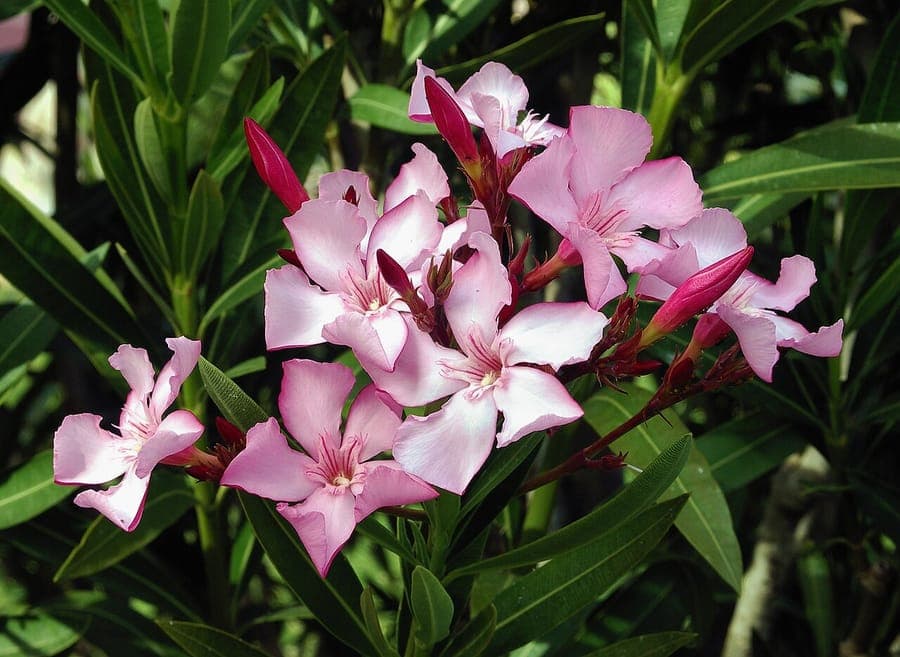
Alvesgaspar / CC BY 2.5, via Wikimedia Commons
Oleander: complete guide
Nerium oleander
Want to see Oleander: complete guide in your garden?
1 minute, no credit card
Overview
Oleander, scientifically Nerium oleander, is one of the world's most iconic Mediterranean shrubs. This magnificent plant grows naturally throughout the Mediterranean region, from North Africa to Myanmar, thriving in hot, dry climates where it follows water sources and graces riverbanks and oasis gardens. The plant has been cultivated for millennia and represents Mediterranean garden elegance at its finest. What makes oleander so beloved? The combination of glossy evergreen foliage, continuous flowering from June through October, and exceptional tolerance for heat and drought creates an almost unbeatable garden specimen.
However, it is absolutely critical to understand that oleander is completely toxic. Every part of the plant, including leaves, stems, flowers, and seeds, contains cardiac glycosides that are highly poisonous to humans and animals. This makes oleander unsuitable for gardens where children or pets have unsupervised access. Additionally, oleander is not frost-hardy above USDA zone 8 and will be killed by winter freezes in Netherlands, Belgium, France, and Germany. In these regions, oleander must be grown in containers and brought indoors for winter protection.
For gardeners in warm climates or those willing to provide winter protection, oleander is an absolutely essential plant. The flowers are spectacular, the fragrance attracts pollinators, and maintenance is minimal once established.
Appearance and bloom cycle
Oleander grows as a shrub ranging from 2 to 6 meters in height depending on cultivar and climate. In containers in cold regions, growth remains 1 to 2 meters. The leaves are highly characteristic: lanceolate, 5 to 12 centimeters long, dark green, and very glossy. The foliage is leathery, perfectly matching the plant's drought-tolerant nature. Leaves emerge in whorls of three, creating a very organized, structured appearance.
The flowers are oleander's true glory. They appear in terminal clusters composed of five-lobed flowers measuring 2 to 4 centimeters across. Color variation is remarkable: red, pink, purple, yellow, cream, and white are all available depending on cultivar selection. Many cultivars feature semi-double or fully double flowers with multiple layers of petals creating a rose-like appearance. The flowering season is exceptionally long, beginning in June and continuing through October, extending even longer in Mediterranean climates. The fragrance is pleasantly sweet, attractive to bees and butterflies.
The fruit consists of long, slender pods reaching up to 15 centimeters in length. These distinctive seed pods are yellowish-brown and contain numerous fine, plumed seeds dispersed readily by wind. The fruit remains ornamental well into winter.
Ideal location
Oleander absolutely requires full sun: minimum 6 to 8 hours of direct sunlight daily. In shade, the plant grows poorly and flowers rarely. The location must be sheltered from harsh winds, though the plant is reasonably wind-tolerant. In gardens, south or west-facing positions are ideal. The plant tolerates poor positioning surprisingly well but performs best in unobstructed sun.
Temperature is critical. The plant will not survive winter temperatures below minus 5 degrees Celsius for extended periods. USDA zones 8 through 11 are suitable for year-round outdoor cultivation. In zone 8, young plants may not survive their first winter outdoors. In Netherlands, Belgium, France, and Germany, oleander can ONLY be grown in containers as a patio or terrace plant, requiring movement to protected locations during winter months.
Free design
Want to see Oleander: complete guide in your garden? Make a free design now.
Soil requirements
Oleander is not particular about soil chemistry. It grows well in sandy, loamy soils with pH between 6.0 and 8.0. Soil must be extremely well-drained; waterlogging and moisture excess are fatal. In containers, a mixture of garden soil, coarse sand, and perlite in 2:1:1 ratio is recommended. The plant tolerates poor, mineral-deficient soils well; excessive fertilization produces leafy growth at the expense of flowering.
Watering
Once established, oleander is exceptionally drought-tolerant. During the growing season (May through October), water when soil feels dry 2 to 3 centimeters below the surface. Weekly watering is usually sufficient. In containers, watering must be more frequent: 2 to 3 times weekly during hot periods. In winter, watering must be drastically reduced; provide only enough moisture to prevent complete desiccation.
Pruning
Oleander responds excellently to pruning and tolerates heavy cutting. Pruning should occur in late winter just before growth begins, around March-April. Cutting approximately 50 percent of previous year's growth promotes dense, compact form and encourages flowering. Remove dead or damaged branches at any time. Caution: wear gloves when handling cut material due to toxicity.
Maintenance calendar
March-April: Spring pruning and season start May-October: Flowering, regular watering, optional light feeding every two weeks November-February: Dormancy, minimal water, no feeding, frost-free storage
Winter hardiness
Oleander is not hardy above zone 8. In zone 8, mature, established plants may survive with protection. In cold regions, the plant must be grown in containers and brought indoors for winter. Ideal overwintering occurs at 5 to 10 degrees Celsius in a bright location, such as a cool greenhouse or bright basement.
Companion plants
Oleander grows beautifully with other Mediterranean plants including lavender, rosemary, santolina, and rock rose. In containers, multiple olanders in contrasting flower colors create stunning displays. Pairing with silver-foliaged plants like dusty miller or artemisia provides elegant contrast and emphasizes the glossy green foliage. Blue-flowering salvias and catmint complement oleander's warm tones perfectly.
Closing
Oleander is an essential plant for warm-climate gardens but requires careful attention to toxicity and winter protection in cold regions. The flowering is spectacular, the plant is remarkably low-maintenance, and it brings authentic Mediterranean character to any garden fortunate enough to accommodate it. For detailed information about Mediterranean garden design and container cultivation techniques, visit gardenworld.app. For comprehensive safety information about toxic plants and precautionary measures, consult the resources available on gardenworld.app.
Want to see Oleander: complete guide in your garden? Make a free design now.
Upload a photo, pick a style, and get a photorealistic design with plant list in under a minute.
No credit card required


Similar plants
Asclepias speciosa: complete guide
Asclepias speciosa
Showy milkweed: striking pink-white flowers, fragrant blooms. Essential monarch butterfly host plant.
Plumeria obtusa: complete guide
Plumeria obtusa
Discover the Singapore graveyard flower: an exotic evergreen with mesmerizing white blooms and exquisite fragrance. Expert cultivation, care, and maintenance tips.
Wrightia arborea: complete guide
Wrightia arborea
Wrightia arborea, known as doodhi, is an elegant tree from South Asia with delicate white flowers. Discover how to cultivate this exotic plant.