Geoff Fox / CC BY 3.0, via Wikimedia Commons
Weeping bottlebrush (Callistemon viminalis): care and 'Little John'
Callistemon viminalis
Want to see Weeping bottlebrush (Callistemon viminalis): care and 'Little John' in your garden?
Full design in HD: €7.99
Look after your Weeping bottlebrush with the GardenWorld app
Identify plants with your camera and get a care calendar with reminders for this plant.


Overview
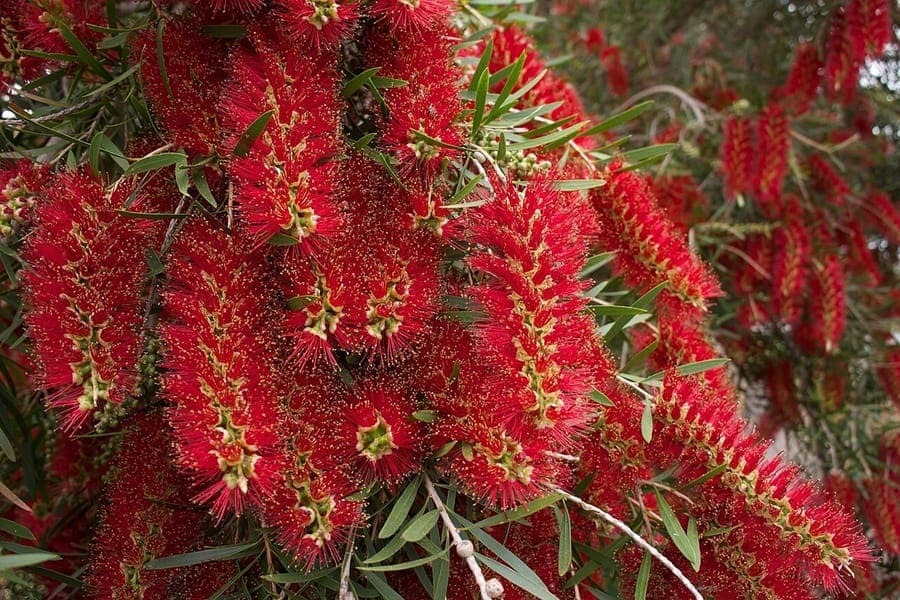
Weeping bottlebrush (Callistemon viminalis) is the bottlebrush with gracefully drooping branches. In eastern Australia, in Queensland and New South Wales, it grows along rivers and creeks into a small tree 5 to 8 m tall, with a crown reminiscent of a small weeping willow. In late spring its twigs are hung with bright red brushes. That is why it is a popular street tree and garden shrub in southern Europe and in warm climates around the world.
Like the other bottlebrushes, the species has been moved by many botanists to the genus Melaleuca since a revision published in 2006, and is now often called Melaleuca viminalis. In the nursery trade you will almost always still find it as Callistemon viminalis, usually with a cultivar name attached.
In Britain and north-west Europe you are most likely to meet it as a compact cultivar. The best known is 'Little John', a dwarf form roughly 60 cm to 1 m tall and wide, with dense blue-green foliage and dark red flowers. 'Captain Cook' grows a little larger, to around 1.5 to 2 m, and flowers very freely. Both are ideal for a pot on a patio or balcony.
One thing to bear in mind: Callistemon viminalis is more tender than the better-known crimson bottlebrush (Callistemon citrinus), and it responds differently to pruning. Mixing up the two can mean leaving the plant outside too long in autumn. If you want to know where a container plant like this would look best on your patio, you can have a garden design created on gardenworld.app that also considers where your pots will spend the winter.
Appearance and bloom cycle
The difference from the upright crimson bottlebrush is obvious at a glance. The twigs of Callistemon viminalis are thin and supple, and on the species and larger cultivars they clearly arch and droop. The leaves are narrow, linear to narrowly lance-shaped, 3 to 7 cm long and usually only 3 to 7 mm wide. They feel softer than those of Callistemon citrinus and do not smell of lemon when crushed. Young shoots are silky-haired and often pink or coppery.
The flower spikes are 4 to 10 cm long and bright scarlet to crimson. They consist of dozens of long stamens forming a soft brush. On 'Little John' the spikes are shorter and darker. As with all bottlebrushes, the twig carries on growing from the tip of the spike after flowering, leaving a ring of woody seed capsules behind. On this species they are less conspicuous because the twigs are thinner and the capsules smaller.
Outdoors it flowers in May and June, sometimes from late April in a warm spot. After a good summer a second flush follows in August or September. Bees and bumblebees visit the flowers.
Callistemon viminalis is not known to be toxic to people, cats or dogs. Even so, it is sensible to stop pets chewing the aromatic leaves.
Ideal location: container or open ground
Give it full sun. The more light it gets, the better it flowers and the more compact it grows. A south or west-facing patio is ideal, preferably sheltered from cold easterly winds. In partial shade the twigs stretch and few spikes appear.
In most of Britain and north-west Europe, Callistemon viminalis is a container plant. Only the very mildest coastal gardens, such as the Isles of Scilly or the far south-west, offer a reasonable chance outdoors, and even there a hard winter can kill it. It tolerates less frost than its upright cousin.
Use a pot one size larger than the root ball. For 'Little John', a pot 30 to 40 cm across is often enough even after several years. Weeping forms look best in a tall pot or on a plinth, so that the twigs can fall freely. Repot every two or three years in spring.
Soil requirements and compost
This species likes a moisture-retentive but well-drained, slightly acidic compost. Mix a loam-based container compost with about a third ericaceous compost and some grit or clay granules, and add a drainage layer at the bottom. In the wild it often grows on stream banks, so a slightly heavier, moisture-holding mix is no problem, as long as water never stands in the pot.
It is less tolerant of lime than Callistemon citrinus. With hard tap water, iron deficiency soon appears: yellow young leaves with green veins. Use rainwater wherever possible and give an iron chelate if the leaves turn yellow.
Free preview
Want to see Weeping bottlebrush (Callistemon viminalis): care and 'Little John' in your garden? Make a free preview of your design.
Watering and feeding
Water matters more to this bottlebrush than to many container plants. From April to September keep the root ball evenly moist. On hot days water every day, and with a small pot sometimes morning and evening. The plant shows a dry root ball immediately: the young shoot tips go limp and wither.
Do not leave the pot standing in a puddle either. A saucer filled with gravel keeps water beneath the pot without the roots sitting in it.
Feed every two weeks from April to mid-August with a liquid fertiliser for flowering container plants or citrus, ideally one low in phosphorus. Then stop, so that the wood can ripen.
Pruning
Prune Callistemon viminalis differently from the stiff, upright species. After flowering, simply remove the faded spikes just below the lowest seed capsules and shorten any overlong twigs a little. That keeps its natural, loose shape.
Do not shear it like a hedge, or you will lose the lovely weeping twigs and next year's flowers. 'Little John' needs hardly any pruning and stays compact on its own. Hard rejuvenation into old wood is less reliable with this species than with Callistemon citrinus, so reduce an oversized plant gradually.
In winter, indoors in dry air, red spider mite and scale insects can appear. Check the undersides of the leaves and the twigs regularly, and mist the plant occasionally with tepid water.
Maintenance calendar
April: Move outside after the last hard night frost, first to a sheltered spot out of strong sun. Repot if needed.
May-June: Main flowering. Check the root ball daily and feed every two weeks.
July: Remove faded spikes and trim lightly.
August-September: A second flush is possible. Stop feeding in mid-August.
October: Bring under cover before the first frost. A plant calendar on gardenworld.app can remind you when your tender container plants need to come in.
November-March: Overwinter bright and cool with moderate watering.
Winter hardiness
Callistemon viminalis is one of the more tender bottlebrushes. It usually shrugs off a light frost of -1 to -2 °C, but at around -3 to -5 °C the twigs and leaves are badly damaged, and in a pot it happens even sooner because the root ball freezes. The RHS rates 'Little John' H3, meaning it is suitable outdoors only in mild regions or sheltered spots and otherwise needs protection. In most gardens, assume it needs frost-free shelter every winter.
Overwintering
Bring the plant in during October, or at least before the first frost. Ideal winter quarters are bright and cool, between 5 and 12 °C: an unheated conservatory, a cool porch or a bright spare room. In a dark garage or cellar it drops its leaves and weakens.
Water moderately in winter. The compost can dry slightly on top but must never dry out completely. Do not feed. In a warm living room the plant usually survives, but it soon attracts red spider mite and sets fewer buds for spring. If that is your only option, keep it as close to a window and as far from the heating as possible.
Bring it back outside gradually in April. After months indoors the leaves scorch easily in bright spring sun, so start with a few days in light shade. Keep fleece handy in case of a late night frost.
Companion plants
With its weeping twigs and red brushes, Callistemon viminalis brings a southern feel to a patio. Group it with a lemon tree (Citrus limon) and a bougainvillea (Bougainvillea glabra) for a colourful set of container plants that share the same winter quarters. An African lily (Agapanthus africanus) with blue flowers makes a fine contrast.
As a green backdrop, a Chusan palm (Trachycarpus fortunei) works well, and it is hardy enough to stay outside. The grey foliage of shrubby germander (Teucrium fruticans) makes the red of the bottlebrush look even brighter.
Final thoughts
Callistemon viminalis is the graceful, weeping relative of the common bottlebrush, with narrower leaves, a looser habit and less frost tolerance. As the compact 'Little John' or 'Captain Cook' it makes a superb container plant for a sunny patio. Give it plenty of light, regular water, a slightly acidic compost and bright, frost-free winter quarters, and prune only lightly. Then you can enjoy its red brushes every spring, whether you call it Callistemon or Melaleuca viminalis.
Frequently asked questions about Weeping bottlebrush
Is Weeping bottlebrush winter hardy?
Callistemon viminalis is one of the more tender bottlebrushes. It usually shrugs off a light frost of -1 to -2 °C, but at around -3 to -5 °C the twigs and leaves are badly damaged, and in a pot it happens even sooner because the root ball freezes.
When and how do you prune Weeping bottlebrush?
Prune Callistemon viminalis differently from the stiff, upright species. After flowering, simply remove the faded spikes just below the lowest seed capsules and shorten any overlong twigs a little.
How much water does Weeping bottlebrush need?
Water matters more to this bottlebrush than to many container plants. From April to September keep the root ball evenly moist.
Where does Weeping bottlebrush grow best?
Give it full sun. The more light it gets, the better it flowers and the more compact it grows.
What soil does Weeping bottlebrush need?
This species likes a moisture-retentive but well-drained, slightly acidic compost. Mix a loam-based container compost with about a third ericaceous compost and some grit or clay granules, and add a drainage layer at the bottom.

See it in your garden
See Weeping bottlebrush in your garden
One photo of your garden and a few questions. You see the result in about a minute.
Try it with a photoIdentify this plant in your own garden. Identify a plant
Similar plants
Lily-of-the-Nile: complete guide
Agapanthus africanus
Everything you need to grow Agapanthus africanus: ideal conditions, watering, winter care, and companion planting for UK and US gardens.
Chinese windmill palm: complete guide
Trachycarpus fortunei
Chinese windmill palm is a hardy palm with fan-shaped leaves and exotic appearance. Suitable for temperate gardens as a specimen or accent plant.
Teucrium fruticans: complete guide
Teucrium fruticans
Discover the Tree Germander, a Mediterranean shrub with silvery-green foliage and blue flowers. Learn all about care, location and hardiness.
