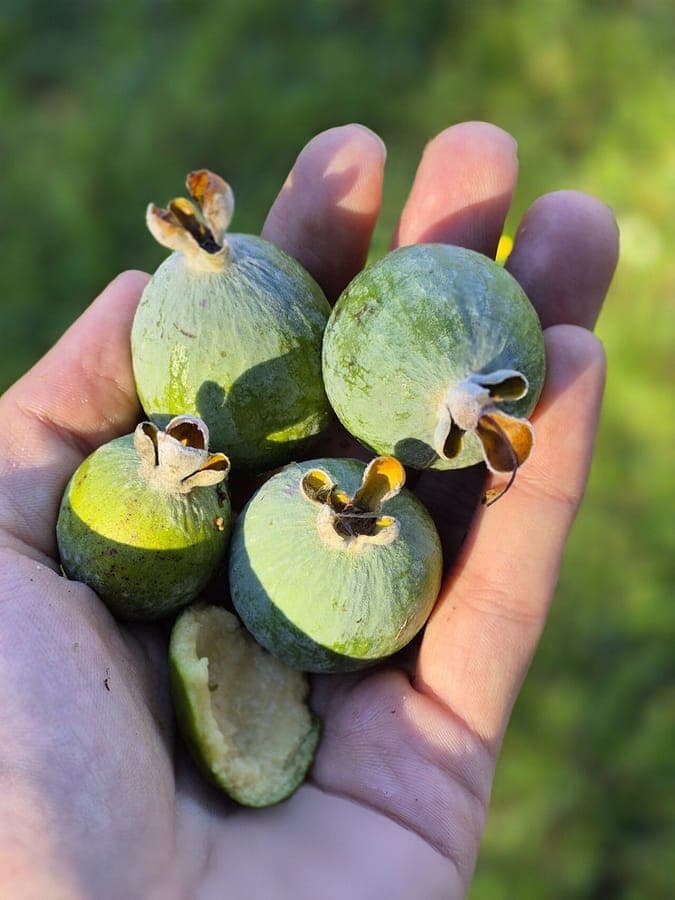
Gabriel Collares / CC BY 4.0, via Wikimedia Commons
Feijoa (Acca sellowiana): growing pineapple guava
Acca sellowiana
Want to see Feijoa (Acca sellowiana): growing pineapple guava in your garden?
Full design in HD: €7.99
Look after your Feijoa with the GardenWorld app
Identify plants with your camera and get a care calendar with reminders for this plant.


Overview
The feijoa or pineapple guava (Acca sellowiana) is an evergreen shrub from South America that brings an exotic note to the garden without having to be dragged indoors every winter. It has grey-green leaves with silver undersides, spectacular flowers with red stamens and edible petals and, after a kind autumn, green fruits whose flavour sits somewhere between pineapple, guava and mint. In north-west Europe it reaches 2 to 3 m tall and about as wide.
The plant comes from southern Brazil, Uruguay and north-eastern Argentina, where it grows in upland areas with cool winters. That makes it tougher than you might expect of an exotic. It is still often sold under its old name, Feijoa sellowiana, and belongs to the myrtle family (Myrtaceae), alongside myrtle and guava.
As an ornamental shrub the feijoa is always worth growing; as a fruit bush in our climate it is a gamble that pays off in warm years. On gardenworld.app you can have a garden design drawn up that gives a feijoa a sheltered spot, for instance against a sunny wall or as an evergreen hedge.
Appearance and bloom cycle
The feijoa grows as a dense, rounded shrub, or with some pruning as a small multi-stemmed tree. The leaves are oval, 3 to 7 cm long and leathery, matt grey-green above and felted silvery white beneath. In a breeze they give the same silvery shimmer you know from olive trees.
It flowers in June and July. The flowers are 3 to 4 cm across with four thick, fleshy petals, white on the outside and pink to purple inside. From the centre springs a tuft of dozens of long crimson stamens tipped with yellow anthers. The petals are edible and taste sweet, a little like marshmallow; in South America birds eat them and pollinate the flower as they do so.
The fruits are egg-shaped, 4 to 7 cm long, with a waxy green skin that stays green when ripe. The dried remains of the calyx sit on top, as you can see in the photograph at the top. The flesh is creamy white and slightly gritty, with a jelly-like centre holding tiny edible seeds.
Ideal location
Give the feijoa the warmest, sunniest spot in your garden, sheltered from cold north and east winds. A south- or west-facing wall is ideal, as it radiates warmth that helps both flowering and ripening. It grows in partial shade too, but flowers and fruits less.
The feijoa tolerates salty sea winds well, which makes it an excellent choice for coastal gardens, where the milder climate also means fruit ripens more often. In a large pot of at least 50 litres it can stand on the patio and spend hard winters in a cold greenhouse or unheated garage.
Soil requirements
Acca sellowiana wants well-drained, humus-rich soil that is slightly acidic to neutral, with a pH of 5.5 to 7. It tolerates a little lime, but on very chalky ground the leaves may yellow. Wet roots in winter are far more dangerous than cold: on heavy clay, plant on a slight mound or mix grit and compost into the soil.
Plant in April or May so the shrub has a whole summer to root in before its first winter. In spring give a little compost or an organic fertiliser for fruit bushes. Too much nitrogen gives plenty of leaves but few flowers.
Watering
Once established the feijoa is fairly drought-tolerant, but for good fruit set it needs adequate moisture from July to October. In dry spells give a thorough soak of 10 to 20 litres once a week. In the first year after planting, water weekly whenever it is dry. In a pot, check every couple of days in summer and let the top few centimetres dry out between waterings. In winter, potted plants need very little water.
Free preview
Want to see Feijoa (Acca sellowiana): growing pineapple guava in your garden? Make a free preview of your design.
Pollination
This is the key point if you want fruit. Many feijoas are poorly self-fertile or not at all. Varieties such as 'Apollo', 'Coolidge' and 'Unique' are sold as (partly) self-fertile, but even these crop better with a second variety nearby. Ideally, plant two different varieties or two seedlings.
Bees and bumblebees visit the flowers, but they produce little nectar and so attract fewer insects. Lend a hand yourself: on a dry, sunny day, use a soft paintbrush to take pollen from one shrub and dab it onto the stigmas of the other. Repeat this a few times during flowering.
Pruning
The feijoa needs little pruning. It flowers on the current season's growth, so prune ideally in March or early April, just before growth starts. Remove dead and crossing branches and shorten overlong shoots to keep the shrub compact. If you want a small tree, gradually remove the lowest branches.
As a hedge it can be clipped to shape, but every cut costs flowers and therefore fruit. An informal hedge that you tidy lightly after the harvest is the best compromise. Pests and diseases are rarely a problem in our gardens.
Harvesting
The fruits ripen five to six months after flowering, so in October and November. In British and north-west European gardens the crop is uncertain: in cool years the fruits stay small or are not ripe before the first frosts. On the coast and against a warm wall, success is more likely.
A ripe feijoa drops from the bush by itself. So you do not pick, you gather: lay some straw or a sheet under the shrub and collect fallen fruit daily. Fruits still hanging when light frost threatens can be picked and left indoors at room temperature for a few days to finish ripening. A ripe fruit gives slightly when pressed and smells strongly aromatic.
Cut the fruit in half and scoop out the flesh with a spoon, or use it in smoothies, chutney or jam. They keep for about a week in the fridge. The skin is edible but bitter.
Maintenance calendar
January-February: Dormant period. Protect young shrubs with fleece in hard frost.
March-April: Light pruning. Apply compost. Move potted plants back outdoors.
May: Planting time. Lay a mulch.
June-July: Flowering. Hand-pollinate with a brush. Water in dry spells.
August-September: Fruits swell. Water regularly.
October-November: Harvest; gather fallen fruit daily. Bring potted plants under cover in hard frost.
December: Mulch the root zone. The plant calendar on gardenworld.app shows the right timing for these jobs in your area.
Winter hardiness
A mature feijoa withstands temperatures down to about -12 °C, and older plants in a sheltered spot sometimes down to -15 °C. Young plants are more tender. Across much of southern Britain and the Low Countries it survives outdoors in a sheltered position, although severe winters can cause leaf damage or dieback. The shrub usually reshoots from older wood afterwards.
Protect young shrubs for their first winters with fleece and a mulch of leaves around the base. Move a potted plant into a cool, light space when temperatures fall below -5 °C. The feijoa is not poisonous to people, dogs or cats; both fruit and petals are edible.
Companion plants
The feijoa looks good with other southern evergreens that love sun and well-drained soil. Myrtle (Myrtus communis) is a close relative, and the olive (Olea europaea) shares its silvery character. Rosemary (Rosmarinus officinalis) and lavender (Lavandula angustifolia) fill the space at its feet with scent and flowers for bees.
For a mixed evergreen hedge by the sea, combine it with Pittosporum tenuifolium and Chilean myrtle (Luma apiculata). Together they form a windbreak with varied leaf colours and a long flowering season.
Final thoughts
Acca sellowiana is a graceful evergreen with remarkable flowers and, when the weather plays along, an autumn harvest with a flavour all of its own. Choose a warm, sheltered spot, plant two varieties for better pollination, and in cool years expect flowers rather than fruit. As an ornamental it never disappoints, and the feijoas themselves are a welcome bonus.
Pruning
Frequently asked questions about Feijoa
Is Feijoa winter hardy?
A mature feijoa withstands temperatures down to about -12 °C, and older plants in a sheltered spot sometimes down to -15 °C. Young plants are more tender.
When and how do you prune Feijoa?
The feijoa needs little pruning. It flowers on the current season's growth, so prune ideally in March or early April, just before growth starts.
How much water does Feijoa need?
Once established the feijoa is fairly drought-tolerant, but for good fruit set it needs adequate moisture from July to October. In dry spells give a thorough soak of 10 to 20 litres once a week.
Where does Feijoa grow best?
Give the feijoa the warmest, sunniest spot in your garden, sheltered from cold north and east winds. A south- or west-facing wall is ideal, as it radiates warmth that helps both flowering and ripening.
What soil does Feijoa need?
Acca sellowiana wants well-drained, humus-rich soil that is slightly acidic to neutral, with a pH of 5.5 to 7. It tolerates a little lime, but on very chalky ground the leaves may yellow.

See it in your garden
See Feijoa in your garden
One photo of your garden and a few questions. You see the result in about a minute.
Try it with a photoIdentify this plant in your own garden. Identify a plant
Similar plants
Myrtle: complete guide
Myrtus communis
Myrtle is a Mediterranean shrub with glossy leaves and white flowers. Ideal for sunny locations, grows 1-3 meters tall. Prefers dry to moderately moist soil with pH 6.0-8.0. Suitable for terrace containers in the Netherlands.
Olive tree: complete guide
Olea europaea
Everything about the olive tree (Olea europaea): planting, care, overwintering and cultivar selection. Practical tips for bringing Mediterranean character to your garden.
Luma apiculata: complete guide
Luma apiculata
Chilean myrtle is an elegant shrub with refined leaves and decorative bark. Ideal for sheltered garden spots in mild climates.
