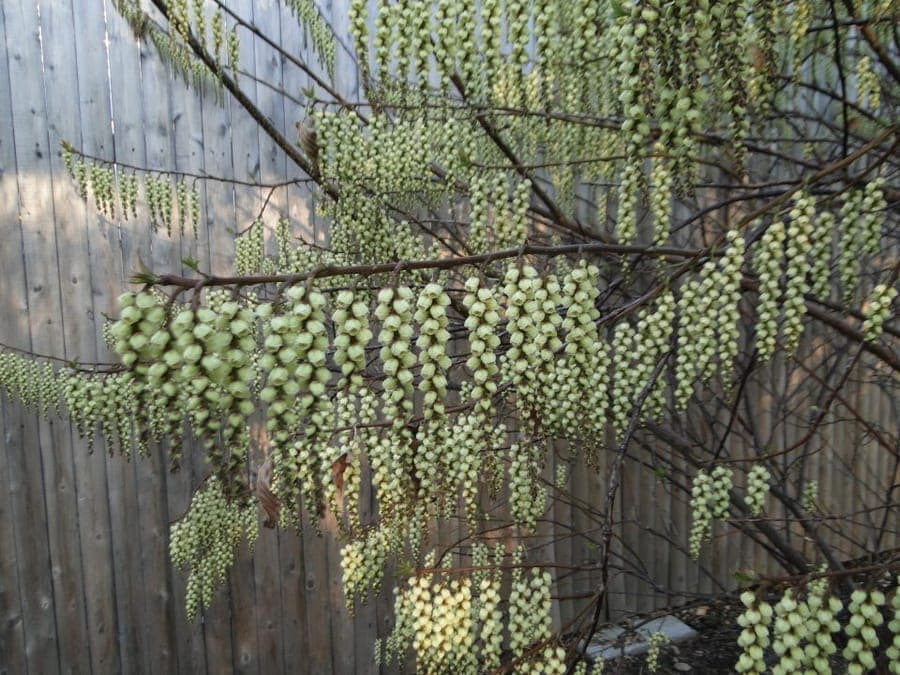
Lotos leo / CC BY-SA 3.0, via Wikimedia Commons
Early stachyurus (Stachyurus praecox): complete guide
Stachyurus praecox
Want to see Early stachyurus (Stachyurus praecox): complete guide in your garden?
Full design in HD: €7.99
Look after your Early stachyurus with the GardenWorld app
Identify plants with your camera and get a care calendar with reminders for this plant.


Overview
Walk round the garden in February and there is not much in flower. Early stachyurus (Stachyurus praecox) is one of the shrubs that changes that. Its bare, arching branches are hung with hundreds of short, stiff tassels of pale yellow bells, like strings of beads or tiny necklaces. Gardeners usually just call it stachyurus, and the German name, Japanese pearl-tail, captures the look rather nicely.
The species comes from Japan, where it grows in open woodland and along forest edges on moist, humus-rich soil. It belongs to the small family Stachyuraceae. In gardens it makes a deciduous shrub of 1.5 to 3 m high and about as wide, with an open, arching habit. Growth is moderate, and young plants begin flowering well within a few years.
This is not a showy plant. It is a quiet surprise for late winter, a shrub best planted where you can see it from a window or beside a path you use even in February. In summer it becomes a calm green shrub that blends easily with other shade-tolerant plants.
Appearance and bloom cycle
What is most striking is how the flowers develop. As early as autumn, before the leaves fall, stiff, hanging racemes of small green buds appear along the twigs. They remain visible all winter. Depending on the weather, they open between mid-February and late March. Each raceme is 5 to 10 cm long and carries dozens of bell-shaped flowers about 8 mm across, pale yellow to greenish yellow. The photograph shows a shrub in full flower, its bare branches almost entirely draped with pale tassels.
Flowers appear before the leaves, so the framework of branches remains on show. The twigs are glossy reddish brown to purplish brown, which contrasts beautifully with the pale flowers in winter. Leaves unfold in April and are ovate to lance-shaped, 8 to 15 cm long, with a long tapering tip and a toothed margin. In autumn they sometimes turn yellow or reddish, though not reliably every year.
After flowering, small greenish-yellow berries about 1 cm across form, but they are inconspicuous. The plant is not a major bee magnet, though bumblebees and early bees visit the flowers on mild February days. Little is known about toxicity to people or animals; it is not listed as poisonous, but it is sensible not to eat any part of it and to keep pets away from the berries.
Ideal location
Stachyurus praecox does best in partial shade. Morning sun with afternoon shade is ideal. In full sun the leaves can scorch during dry summers unless the soil stays reliably moist. It will grow in deeper shade but flowers less freely there.
Shelter from cold easterly and northerly winds is important. Because flowering is so early, a hard night frost of around -6 °C or colder can turn open flowers brown. The shrub itself is unharmed, but that year's display is over too soon. A position in the lee of a wall, hedge or larger shrubs reduces the risk. Plant it where you will actually see it: by the front door, next to the terrace, or within view of the kitchen window.
Allow for its spread. A mature shrub takes up 2 to 3 m, so plant at least 1.5 m from paths and walls.
Soil requirements
The plant likes humus-rich, moisture-retentive and well-drained soil. Slightly acidic to neutral ground is ideal, with a pH of roughly 5.5 to 7. On very chalky soil the leaves may turn yellow, so work in plenty of leaf mould or ericaceous compost there. Improve sandy soil with compost and leaf mould, and heavy clay with compost and some grit so that water does not stand.
When planting, dig a hole twice the width of the root ball and mix the excavated soil with about a third compost. A mulch of leaf mould or chipped bark keeps the soil cool and moist and tops up the organic matter every year. In spring, a handful of organic fertiliser or well-rotted compost around the base is all it needs.
Free preview
Want to see Early stachyurus (Stachyurus praecox): complete guide in your garden? Make a free preview of your design.
Watering
In the first year after planting, give 10 litres a week during dry spells. After that, an established plant usually copes well through a normal summer, provided the soil is rich in humus. During longer droughts, especially in July and August, give a thorough soaking once a week. Drooping leaves or brown leaf edges indicate a lack of water.
One thing to remember: next year's flower buds form in late summer. A dry August or September often means sparse flowering in February, so keep the soil lightly moist during that period. There is no need to water in winter.
Pruning
Stachyurus praecox needs little pruning and looks best with its natural, arching shape. Always prune straight after flowering, in March or April. Prune in autumn or winter and you will cut off the racemes carrying the flower buds.
On older shrubs, carry out renewal pruning every two or three years: saw out one or two of the oldest, least floriferous stems close to the ground. This keeps the shrub open and encourages vigorous young shoots that flower most freely. Also remove any dead or damaged wood. Avoid clipping it into a ball, which robs the plant of its grace.
Maintenance calendar
January: The bud tassels are ready and waiting. Enjoy the first hints of colour in mild weather.
February–March: Full flowering. If hard night frost is forecast during flowering, drape young plants with fleece overnight.
March–April: Prune straight after flowering. Spread compost or organic fertiliser around the base and renew the mulch.
April–May: The leaves unfold. An ideal time to plant new shrubs.
June–August: Water during long dry spells, especially in August when the new buds are forming.
September–October: The new racemes become visible along the twigs. You can still plant in October while the soil is warm.
November–December: Leaf fall. Leave the fallen leaves beneath the shrub as a natural mulch.
The plant calendar on gardenworld.app helps you keep track of these moments and shows each month what needs doing in your garden.
Winter hardiness
Stachyurus praecox is reliably hardy across most of the UK and north-west Europe. Established plants tolerate frost down to about -15 °C without lasting damage, and even in harder winters the shrub usually regrows, although the tips of the shoots may be killed. German horticultural sources list it, together with Stachyurus chinensis, as one of the species that are hardy in central Europe.
The weak point is not the shrub but its early flowering. Open flowers tolerate light frost, but they turn brown in a hard night frost in February or March. That is why a sheltered position works best. Give young plants a layer of leaf mould over the roots in their first winter. In containers the plant is more vulnerable, so stand pots against the house wall in winter and wrap them in hessian or bubble wrap.
Companion plants
Stachyurus praecox looks its best alongside other plants that offer something in late winter. Chinese witch hazel (Hamamelis mollis) flowers at the same time with fragrant, spidery yellow blooms and makes a superb partner. At its feet, snowdrops (Galanthus nivalis), Cyclamen coum and early crocuses (Crocus tommasinianus) form a carpet beneath the hanging tassels.
Lenten roses (Helleborus orientalis) share its liking for partial shade and humus-rich soil and flower at the same time. For winter colour, red-barked dogwood (Cornus alba) provides bright red stems that stand out against the pale yellow flowers. In summer, ferns and hostas work well beneath and beside the shrub.
Final thoughts
Stachyurus praecox is a shrub for anyone who wants to enjoy the garden in February as well. It is hardy, needs little pruning and suits any garden with some partial shade and humus-rich soil. Its strings of pale beads on bare branches are a sight few other plants can offer.
Would you like to give it a place in a winter garden with witch hazel, hellebores and bulbs? On gardenworld.app you can have a garden design created that works out combinations like these for your own plot, taking account of soil, light and the views from the house. That way, late winter becomes a season to look forward to.
Frequently asked questions about Early stachyurus
Is Early stachyurus winter hardy?
Stachyurus praecox is reliably hardy across most of the UK and north-west Europe. Established plants tolerate frost down to about -15 °C without lasting damage, and even in harder winters the shrub usually regrows, although the tips of the shoots may be killed.
When and how do you prune Early stachyurus?
Stachyurus praecox needs little pruning and looks best with its natural, arching shape. Always prune straight after flowering, in March or April.
How much water does Early stachyurus need?
In the first year after planting, give 10 litres a week during dry spells. After that, an established plant usually copes well through a normal summer, provided the soil is rich in humus.
Where does Early stachyurus grow best?
Stachyurus praecox does best in partial shade. Morning sun with afternoon shade is ideal.
What soil does Early stachyurus need?
The plant likes humus-rich, moisture-retentive and well-drained soil. Slightly acidic to neutral ground is ideal, with a pH of roughly 5.5 to 7.

See it in your garden
See Early stachyurus in your garden
One photo of your garden and a few questions. You see the result in about a minute.
Try it with a photoIdentify this plant in your own garden. Identify a plant
Similar plants
Chinese Witch Hazel: complete guide
Hamamelis mollis
Chinese witch hazel blooms in January-February with fragrant yellow flowers even in deep winter. Master care, site selection, and pruning to enjoy 30+ years of winter color.
Lenten-rose: complete guide
Helleborus orientalis
Learn how to grow and care for Helleborus orientalis. This early-blooming perennial thrives in shady spots and flowers from February to April, adding colour when little else is blooming.
Common snowdrop: complete guide
Galanthus nivalis
Common snowdrop growing guide. The world's most familiar snowdrop with delicate white pendant flowers.
