
Wikimedia Commons / CC BY-SA 3.0, via Wikimedia Commons
Common snowdrop: complete guide
Galanthus nivalis
Want to see Common snowdrop: complete guide in your garden?
1 minute, no credit card
Overview
The common snowdrop (Galanthus nivalis) is the world's most beloved snowdrop. Native to Europe (from the Pyrenees to Ukraine), it thrives in beech and spruce forests, naturalizing freely.
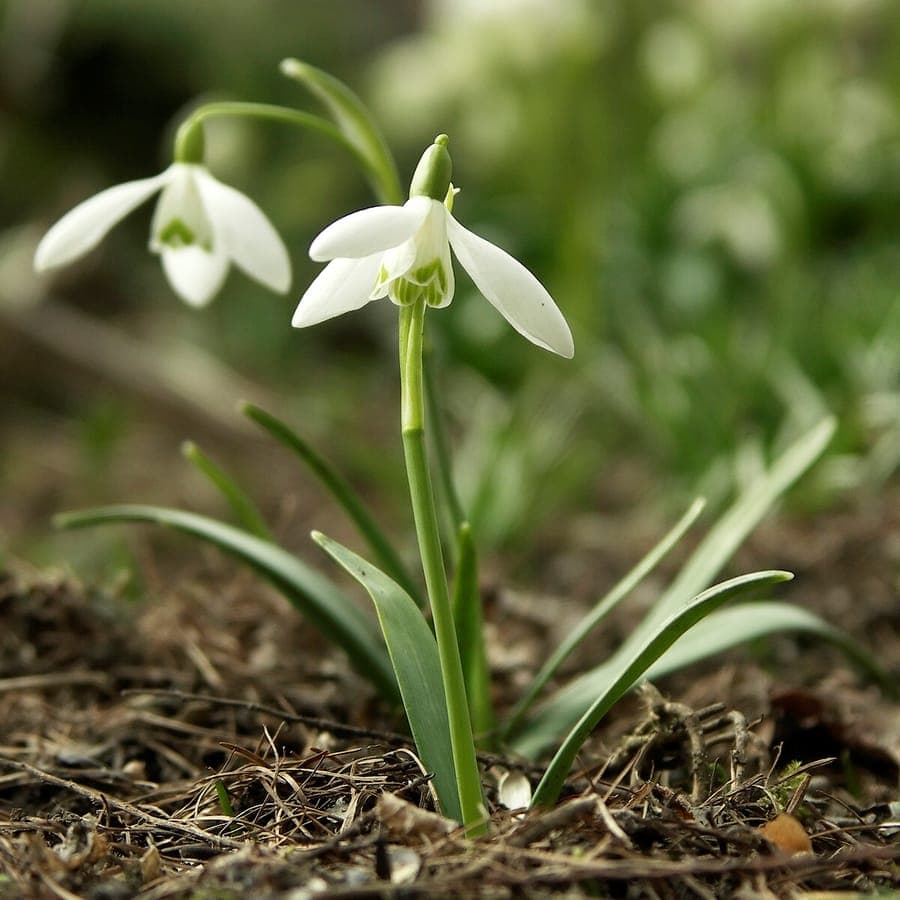
It symbolizes hope and renewal: white flowers appear January-February, often still beneath snow. The blooms are modest but abundant - hanging bells with a small green heart-shaped mark. Growth is compact (15-20 cm) and colonies form quickly into dense drifts.
Classic, reliable, and essential for anyone who can't imagine a winter garden without snowdrops.
Appearance & bloom cycle
Common snowdrop forms compact clumps of slender, gray-green leaves, about 15-20 cm. Foliage is narrower and more delicate than giant snowdrop, with a waxy coating.
From January through March, flowers emerge: pendant, up to 2 cm, pure white with two small green flecks on each segment. Each bulb typically produces one flower. Scent is light and pleasant, especially on mild days. Bloom is often interrupted by frost, but plants weather this without concern.
Ideal location
Snowdrops prefer partial shade beneath deciduous trees - protection from intense afternoon sun. Beneath oaks, birches, maples, or mixed woodland is ideal.
Where soil dries in summer, full sun is tolerated, but partial shade extends bloom and vigour.
Soil requirements
Excellent drainage is essential. Snowdrops despise waterlogging. Plant on raised sites or in soil heavily amended with sand and humus.
Soil pH 6.5-7.5 is optimal. In heavy clay: incorporate sand before planting.
Free design
Want to see Common snowdrop: complete guide in your garden? Make a free design now.
Watering
Snowdrops are drought-tolerant once established. Natural winter and spring moisture suffices. Supplemental water is rarely needed.
Ensure good drainage; winter-wet roots are fatal. In drying soils post-bloom: sparse watering only if bone-dry.
Pruning
No pruning needed. Leave foliage undisturbed until it naturally fades - it recharges the bulb. Remove only dead material.
If you want self-sown colonies, leave seed heads. Snowdrops naturalize readily.
Maintenance calendar
September-October: Plant bulbs (sooner is better)
November-December: Minimal care, check drainage
January-March: Bloom period; snow can be gently cleared
March-April: Foliage continues; bloom fades
May: Foliage disappears, remove dried material
June-September: Above-ground rest; underground development
Winter hardiness
Common snowdrop is extremely hardy, USDA zones 3-8. It grows in mountains with temperatures to -25 °C with ease. No protection needed in Benelux, France, or Germany.
Companion plants
Pair with:
- Other Galanthus species: G. elwesii for larger flowers, G. plicatus for later bloom
- Scilla sibirica (Siberian squill) for blue
- Crocus vernus for purple and yellow
- Eranthis hyemalis (Winter aconite) for gold
- Helleborus (Christmas rose) for green and cream tones
Conclusion
The common snowdrop is the classic early flower - indispensable and dependable. Plant them in sweeps for dramatic impact in late winter.
Design your garden at gardenworld.app and add snowdrops to borders beneath trees. Discover more plant ideas at gardenworld.app.
Want to see Common snowdrop: complete guide in your garden? Make a free design now.
Upload a photo, pick a style, and get a photorealistic design with plant list in under a minute.
No credit card required


Similar plants
Douglas' Onion: complete guide
Allium douglasii
Douglas' onion is a compact ornamental allium with purple flowers, perfect for rock gardens and sunny borders. Learn care, siting and hardiness.
Oblique onion: complete guide
Allium obliquum
The oblique onion is a hardy ornamental allium with chartreuse flower heads and blue-green foliage. Location, soil and care explained.
False hooded garlic: complete guide
Allium pseudocalyptratum
Discover false hooded garlic (Allium pseudocalyptratum): a rare ornamental onion from Lebanon for rock gardens and alpine troughs.