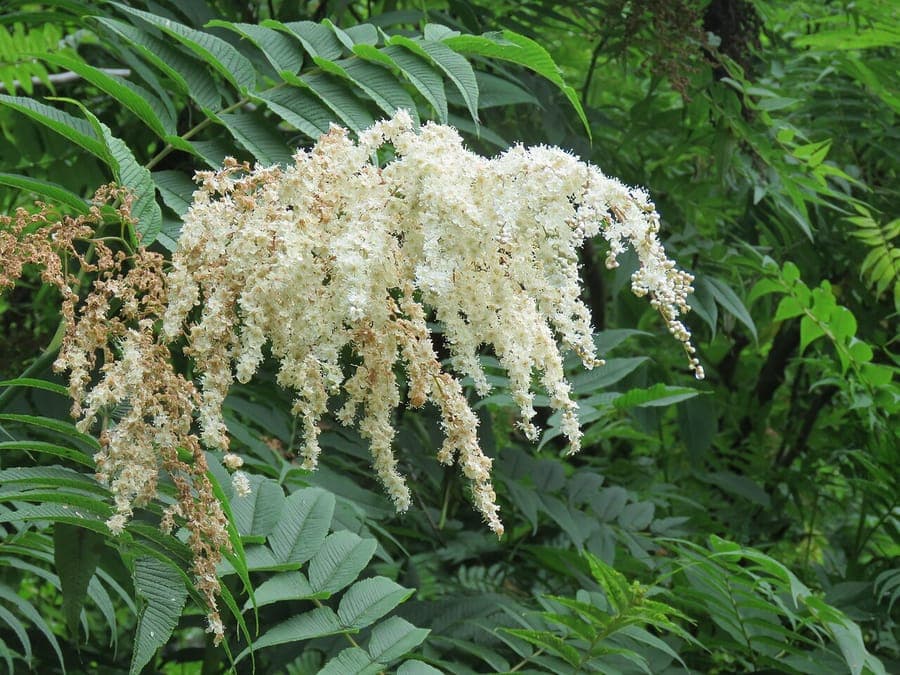
Vinayaraj / CC BY-SA 4.0, via Wikimedia Commons
Himalayan sorbaria: complete guide
Sorbaria tomentosa
Want to see Himalayan sorbaria: complete guide in your garden?
Full design in HD: €7.99
Look after your Himalayan sorbaria with the GardenWorld app
Identify plants with your camera and get a care calendar with reminders for this plant.


Overview
Himalayan sorbaria (Sorbaria tomentosa), also called Kashmir false spiraea, is an elegant ornamental shrub native to the Himalayan region. This member of the Rosaceae family reaches 3-6 feet in height and width. The plant produces stunning white, feathery flower panicles in summer that transform the garden landscape.
While not as commonly cultivated as some relatives, this shrub is invaluable for gardens seeking height, texture, and subtle elegance.
Appearance and Bloom
Himalayan sorbaria is an upright shrub with finely compound leaves resembling fern foliage. These leaves consist of numerous small leaflets arranged along a central stem. The foliage turns warm yellow in autumn.
Flowers appear in June to July in long, feathery panicles. These panicles consist of countless tiny, star-shaped white flowers packed closely together. A mature plant can display ten or more flower panicles simultaneously.
Ideal Location
Himalayan sorbaria thrives in partial to deep shade. The plant tolerates full sun but appreciates protection from afternoon sun in hot climates. In cooler regions, full sun is acceptable.
Use this shrub in shade gardens where many plants struggle. Plant along woodland edges, beneath large trees, or in northeast-facing locations. It works well in mixed borders, providing structure and height.
Soil
Himalayan sorbaria prefers consistently moist to moderately wet soils. It dislikes dry conditions. Acidic to neutral soil is preferred (pH 5.5-6.5).
Amend soil generously with organic matter at planting for moisture retention and nutrients. Apply mulch annually around the plant.
Free preview
Want to see Himalayan sorbaria: complete guide in your garden? Make a free preview of your design.
Watering
Regular watering is essential, especially during the growing season and dry periods. The soil should never completely dry out. Deep watering several times weekly is better than shallow daily sprinkling.
In drier climates, consistent moisture may be required for half the growing season. Once established, the plant tolerates some dryness but performs better with consistent moisture.
Pruning
Himalayan sorbaria grows naturally in an attractive form requiring minimal pruning. Remove dead or damaged branches in spring. You may remove crowded twigs to maintain neater shape.
Pruning after blooming in October can keep the plant more compact, though not essential. Avoid heavy pruning during the growing season.
Maintenance Calendar
Spring: Add mulch, prune dead wood. Summer: Water regularly, enjoy flowers. Fall: Observe autumn foliage color. Winter: Minimal activity.
Winter Hardiness
Himalayan sorbaria is hardy to USDA zone 5 (-20 to -30 degrees Fahrenheit). In colder areas, winter protection may be helpful. The plant can freeze back to ground level and resprout in spring.
Companion Plants
Pair Himalayan sorbaria with other shade-tolerant plants. Hostas and other foliage plants contrast beautifully with feathery flowers. Blue astilbes, red rodgersia, and white bridal-wreath create harmonious combinations.
Blue forget-me-nots and hellebores provide early color before sorbaria blooms.
Conclusion
Himalayan sorbaria is a valuable plant for creating graceful shade gardens. With proper care, it remains a shrub of beauty for many years. Find plants at specialty nurseries and large garden centers.
Ideal for gardenworld.app users seeking to transform shaded areas with style and elegance.
Frequently asked questions about Himalayan sorbaria
Is Himalayan sorbaria winter hardy?
Himalayan sorbaria is hardy to USDA zone 5 (-20 to -30 degrees Fahrenheit). In colder areas, winter protection may be helpful.
When and how do you prune Himalayan sorbaria?
Himalayan sorbaria grows naturally in an attractive form requiring minimal pruning. Remove dead or damaged branches in spring.
How much water does Himalayan sorbaria need?
Regular watering is essential, especially during the growing season and dry periods. The soil should never completely dry out.
Where does Himalayan sorbaria grow best?
Himalayan sorbaria thrives in partial to deep shade. The plant tolerates full sun but appreciates protection from afternoon sun in hot climates.
What soil does Himalayan sorbaria need?
Himalayan sorbaria prefers consistently moist to moderately wet soils. It dislikes dry conditions.

See it in your garden
See Himalayan sorbaria in your garden
One photo of your garden and a few questions. You see the result in about a minute.
Try it with a photoIdentify this plant in your own garden. Identify a plant
Similar plants
New Zealand bur (Acaena microphylla): care guide
Acaena microphylla
Acaena microphylla forms a low, bronze-green carpet with red spiny burs in summer. Advice on position, soil, trimming, hardiness and keeping its spread in check.
Apple serviceberry: complete guide
Amelanchier × grandiflora
Everything about apple serviceberry (Amelanchier × grandiflora): white April flowers, edible berries, autumn colour, position, pruning and cultivars such as 'Ballerina'.
Dwarf goat's beard (Aruncus aethusifolius): complete guide
Aruncus aethusifolius
Everything about dwarf goat's beard (Aruncus aethusifolius): position, soil, watering, pruning and hardiness. A compact perennial with lacy leaves for shade and rock gardens.
