Salicyna / CC BY-SA 4.0, via Wikimedia Commons
New Zealand bur (Acaena microphylla): care guide
Acaena microphylla
Want to see New Zealand bur (Acaena microphylla): care guide in your garden?
Full design in HD: €7.99
Look after your New Zealand bur with the GardenWorld app
Identify plants with your camera and get a care calendar with reminders for this plant.


Overview
Acaena microphylla is a low, mat-forming perennial from New Zealand, known in English as New Zealand bur. In its homeland, where it grows wild on both the North and South Islands, the genus goes by the names bidibid or piripiri, after the spiny little fruits that hitch a ride on clothes and fur. It belongs to the rose family (Rosaceae), though you would hardly guess it from the fine, pinnate leaves and round flower heads.
The plant grows only 3 to 5 cm tall, but spreads by creeping, rooting stems into a dense carpet 50 cm or more across. The leaves are bronze-green to coppery, and in summer small globes appear that develop into striking red, spiny seed heads. That makes it popular in rock gardens, gravel gardens, between paving slabs and on low walls. The best-known cultivar is 'Kupferteppich' (copper carpet), with distinctly copper-brown foliage.
On gardenworld.app you can create a garden design that puts a ground cover like this exactly where it works best, for example as a green seam between stepping stones or along the edge of a gravel bed.
One caveat belongs here. New Zealand burs can spread considerably, and their spiny fruits are carried off by animals and walkers. Related Acaena species have naturalised in Britain and Ireland, and in Northern Ireland every species of Acaena is listed as an invasive non-native plant: it is an offence to plant them, or cause them to grow, in the wild there. Never plant it in or next to natural habitat, and keep its spread in the garden under control.
Appearance and bloom cycle
The leaves are pinnate, made up of a row of small, oval, toothed leaflets only a few millimetres long. Their colour ranges from grey-green and bronze-green to copper-brown, depending on the cultivar, the amount of sun and the season. Most foliage stays on through winter, although it can turn browner in hard frost.
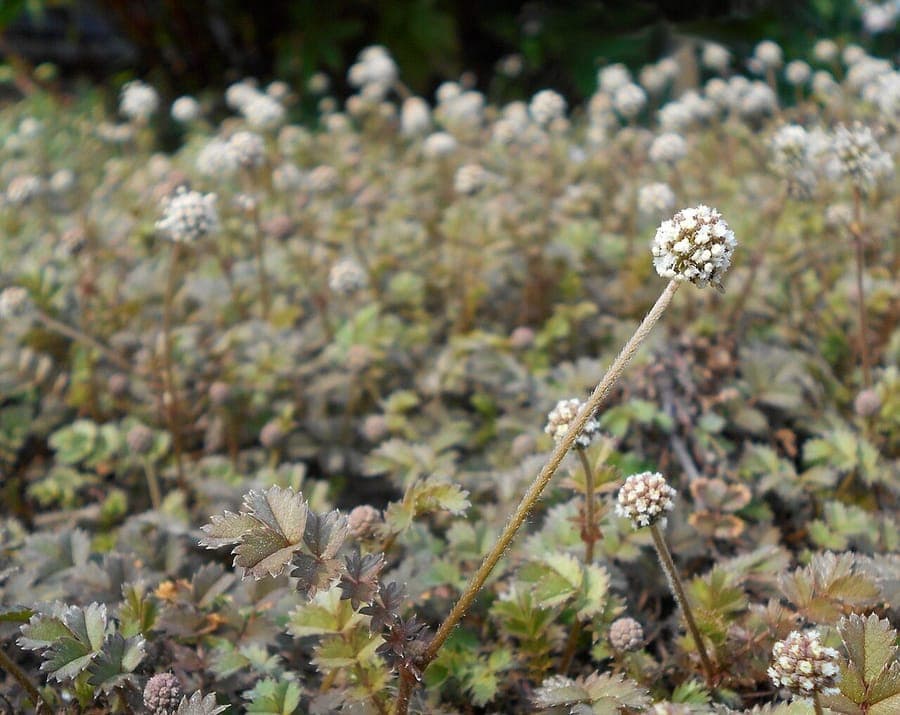
In June and July, small spherical flower heads about 1 cm across appear on thin, upright stalks. The individual flowers are tiny and inconspicuous, with white to cream stamens that give the globes a fluffy look. That stage is what you see in the photo: whitish globes above a carpet of bronze-green leaves. The heads then develop into seed heads armed with long red spines tipped with tiny barbs. From July into September these red burs are the plant's main ornamental feature. They cling readily to socks, trouser legs and the coats of dogs and cats.
Ideal location
Acaena microphylla does best in full sun to light shade. In sun the carpet stays dense and both leaves and burs colour up well. In too much shade it becomes sparse and the red of the spines stays weak.
It is ideal for rock gardens, gravel gardens, dry-stone walls, gaps between paving and the front of a border. It tolerates light foot traffic, so it is fine between stepping stones, but it is less suited as a lawn substitute on a busy path. Remember too that the spiny fruits catch on clothing in summer. If you have a long-haired dog or children who play barefoot, avoid planting it along the paths they use every day.
Soil requirements
New Zealand bur needs free-draining soil. Sand, gravel and stony loam are ideal. On heavy clay that stays wet in winter, the plant rots easily. In that case, work coarse grit into the top layer, or plant in a raised bed or rockery.
Poor to moderately fertile soil is better than rich ground. On rich soil it grows loose and lanky and flowers less. Feeding is unnecessary. pH is not critical, and slightly acidic to slightly alkaline conditions are all fine. A mulch of gravel keeps the crown dry and helps prevent rot.
Free preview
Want to see New Zealand bur (Acaena microphylla): care guide in your garden? Make a free preview of your design.
Watering
An established plant copes well with drought. In the first year after planting, water regularly in dry weather so the creeping stems can root properly. After that, water only during long, hot dry spells, and then soak the ground rather than giving a little every day.
Too much water is a bigger risk than too little, especially in winter. If the plant is in a pot or trough, let the compost dry out between waterings and make sure the drainage hole is generous.
Pruning
Proper pruning is not needed, but you do need to keep it in check. In spring and summer, cut or pull out any runners that stray beyond their space. Because the stems root as they go, these pieces are easy to replant elsewhere. The RHS recommends exactly this, pulling out rooted stems to restrict its spread.
If you do not want the spiny fruits, cut the flower stalks off as soon as the globes have finished flowering. That also prevents the seed from spreading. In spring, clip away any brown or frosted foliage; the carpet recovers quickly. After a few years the centre of the mat may become bare, so rejuvenate it by lifting pieces and replanting them.
Maintenance calendar
March and April: Trim away frosted or brown foliage. Plant new specimens or lift pieces to propagate.
May: The plant is in full growth. Weed between young mats so they close up quickly.
June and July: Flowering, with whitish globes. Remove the flower stalks if you do not want spiny fruits.
August and September: Red seed heads. Keep runners within bounds and water in long droughts.
October and November: Do not let fallen leaves from trees lie on the mat; it rots quickly underneath.
December to February: Dormant period. Little to do, apart from avoiding standing water around the plant.
The plant calendar on gardenworld.app sets out these jobs month by month for you.
Winter hardiness
Acaena microphylla is fully hardy in most of Britain. The RHS rates the species H5, which corresponds to frost down to about -15 to -10 °C. The cultivar 'Kupferteppich' is rated a little more cautiously at H4.
The main danger in winter is not cold but wet. In free-draining soil, perhaps with a gravel mulch, the plant reappears every spring looking good. In hard frost without snow cover the leaves may turn brown, but it usually regrows from the roots.
No reports of toxicity are known. The real nuisance is the spiny fruits, which can tangle in pets' coats. Comb your dog through if it has brushed past a plant in fruit.
Companion plants
In a rock garden or gravel garden, New Zealand bur sits nicely beside other low, drought-loving plants. Creeping thyme (Thymus praecox) adds pink flowers in summer, biting stonecrop (Sedum acre) a splash of yellow, and houseleeks (Sempervivum calcareum) provide sturdy rosettes among the fine foliage. Blue fescue (Festuca glauca) adds height and a cool blue-grey tone that sets off the coppery leaves.
Leptinella squalida, another New Zealander, forms a similar low, fern-like carpet and pairs well with Acaena microphylla in a New Zealand corner. For contrast, combine a green mat-former with the coppery 'Kupferteppich'. Avoid planting fast-spreading ground covers right next to it, as they will crowd each other out.
Final thoughts
Acaena microphylla is a neat, copper-toned ground cover for sunny, dry spots. It fills gaps, walls and rockeries with a fine carpet, and in summer its red spiny burs add a surprising accent. It asks little: free-draining soil, sun and an occasional trim to keep it within bounds. Do keep its downside in mind: the fruits catch in fur and clothing, and related species have escaped in parts of Britain and Ireland. Plant it only in the garden, well away from natural habitat.
Frequently asked questions about New Zealand bur
Is New Zealand bur winter hardy?
Acaena microphylla is fully hardy in most of Britain. The RHS rates the species H5, which corresponds to frost down to about -15 to -10 °C.
When and how do you prune New Zealand bur?
Proper pruning is not needed, but you do need to keep it in check. In spring and summer, cut or pull out any runners that stray beyond their space.
How much water does New Zealand bur need?
An established plant copes well with drought. In the first year after planting, water regularly in dry weather so the creeping stems can root properly.
Where does New Zealand bur grow best?
Acaena microphylla does best in full sun to light shade. In sun the carpet stays dense and both leaves and burs colour up well.
What soil does New Zealand bur need?
New Zealand bur needs free-draining soil. Sand, gravel and stony loam are ideal.

See it in your garden
See New Zealand bur in your garden
One photo of your garden and a few questions. You see the result in about a minute.
Try it with a photoIdentify this plant in your own garden. Identify a plant
Similar plants
Mother of thyme: complete guide
Thymus praecox
Mother of thyme (Thymus praecox) is a low-growing, drought-tolerant ground cover perfect for sunny gardens. Ideal between stepping stones or as a fragrant lawn alternative.
Biting stonecrop: complete guide
Sedum acre
Biting stonecrop (Sedum acre) is an ultra-low-maintenance succulent with bright yellow flowers. Ideal for roofs, crevices, and sun-baked borders in any garden.
Limestone Houseleek: complete guide
Sempervivum calcareum
Discover the Limestone Houseleek (Sempervivum calcareum), a hardy succulent for dry gardens. With red-tipped leaves, this Alpine treasure is perfect for sunny, drought-tolerant landscapes.
