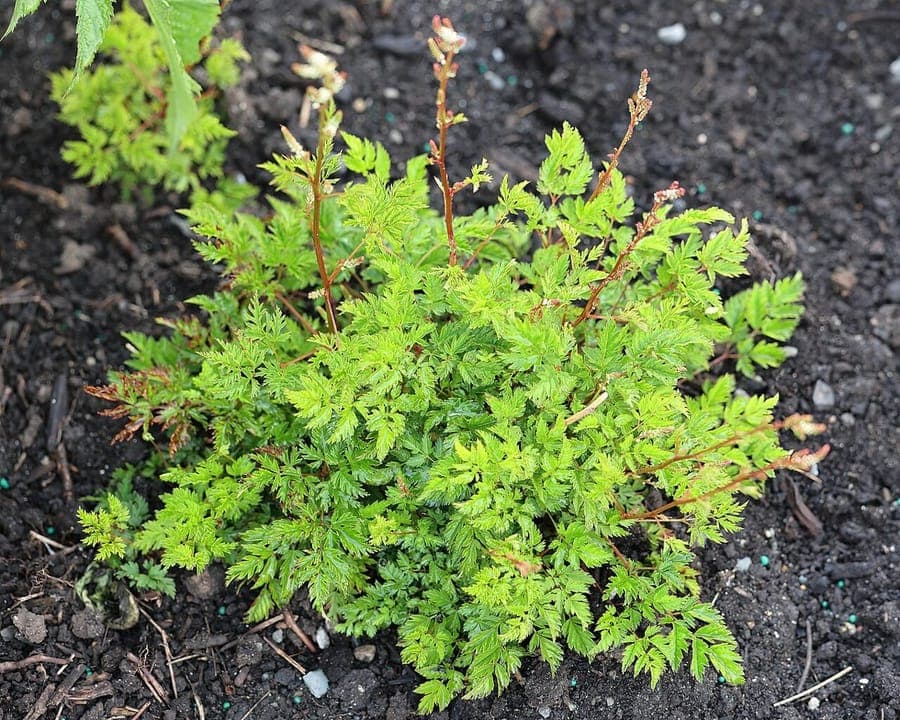
Cephas / CC BY-SA 4.0, via Wikimedia Commons
Dwarf goat's beard (Aruncus aethusifolius): complete guide
Aruncus aethusifolius
Want to see Dwarf goat's beard (Aruncus aethusifolius): complete guide in your garden?
Full design in HD: €7.99
Look after your Dwarf goat's beard with the GardenWorld app
Identify plants with your camera and get a care calendar with reminders for this plant.


Overview
The common goat's beard is a giant of nearly two metres, but its little cousin fits into any shady corner. Dwarf goat's beard, botanically Aruncus aethusifolius, barely reaches 30 cm and forms a dense mound of fine, lacy foliage topped in early summer by small plumes of creamy white flowers. It is an undemanding perennial that comes back reliably every year.
Aruncus aethusifolius belongs to the rose family (Rosaceae) and comes from Korea, where it grows on shaded mountain slopes and rocky spots in upland woods. That is why it is also known as Korean goat's beard. Its origins tell you straight away what it wants in the garden: a cool root run, some shade and soil that does not dry out.
It is a versatile plant. It works well at the front of a shady border, along a path, between stones in a shaded rock garden and even in a generous container. If you would like to see how it fits in your own garden among ferns, hostas and other shade lovers, you can have a garden design made on gardenworld.app that takes account of the light in your plot.
Appearance and bloom cycle
The foliage is attractive all season. Each leaf is two or three times divided and finely cut, giving the plant an airy, almost fern-like look. The species name aethusifolius refers to its resemblance to the leaves of fool's parsley (Aethusa). In spring the leaves emerge bright green, often with a reddish tinge on the young stems. In summer they are fresh green and glossy, and in autumn they turn yellow, orange or russet, depending on the position.
Flowering runs through June and July. Branched plumes of hundreds of tiny creamy white flowers appear on thin, reddish stems. In flower the plant reaches about 25 to 40 cm tall and 30 to 40 cm across. After flowering the plumes turn rusty brown. You can leave them in place, as they stay decorative well into autumn. The flowers attract small bees, hoverflies and other insects.
Ideal location
Dwarf goat's beard is happiest in partial shade. Morning sun with afternoon shade is perfect. It still flowers well in the dappled light beneath tall trees. In deep shade the foliage stays handsome, but you will get fewer flowers.
Full sun is possible, provided the soil never dries out. In a dry, sunny spot the fine leaves scorch in summer and go brown at the edges. Also avoid places where wind blows dry air through the border.
Space plants 30 to 35 cm apart if you want a small group or low ground cover. It spreads slowly but is never invasive.
Soil requirements
Aruncus aethusifolius likes a humus-rich soil that holds moisture yet drains well. A loose woodland soil with plenty of leaf mould is ideal. On sandy soil, dig a generous amount of garden compost or leaf mould into the top 20 cm before planting so the ground holds more moisture. On heavy clay, mix in compost and some grit so that water does not sit around the roots in winter.
The pH can be slightly acidic to neutral, roughly between 5.5 and 7. A 3 to 5 cm mulch of leaf mould or fine bark keeps the roots cool and moist and tops up the humus each year. Extra feeding is rarely needed; a handful of compost in spring is enough.
Watering
In the first year after planting, water weekly in dry weather so the roots establish well. After that the plant is fairly self-sufficient in a shady spot with plenty of humus. Even so, it likes evenly moist soil, so during long dry spells in summer a generous soak of around 5 litres per plant every few days is welcome.
Brown leaf edges or drooping foliage are the first signs of thirst. Plants in containers dry out faster and need checking almost daily in summer. Water in the morning where possible and aim at the base of the plant.
Free preview
Want to see Dwarf goat's beard (Aruncus aethusifolius): complete guide in your garden? Make a free preview of your design.
Pruning
There is little pruning to do. You can remove the spent plumes after flowering if you prefer a neat look, but the rusty seed heads are lovely in late summer, so feel free to leave them until autumn.
In late autumn or early spring, cut the dead foliage and old stems down to just above the ground. Do this before the end of March at the latest, before the new shoots appear. If you want to give insects somewhere to overwinter, leave the old foliage until February.
Division is rarely needed because the plant stays compact. To propagate, divide in early spring or in September. The rootstock is fairly tough, so use a sharp spade or knife to cut off pieces with several buds each and replant them straight away.
Maintenance calendar
February–March: Cut back old leaves and stems. Scatter a handful of compost around the plant and renew the mulch.
April–May: New leaves unfurl. Divide or move plants if needed. Keep an eye out for slugs on young shoots.
June–July: Flowering time. Water during dry spells, especially in sunnier positions.
August–September: The plumes turn rusty brown. Leave them or cut them off. Plant new specimens from September.
October–November: Enjoy the autumn colour of the foliage. Otherwise leave the plant alone.
December–January: Dormancy. The plant retreats underground and needs no protection.
Winter hardiness
Dwarf goat's beard is extremely hardy. It tolerates frost down to about -30 °C (USDA zone 4) and never needs winter protection in Britain or the Low Countries. The top growth dies back in autumn; the rootstock overwinters safely underground and resprouts in April.
It usually overwinters well in containers too, as long as the pot is frost-proof and not standing in water. In severe winters, move pots against a wall or raise them on pot feet.
Little is known about toxicity, and dwarf goat's beard is not regarded as poisonous to people or pets. Still, clear away fallen leaves if young dogs or rabbits like to nibble on plants.
Companion plants
The fine texture of dwarf goat's beard looks best next to plants with large, calm leaves. Hostas are the classic partner, their broad leaves contrasting beautifully with the lacy foliage. Siberian bugloss (Brunnera macrophylla) flowers blue in spring and fills the gap before the goat's beard blooms.
Japanese astilbe (Astilbe japonica) is a related shade plant with similar needs, flowering in pink, red or white. Barrenwort (Epimedium grandiflorum) provides low, graceful ground cover. For year-round structure, a soft shield fern (Polystichum setiferum) is a good choice. In a shaded rock garden, combine dwarf goat's beard with heucheras and small ferns.
Final thoughts
Aruncus aethusifolius is an underrated perennial with something to offer all season: fresh new leaves in spring, creamy white plumes in early summer, decorative seed heads in late summer and lovely autumn colour. Give it partial shade, humus-rich soil that does not dry out and a quick tidy in early spring, and it will look good for many years.
If you want a reminder of exactly when to cut back, divide or feed, use the plant calendar on gardenworld.app. You will get a nudge at the right moment and your dwarf goat's beard will stay fresh year after year.
Frequently asked questions about Dwarf goat's beard
Is Dwarf goat's beard winter hardy?
Dwarf goat's beard is extremely hardy. It tolerates frost down to about -30 °C (USDA zone 4) and never needs winter protection in Britain or the Low Countries.
When and how do you prune Dwarf goat's beard?
There is little pruning to do. You can remove the spent plumes after flowering if you prefer a neat look, but the rusty seed heads are lovely in late summer, so feel free to leave them until autumn.
How much water does Dwarf goat's beard need?
In the first year after planting, water weekly in dry weather so the roots establish well. After that the plant is fairly self-sufficient in a shady spot with plenty of humus.
Where does Dwarf goat's beard grow best?
Dwarf goat's beard is happiest in partial shade. Morning sun with afternoon shade is perfect.
What soil does Dwarf goat's beard need?
Aruncus aethusifolius likes a humus-rich soil that holds moisture yet drains well. A loose woodland soil with plenty of leaf mould is ideal.

See it in your garden
See Dwarf goat's beard in your garden
One photo of your garden and a few questions. You see the result in about a minute.
Try it with a photoIdentify this plant in your own garden. Identify a plant
Similar plants
Hosta: complete guide
Hosta
Everything about hostas (plantain lilies): varieties, planting, care and slug control. Expert tips for stunning foliage in shade gardens.
Great forget-me-not: complete guide
Brunnera macrophylla
Brunnera macrophylla, also known as Great forget-me-not, is a shade-loving perennial with heart-shaped leaves and spring blue flowers. Learn care, soil and planting tips.
Japanese astilbe: complete guide
Astilbe japonica
Japanese astilbe brings elegant feathery flowers and fine foliage to shaded gardens. Perfect border perennial for moist soils and cool settings.
