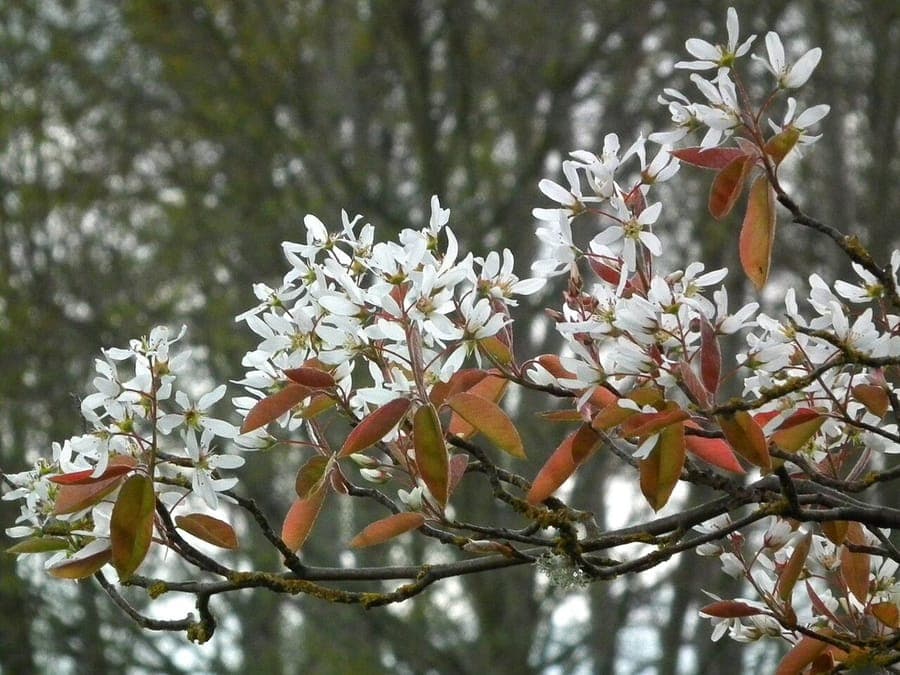
BlueCanoe / CC BY-SA 3.0, via Wikimedia Commons
Apple serviceberry: complete guide
Amelanchier × grandiflora
Want to see Apple serviceberry: complete guide in your garden?
Full design in HD: €7.99
Look after your Apple serviceberry with the GardenWorld app
Identify plants with your camera and get a care calendar with reminders for this plant.


Overview
Apple serviceberry (Amelanchier × grandiflora) is one of the best small trees for an ordinary garden. It has something to offer in every season: white flowers in April, coppery young leaves, edible berries in June and fiery autumn colour in October. And it stays compact enough for a front garden or a small town plot.
Amelanchier × grandiflora is a natural hybrid between two North American species, Amelanchier arborea and Amelanchier laevis. The name grandiflora refers to its flowers, which are larger than those of most other serviceberries. In nurseries you will mainly find named cultivars. 'Ballerina' was selected in Boskoop in the Netherlands and has large, pure white flowers and a broad, rather open crown. 'Robin Hill' has pink buds and a narrower, upright shape that makes it a good street tree. 'Autumn Brilliance' is known for especially vivid autumn colour.
Depending on the cultivar and how it is pruned, it becomes a large multi-stemmed shrub or a small tree 5 to 8 m tall and 4 to 6 m wide. It grows at a moderate rate of about 30 cm a year. On gardenworld.app you can have a garden design made in which an apple serviceberry takes centre stage, for example as a multi-stemmed tree beside the patio or as a specimen in the lawn.
Appearance and bloom cycle
The flowers open in April, often around mid-month. They are star-shaped, with five narrow white petals 1.5 to 2 cm long, and hang in loose clusters along the branches. At the same time the young leaves unfold in copper to bronze-red. That contrast is what makes the display so lovely, and the photo shows it well: white flower clusters among reddish, newly opened leaves on grey, lichen-covered branches. Flowering lasts one to two weeks, and bees, bumblebees and other early insects visit readily.
After flowering the leaves turn green. They are oval, 4 to 8 cm long and finely toothed. In June and July the berries ripen: red at first, then dark purple to almost black, about 1 cm across. They taste sweet, a bit like blueberries with a hint of almond, and you can eat them raw, scatter them over muesli or make jam. Be quick, though: blackbirds and starlings know exactly when they are ripe.
In October the leaves turn orange to scarlet, some of the best autumn colour of any small tree. In winter you are left with a graceful outline of grey trunks and fine twigs.
Ideal location
Apple serviceberry flowers and colours best in full sun or light partial shade. It also grows in shade, but autumn colour is less intense and there are fewer berries.
Give the tree enough room to develop its natural shape, keeping at least 3 m from buildings and other trees. A multi-stemmed specimen looks best where you can see under its canopy, beside a patio or at the edge of a lawn. Its roots are not aggressive, so you can happily plant ground cover or perennials underneath.
An important caveat: the closely related Amelanchier lamarckii has escaped from gardens in Belgium and the Netherlands and is regarded as an invasive non-native on heathland and in woods and woodland edges. Birds spread the seeds. The same risk cannot be ruled out for Amelanchier × grandiflora. So avoid planting one right next to a nature reserve, heath or woodland, and choose native alternatives near such areas.
Soil requirements
The ideal soil is moisture-retentive, rich in organic matter and free-draining, slightly acidic to neutral. Loam, sandy loam and humus-rich sandy soil are excellent. It also grows on heavy clay, as long as the ground does not stay waterlogged. On dry, poor sand or very chalky soil it grows more slowly and the leaves can look paler in summer.
Dig a generous planting hole, twice as wide as the root ball, and mix in compost. Stake a young tree for the first few years. A 5 cm layer of leaf mould or bark around the base keeps the soil cool and moist. Extra feeding is usually unnecessary.
Free preview
Want to see Apple serviceberry: complete guide in your garden? Make a free preview of your design.
Watering
For the first two years after planting, apple serviceberry needs regular watering: about 20 litres a week in dry weather from April to September. Water slowly so it soaks in deeply. Once established, the tree looks after itself in a normal summer. In prolonged drought, particularly on sandy soil, give it a thorough soak now and then. Leaves that colour up or drop early are a sign of drought stress.
In a large container, which works for compact specimens, you will need to water much more often in summer.
Pruning
Apple serviceberry needs very little pruning; its natural shape is its greatest asset. Prune only to remove dead, damaged or crossing wood. The best time is late winter (February) or straight after flowering.
For a multi-stemmed tree, choose three to five strong stems and remove the suckers that appear at the base every year. For a single-stemmed tree, gradually remove the lower side branches until you reach the crown height you want. Never prune hard in one go, as that triggers lots of vigorous water shoots.
Watch out for fireblight, a disease that affects trees in the rose family. Shoots suddenly turn brown and curl over like a shepherd's crook. Cut affected shoots well back into healthy wood and disinfect your secateurs after each cut. Fortunately, it is not common on serviceberries.
Maintenance calendar
February: Light pruning: remove dead, crossing and damaged wood. Take out suckers.
March: Spread a mulch of leaf mould around the base.
April: Flowers with coppery young foliage. Water young trees if spring is dry.
June–July: Pick the berries. Water in dry spells, especially young trees.
October: Autumn colour. A good time to plant new trees.
November–January: Dormant. Plant bare-root or root-balled trees while it is not freezing.
For an overview of what you can do in your garden each month, the planting calendar on gardenworld.app is a handy guide.
Winter hardiness
Amelanchier × grandiflora is extremely hardy and tolerates temperatures down to about -30 °C (USDA zone 4). It never needs winter protection in Britain or the Low Countries, and late frosts during flowering rarely do lasting harm.
The berries are edible and have been eaten for centuries. Like many members of the rose family, the seeds contain small amounts of cyanogenic glycosides. Eating the berries whole, seeds and all, is not a problem; just avoid grinding up large quantities of seeds. The leaves and twigs are not really dangerous to pets, but do not let dogs or rodents chew on them.
Companion plants
Under an apple serviceberry you can play beautifully with spring flowers. Wild daffodils (Narcissus pseudonarcissus) flower just before or with the tree, and Lenten rose (Helleborus orientalis) brings colour to the base as early as February. Siberian bugloss (Brunnera macrophylla) adds little blue flowers in April beneath the white canopy.
As summer ground cover, big-root cranesbill (Geranium macrorrhizum) is ideal: semi-evergreen, shade tolerant and also turning red in autumn. Among shrubs, star magnolia (Magnolia stellata) fits well, heralding spring with white starry flowers in March and April.
For autumn, combine the tree with ornamental grasses or asters, so its orange-red leaves get a warm backdrop.
Final thoughts
Amelanchier × grandiflora is a small tree that gives a lot for very little work. Flowers in April, berries in June, autumn colour in October, all at a size that fits almost any garden. Give it a sunny spot, soil that does not dry out and prune as little as possible.
If you live right next to a nature reserve or heath, choose with care and plant it further away. Everywhere else, apple serviceberry is a tree you will enjoy afresh every season.
Frequently asked questions about Apple serviceberry
Is Apple serviceberry winter hardy?
Amelanchier × grandiflora is extremely hardy and tolerates temperatures down to about -30 °C (USDA zone 4). It never needs winter protection in Britain or the Low Countries, and late frosts during flowering rarely do lasting harm.
When and how do you prune Apple serviceberry?
Apple serviceberry needs very little pruning; its natural shape is its greatest asset. Prune only to remove dead, damaged or crossing wood.
How much water does Apple serviceberry need?
For the first two years after planting, apple serviceberry needs regular watering: about 20 litres a week in dry weather from April to September. Water slowly so it soaks in deeply.
Where does Apple serviceberry grow best?
Apple serviceberry flowers and colours best in full sun or light partial shade. It also grows in shade, but autumn colour is less intense and there are fewer berries.
What soil does Apple serviceberry need?
The ideal soil is moisture-retentive, rich in organic matter and free-draining, slightly acidic to neutral. Loam, sandy loam and humus-rich sandy soil are excellent.

See it in your garden
See Apple serviceberry in your garden
One photo of your garden and a few questions. You see the result in about a minute.
Try it with a photoIdentify this plant in your own garden. Identify a plant
Similar plants
Star Magnolia: complete guide
Magnolia stellata
Everything about Star Magnolia (Magnolia stellata): planting, care, pruning and siting. Practical tips for spectacular star-shaped spring flowers.
Lenten-rose: complete guide
Helleborus orientalis
Learn how to grow and care for Helleborus orientalis. This early-blooming perennial thrives in shady spots and flowers from February to April, adding colour when little else is blooming.
Rock crane's-bill: complete guide
Geranium macrorrhizum
Rock crane's-bill (Geranium macrorrhizum) is a tough groundcover thriving in sun or partial shade. Great for rock gardens and dry spots. Grows 20-30 cm tall.
