
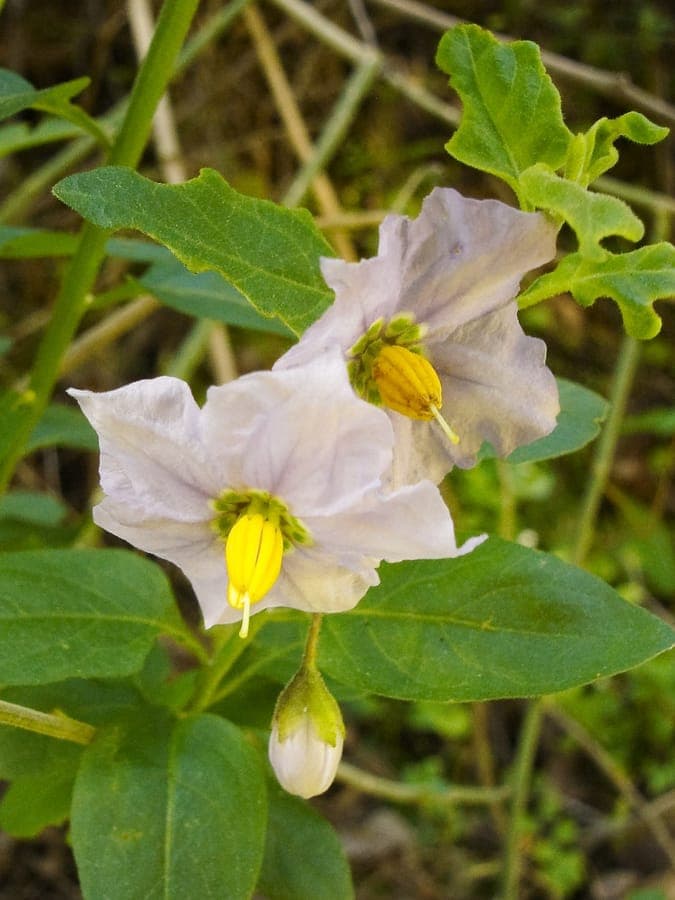
Miguel Vieira / CC BY 2.0, via Wikimedia Commons
Bluewitch nightshade: complete guide
Solanum umbelliferum
Want to see Bluewitch nightshade: complete guide in your garden?
1 minute, no credit card
Overview
Bluewitch nightshade (Solanum umbelliferum) is an interesting native nightshade species originating from southwestern North America, ranging from Oregon to northwestern Mexico. This plant is renowned for its beautiful blue to purple flowers and remarkable adaptability.
It's a compact, spreading shrub excellent for drought-tolerant landscape design. With its characteristic blue flowers and bird-food function, it adds substantial natural value. The plant is relatively low-maintenance and well-suited to contemporary gardens.
Appearance & Bloom
Bluewitch nightshade grows as a compact, spreading shrub with glossy green foliage. Leaves are elliptical to lance-shaped. The plant reaches 30-100 cm depending on growing conditions.
Flowers are small to medium-sized, distinctively blue to purple with yellow stamens, appearing in numerous clusters throughout the growing season. They're highly attractive to bees and pollinators. Following pollination, small round fruits develop, initially green, later turning brownish-black.
The fruits are not toxic but bitter and eagerly eaten by birds. Their presence makes the plant highly valuable for birdwatchers.
Ideal Location
Bluewitch nightshade grows best in warm, sunny positions. Place it where it receives 6+ hours direct sunlight daily. It tolerates lighter shade, though flowering is richer in full sun.
This American plant is excellent for dry locations and rock gardens. It also thrives near stones and heat-reflecting surfaces. The plant has no wind protection requirements and can be placed quite openly.
Its compact growth habit makes it ideal for small gardens, container cultivation on balconies, and modern landscape design. Position it where it can develop naturally without smothering other plants.
Soil
Bluewitch nightshade is undemanding and grows in most soils. It prefers well-draining, slightly infertile soil with pH 6.0-7.5. Problems can arise in wet conditions.
For container cultivation: use standard potting composts mixed with sand for better drainage. For ground cultivation: ensure good drainage. In heavy clay soils, sand addition is advisable.
The plant is tolerant of nutrient-poor substrates. In rich soils, growth may become lush at the expense of flowering. Minimal feeding is therefore preferable.
Watering
Once well-established, bluewitch nightshade is highly drought-tolerant. Nevertheless, it grows better with some watering during growing periods. Young plants need more water than mature specimens.
Water only when soil is dry. Excessive moisture is unfavorable. In winter, when growth stops, provide minimal water. For container plants: wait until the top layer is dry before next watering.
The plant is highly water-efficient and suitable for water-conscious gardening. Drip irrigation may be useful during extremely dry periods.
Free design
Want to see Bluewitch nightshade: complete guide in your garden? Make a free design now.
Pruning
Bluewitch nightshade grows compactly and requires minimal pruning. However, remove weak or dead branches to improve form. This promotes bushier growth.
To achieve full, attractive form, gently pinch growing tips. This encourages side shoots. Older plants can be carefully cut back, which they tolerate well.
Remove overgrown foliage to promote air circulation. The plant doesn't demand much pruning, making it suitable for low-maintenance gardens.
Maintenance Calendar
Spring (March-May): Begin basic care. Plant or repot. Prune for form.
Summer (June-August): Water regularly. Minimal feeding. Check for possible pests. Ensure good air circulation.
Autumn (September-October): Reduce watering. No more feeding.
Winter (November-February): Minimal watering. No feeding. Check supports. In greenhouses: ensure adequate light.
Winter Hardiness
Bluewitch nightshade is relatively hardy, especially when mature. In zones 8-11, outdoor overwintering may be possible, but in cold regions, greenhouse cultivation is needed. In our climate: protection or cool greenhouse.
Best kept in an unheated cool greenhouse or sheltered location with minimum temperatures 5-8°C. Also possible outdoors against heat-reflecting wall with winter protection.
Young plants are more sensitive than mature specimens. For reliable overwintering: move container plants to sheltered, cool greenhouse.
Companion Plants
Bluewitch nightshade fits well in drought-tolerant plantings alongside lavender, rosemary, sage, and other Mediterranean plants. Its blue flowers create beautiful contrasts with silvery-grey foliage.
In wildlife gardens: plant nearby other bird-food plants such as berry-producing shrubs. These combinations are ecologically valuable.
Use it also in natural gardens with rocky elements. Its American origin suits naturalistic planting styles well.
Closing
Bluewitch nightshade is a pragmatic, beautiful choice for those seeking robust, drought-tolerant plants with unique blue blooms. With its flowers, fruits, and bird-food function, it adds genuine value.
This is a plant requiring little maintenance yet offering much. Visit gardenworld.app for more inspiration on drought-tolerant gardening and American wildplants. Minimal effort, maximum bird visitation, and stunning blue flowers make this a winner.
Want to see Bluewitch nightshade: complete guide in your garden? Make a free design now.
Upload a photo, pick a style, and get a photorealistic design with plant list in under a minute.
No credit card required


Similar plants
Solanum dolichosepalum: complete guide
Solanum dolichosepalum
Discover Solanum dolichosepalum, an Andean nightshade with striking long sepals. Growing tips, hardiness, and companion planting for your patio.
Solanum ripense: complete guide
Solanum ripense
Discover Solanum ripense, a moisture-loving Andean nightshade for pond edges and conservatories. Growing tips, hardiness, and companions.
Solanum tomentosum: complete guide
Solanum tomentosum
Discover Solanum tomentosum, a thorny South African nightshade with felted leaves. Growing tips, hardiness, and companion planting ideas.