
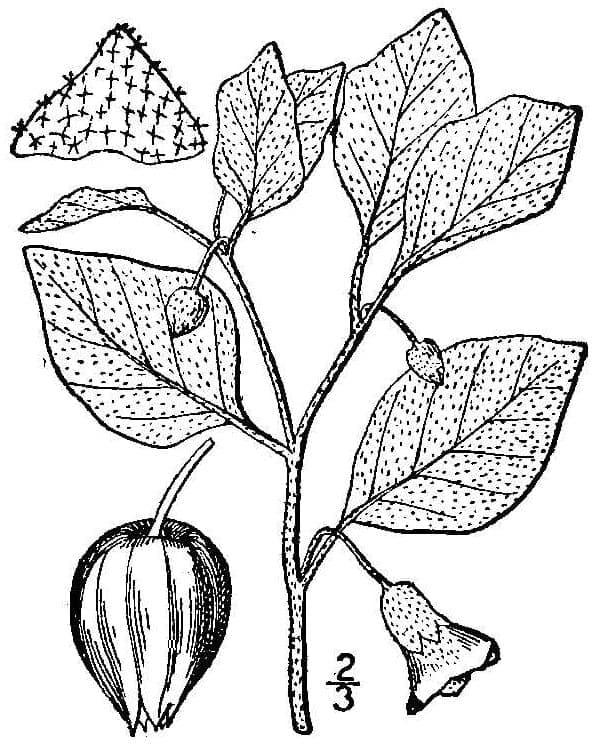
Britton, N.L., and A. Brown. / Public domain, via Wikimedia Commons
Sticky ground-cherry: complete guide
Physalis viscosa
Want to see Sticky ground-cherry: complete guide in your garden?
1 minute, no credit card
Overview
Physalis viscosa, commonly known as grape ground-cherry, sticky ground-cherry, or starhair groundcherry, is a herbaceous perennial in the family Solanaceae. The species was first described by Carl Linnaeus in 1753, and its epithet viscosa refers to the sticky, glandular hairs that cover the stems and leaves. In French it goes by coqueret, in German Sternhaar-Blasenkirsche. It belongs to a large genus that includes the widely grown ornamental Physalis alkekengi as well as the edible tomatillo (Physalis philadelphica).
Native to Mexico, Bolivia, Brazil, Argentina, Paraguay, Uruguay and Chile, this species has also naturalised in parts of Africa, Algeria and Australia. It grows on open, dry grasslands, roadsides and rocky slopes - environments that tell us a great deal about what it needs in the garden. At gardenworld.app you will find creative planting designs that show how drought-tolerant species like this one can serve as low-maintenance ground cover or border plants in sun-drenched spots.
Appearance and bloom cycle
Physalis viscosa is a low-growing, spreading plant that typically reaches 30 to 60 cm in height. The branched stems are clothed in conspicuous stellate (star-shaped) hairs, which give the plant its distinctively sticky texture. Leaves are ovate to oblong, 4 to 8 cm long, with a slightly wavy margin. They are greyish-green in colour and feel somewhat rough to the touch because of the dense indumentum.
Flowers appear from June through August, sometimes extending into September during warm summers. Each bloom is a solitary, nodding, yellow bell to funnel shape, 1 to 2 cm across, with a dark central eye - a classic Physalis flower. After pollination the calyx expands to form the papery, five-angled husk or lantern that encloses the ripening berry. In Physalis viscosa the husk base has a star-like shape, a fitting reflection of the star-hair character of its stems.
The fruits ripen to a yellowish-orange berry inside the papery husk. As autumn progresses the husks turn from pale green to tawny orange-brown and persist on the plant for many weeks, providing continued ornamental interest well beyond the main flowering period.
Ideal location
This species demands full sun. In the wild it inhabits open prairies, dry hillsides and disturbed ground in warm regions of the Americas, which tells us to place it in the sunniest part of the garden - a minimum of six hours of direct sun per day is needed for good flowering and fruiting.
A warm, sheltered microclimate suits it best: think of a south-facing wall, a gravel garden that absorbs and re-radiates heat, or a sunny raised bed. In cooler northern climates it will flower most freely in the warmest part of the growing season. It can also be grown successfully in large containers (at least 30 cm deep and 30 cm wide), provided the pot is placed in full sun and drainage is excellent. Shelter from strong prevailing winds helps keep the slender stems upright.
Soil
Physalis viscosa insists on well-drained, lean soil. It absolutely will not tolerate waterlogged conditions, and sitting in wet soil during winter is the most reliable way to kill the plant. In its native range it grows on sandy, gravelly or even light calcareous soils with good aeration.
For UK and European gardens, sandy loam or a gravel-rich mix is ideal. Heavy clay soils must be amended before planting: dig in plenty of coarse grit, perlite or horticultural sand to improve drainage. A pH of 6.5 to 7.5 (slightly acidic to slightly alkaline) suits the plant. Avoid over-enriching the soil with compost; too much fertility produces lush, disease-prone foliage at the expense of flowers.
At planting, loosen the soil to 30 cm, mix in a 10 cm layer of grit if necessary, and finish with a gravel mulch around the crown. This keeps the crown dry and reflects warmth back to the plant - two factors that markedly improve the plant's performance in cooler climates.
Watering
Once established, sticky ground-cherry is remarkably drought-tolerant. Its root system delves deep to find moisture, and the plant can reduce transpiration under stress. During the first few weeks after planting, water regularly to encourage root establishment.
In the growing season, watering once a week during dry, sunny spells is usually sufficient. During prolonged heatwaves (more than two weeks without significant rain) you can increase frequency slightly, but always allow the surface soil to dry out between waterings. Water at the base of the plant rather than overhead to reduce the risk of fungal problems. A drip irrigation system, if available, is ideal.
From autumn onward, reduce watering sharply. The plant enters dormancy and needs very little moisture. Over-watering in cool or cold conditions is the single biggest risk factor for crown rot.
Free design
Want to see Sticky ground-cherry: complete guide in your garden? Make a free design now.
Pruning
Very little pruning is required. The main task is an early-spring tidy-up: cut all old stems back to just above ground level once the worst of the frosts have passed and the first new buds are showing at the base. Avoid cutting back too early, as the old stems provide some frost protection to the crown.
During the growing season, simply remove yellowed or damaged leaves as you notice them. Deadheading is not necessary and is actually undesirable: the papery husks that follow the flowers are the plant's most decorative feature. Leave them in place until they are fully dried and papery-brown; at that point they can be cut for use in dried flower arrangements - they hold their shape beautifully for months.
To limit self-seeding, remove the husks before they dry completely and the seeds are shed. Since Physalis viscosa also spreads by underground rhizomes, install a root barrier at planting time if you want to keep it within a defined area.
Maintenance calendar
February-March: check for emerging shoots, remove all dead stems once hard frost has passed.
April-May: apply a thin gravel mulch around the crown. If feeding is desired, use a low-nitrogen, high-potassium fertiliser once in spring.
June-August: enjoy the yellow flowers and developing husks. Water during dry spells but allow the soil to dry between waterings.
September-October: leave husks to dry on the plant. Harvest dried husks for arrangements before they shatter.
November-January: mulch the crown with dry straw or fallen leaves in colder regions. Reduce watering to near zero; the plant is dormant.
Winter hardiness
Physalis viscosa originates from subtropical and warm-temperate parts of the Americas and is less cold-hardy than its relative Physalis alkekengi. It is generally considered hardy to USDA zone 7 (minimum temperatures of -17 to -12 degrees Celsius). In the UK, Belgium and the Netherlands this means it can overwinter outdoors with good drainage in most regions, but may need protection in areas with regular deep frosts.
In colder zones, mulch the crown generously with dry leaves or straw in late autumn. Container plants should be moved to a frost-free but cool space (a garage or unheated greenhouse) for winter. Alternatively, you can treat the plant as a short-lived perennial or even an annual, purchasing fresh plants each spring from garden centres.
Even when top growth is killed by frost, the rhizomes can survive underground and push new shoots in spring if the crown is protected. This makes a generous layer of dry mulch well worth the effort.
Companion plants
Physalis viscosa pairs well with other sun-loving, drought-tolerant plants. Salvia nemorosa (ornamental sage) provides a cool blue-purple contrast to the warm yellow flowers. Achillea millefolium (yarrow) in gold or white tones reinforces the prairie feel. Low-growing sedums and houseleeks (Sempervivum) are excellent neighbours on gravelly soils.
In a warm, Mediterranean-style border it suits Lavandula (lavender), Stachys byzantina (lamb's ears) and Echinacea purpurea (purple coneflower). For late-season colour the husks work particularly well alongside the dried seed heads of Rudbeckia and Helenium. Fine-leaved fescues like Festuca glauca add textural contrast without competing for resources.
Avoid positioning it next to moisture-loving plants such as Hosta, Astilbe or tall Phlox. These require rich, consistently moist soil that would be harmful to Physalis viscosa, and the two groups should not share a bed without careful soil zoning.
Closing
Physalis viscosa is a rewarding choice for gardeners who value drought-tough, ornamentally versatile plants. Its yellow flowers and the striking papery orange-brown lanterns that follow them give the plant visual appeal from June right through autumn. It asks for full sun, lean well-drained soil and restrained watering - conditions that mirror its natural prairie habitat.
If you are planning a garden scheme that incorporates this or other sun-loving perennials and want to see how they could work together in a real design, gardenworld.app offers personalised garden design with detailed planting plans to help you make the most of your outdoor space.
Want to see Sticky ground-cherry: complete guide in your garden? Make a free design now.
Upload a photo, pick a style, and get a photorealistic design with plant list in under a minute.
10,000+ gardens designed already
No credit card required


Similar plants
Solanum dolichosepalum: complete guide
Solanum dolichosepalum
Discover Solanum dolichosepalum, an Andean nightshade with striking long sepals. Growing tips, hardiness, and companion planting for your patio.
Solanum ripense: complete guide
Solanum ripense
Discover Solanum ripense, a moisture-loving Andean nightshade for pond edges and conservatories. Growing tips, hardiness, and companions.
Solanum tomentosum: complete guide
Solanum tomentosum
Discover Solanum tomentosum, a thorny South African nightshade with felted leaves. Growing tips, hardiness, and companion planting ideas.