
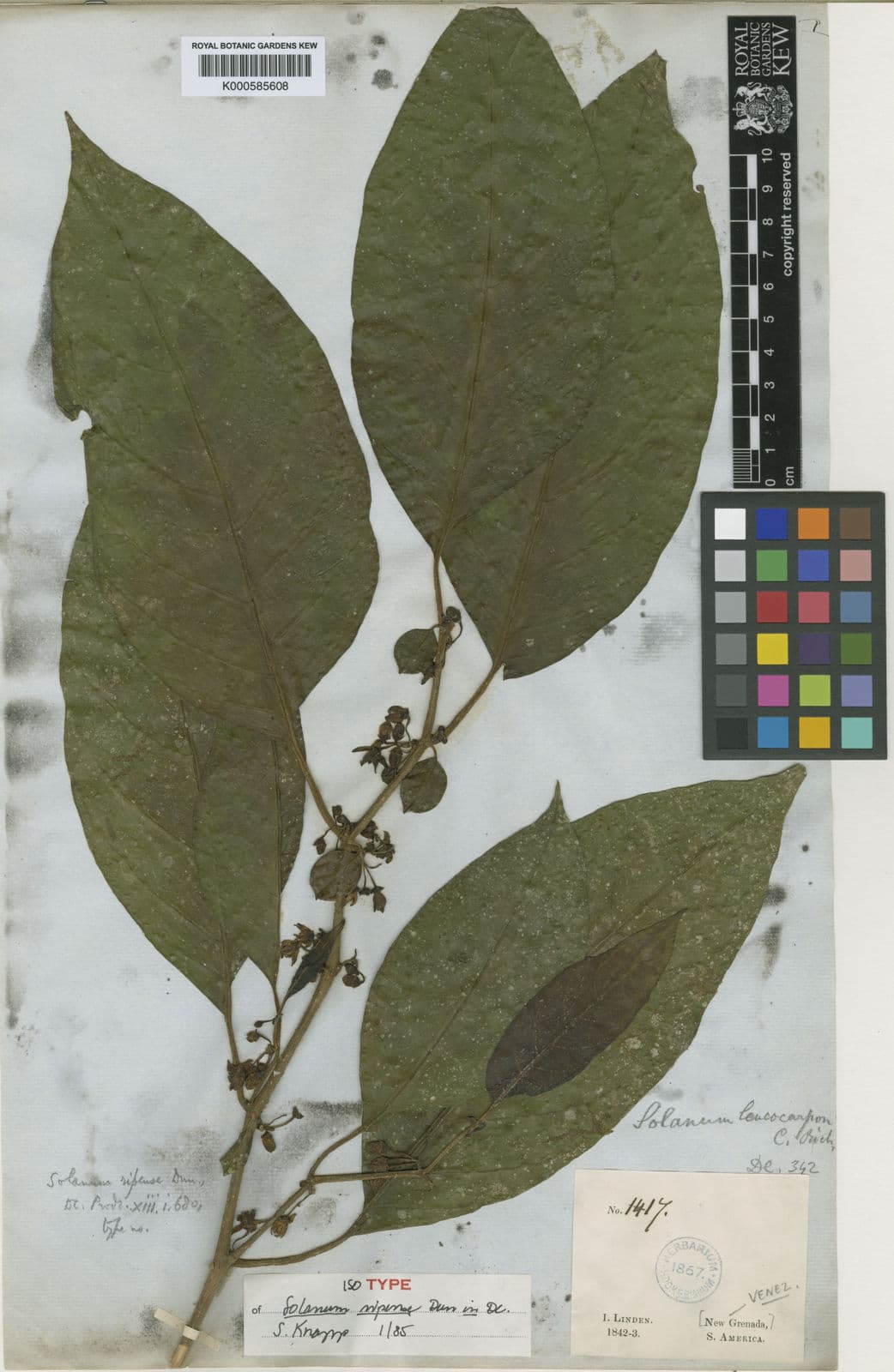
Solanum ripense: complete guide
Solanum ripense
Want to see Solanum ripense: complete guide in your garden?
1 minute, no credit card
Overview
Solanum ripense is a lesser-known nightshade in the family Solanaceae that grows wild along streams and riverbanks in the Andes, from Colombia to northwestern and northern Venezuela, particularly in the Cordillera de Merida (the Sierra Nevada de Merida). French botanist Michel Felix Dunal described the species as early as 1852. The species name ripense comes from the Latin ripa (riverbank) and directly references its preference for moist streamside zones. In English the plant is accordingly known as merida nightshade, and in French as morelle de Merida.
Unlike many other Andean nightshades that grow on drier forest floors, Solanum ripense favors permanently moist, even boggy ground along running water. This specialization makes it an interesting choice for gardeners seeking unusual exotic planting around a pond or in a humid conservatory. On gardenworld.app we file this species among our moisture-loving container plants, alongside other waterside dwellers such as Colocasia and Zantedeschia.
The plant grows as a loose, slightly arching shrub 1 to 2 meters tall, with thin, flexible branches that adapt to the fluctuating water levels of mountain streams. In its native habitat, between 1,500 and 2,800 meters elevation, warm days alternate with cool, humid nights.
Within the genus Solanum, which counts thousands of species worldwide, this riverbank specialist forms a small but recognizable group alongside a handful of other moisture-loving relatives from the South American Andes. For plant collectors already familiar with the common garden varieties, Solanum ripense is a surprising addition to the lineup, precisely because its cultivation needs differ so clearly from the average drought-loving ornamental nightshade.
Appearance and bloom
Solanum ripense carries elongated, glossy leaves 10 to 20 centimeters long that hold up well against the high humidity of its riverside habitat. Leaf margins are gently wavy, and the upper surface shows a fresh, dark green color that contrasts nicely with moist, shaded surroundings.
Flowers grow in small, loose clusters and show the characteristic star shape of the nightshade family: five pointed petals surrounding a central cone of yellow stamens. Color ranges from pure white to soft violet. In a sheltered, humid conservatory or at a pond edge in northern Europe, the plant blooms from June through September.
After flowering, small round berries develop, ripening from green to orange-red. Like nearly all ornamental nightshades, these berries are not edible; they contain solanine-like compounds and should be kept away from children and pets.
Ideal location
Solanum ripense thrives best in partial shade, similar to the light streamside vegetation of its Andean origin where tall trees provide partial cover. Full midday sun combined with dry soil quickly causes leaf wilt, while a spot with filtered light and constant soil moisture brings the plant into full bloom.
A spot at the edge of a pond, in a moist border, or in a large pot on a sheltered, partly shaded patio gives the best results. Protection from cold wind matters, since the thin leaves dry out quickly in drafts.
Free design
Want to see Solanum ripense: complete guide in your garden? Make a free design now.
Soil
The soil must retain moisture without becoming stagnant; good structure with organic matter provides the right balance. Blend standard potting soil with extra compost, some clay granules for water retention, and a bit of coarse sand for structure. A pH between 5.8 and 6.5, mildly acidic, matches the humus-rich, moist soils of its natural riverside habitat.
Feed during the growing season, from April through August, every three weeks with a liquid fertilizer for flowering plants, since the constant moisture washes nutrients out faster than in drier potting mixes.
Watering
Solanum ripense demands considerably more water than most other ornamental nightshades. Keep the soil continuously moist, similar to the riverbank zone where the plant grows naturally, and never let the root ball dry out completely. For containers near a pond, a saucer of water underneath can help keep moisture levels constant.
During indoor winter dormancy, the soil may dry slightly more between waterings, but complete drying remains undesirable; the plant quickly drops leaves if it does.
Pruning
Prune Solanum ripense in early spring, in March, cutting back by roughly half to encourage branching and keep the loose growth habit compact. Remove weakened or dead branches entirely, since the thin twigs are prone to fungal infection when too much moisture combines with stagnant air.
During the growing season, snip off spent flower clusters once berries have dropped to keep the plant tidy and encourage further blooming.
Maintenance calendar
March: prune and repot into fresh, moisture-retentive potting mix. April through August: main growing season, water daily to every other day and feed every three weeks. June through September: bloom and fruit set. September: prepare to move the plant indoors as nights turn cooler. October through February: indoor winter rest at a minimum of 10 degrees Celsius, keep moderately moist. February: gradually increase water and light as new shoots appear.
Winter hardiness
Solanum ripense is not winter hardy in the climate of the Low Countries, corresponding to USDA zone 10b to 11. Frost is lethal to the plant, and even light night frost causes irreversible leaf damage. Grow the plant in a movable pot: outdoors by the pond or on the patio in summer, indoors at a minimum of 10 degrees Celsius in winter.
Because the plant originates from a humid mountain region with a small day-night temperature swing, a stable, not-too-dry overwintering spot matters more than for many other container plants.
Companion plants
Around a pond or in a moist, exotic border, Solanum ripense pairs well with other moisture-loving ornamentals: giant-leaved Gunnera manicata, elephant's ear Colocasia esculenta, Zantedeschia aethiopica, and the ornamental papyrus plant Cyperus papyrus. Together they create a lush, jungle-like scene around the water.
For sourcing: garden centers typically stock the more familiar moisture-loving ornamentals such as Colocasia and Zantedeschia; for Solanum ripense itself, your best bet is a specialist grower of rare Solanaceae or a botanical garden plant sale.
Closing
Solanum ripense is a fascinating, rarely cultivated nightshade that, thanks to its preference for moist, partly shaded conditions, fits perfectly at pond edges and in humid conservatories. With glossy foliage, a long bloom from June through September, and a compact habit of 1 to 2 meters, this Andean species is a surprising addition to any exotic garden. Browse gardenworld.app for more moisture-loving exotics to complete your pondside planting or jungle-themed border design, and get inspired by other gardeners already experimenting with this rare species.
Want to see Solanum ripense: complete guide in your garden? Make a free design now.
Upload a photo, pick a style, and get a photorealistic design with plant list in under a minute.
10,000+ gardens designed already
No credit card required


Similar plants
Solanum dolichosepalum: complete guide
Solanum dolichosepalum
Discover Solanum dolichosepalum, an Andean nightshade with striking long sepals. Growing tips, hardiness, and companion planting for your patio.
Solanum tomentosum: complete guide
Solanum tomentosum
Discover Solanum tomentosum, a thorny South African nightshade with felted leaves. Growing tips, hardiness, and companion planting ideas.
Solanum interius: complete guide to this plains nightshade
Solanum interius
Grow plains nightshade, a drought-tolerant North American wildflower with purple blooms and remarkable adaptability to dry prairie soils.