
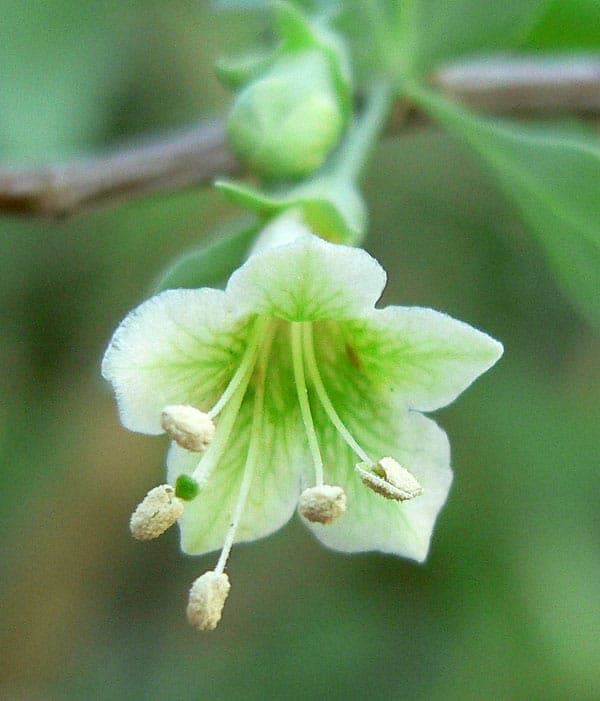
Stan Shebs / CC BY-SA 3.0, via Wikimedia Commons
Pale wolfberry: complete guide
Lycium pallidum
Want to see Pale wolfberry: complete guide in your garden?
1 minute, no credit card
Overview
The pale wolfberry (Lycium pallidum) is a thorny deciduous to semi-evergreen shrub in the nightshade family, Solanaceae, native to the arid southwestern United States and adjacent northern Mexico. Its natural range extends from southern Utah and Arizona through Nevada, Colorado, New Mexico and Texas into the northern Mexican states. Described by British botanist John Miers in 1854, it belongs to the genus Lycium, which also includes the well-known wolfberry Lycium barbarum, the source of commercial goji berries.
The species name pallidum - meaning pale - refers to the muted, pale greenish colour of the berries and foliage, which give the plant a silvery-grey, understated presence in dry landscapes. In temperate gardens it is a distinctive choice for drought-tolerant borders, rock gardens or modern low-maintenance designs with a south-western or Mediterranean character.
At gardenworld.app you can find front and back garden designs showing how thorny structural shrubs and drought-tolerant perennials can be combined into a timeless, wildlife-friendly planting scheme.
Appearance and bloom cycle
Lycium pallidum is a multi-stemmed shrub with a broad, open growth habit and strongly branched stems that terminate in sharp, woody thorns. In the wild it typically reaches 60 to 150 cm in height, sometimes taller, with a similar spread. The branches are green to yellowish-green, lightly hairy or smooth, bearing small, spoon-shaped leaves of light green to blue-green, with a slightly fleshy or waxy texture.
The flowers are funnel-shaped to tubular, lightly lobed at the rim, and range from white to pale green or dull yellow with purple veining - characteristic of the Solanaceae family. They appear in spring, roughly March to May depending on climate, and are visited by small bees and hoverflies. After flowering, the characteristic berries develop: initially green, ripening to a translucent reddish or orange-red in some populations, though typically remaining pale and somewhat watery in colour. The fruits are not particularly attractive to humans but are a valuable food source for birds and small mammals.
Ideal location
The pale wolfberry is a strongly sun-loving shrub that performs best in fully open, sunny positions. Shade leads to weak, sprawling growth and little flowering or fruit production. In its native range it grows on dry, rocky plains, slopes and wash sides in arid and semi-arid regions where direct sun and minimal humidity are the norm.
For garden planting, choose a position with full sun - at least six hours of direct sunlight per day. A sheltered, heat-retaining spot such as against a south-facing wall or stone retaining wall helps the plant through cooler winters. The plant is reasonably wind-hardy, but on heavy soils in combination with cold and wet conditions it can suffer. A dry, sheltered spot on light soil is ideal.
Soil
Lycium pallidum has a marked preference for dry, free-draining, slightly to moderately alkaline soils. Growth data indicate a pH between 7.0 and 8.5, consistent with its occurrence on calcareous and gypsiferous soils across the Southwest. On acid soils (pH below 6.5) it performs poorly. If your soil is acidic, consider adding garden lime to raise the pH.
Free drainage is absolutely essential: standing moisture causes root rot and dieback. On heavy clay soils the plant is difficult to establish; work in plenty of sand, grit or perlite. On light, sandy or stony soils it naturally thrives. Avoid regular feeding: lean soils encourage a compact, robust habit and good fruit production.
Watering
The pale wolfberry is one of the most drought-tolerant shrubs available for garden use. Adapted to an environment with low annual rainfall, it manages perfectly well without supplementary watering in a normal temperate climate. In most European gardens its natural rainfall needs are already met, especially during summer.
In the first growing season, occasional watering is advisable to help the plant establish a strong root system. After that first year the plant is essentially self-sufficient. If you do water, always water at the base of the plant - avoid wetting the foliage. Overwatering is more damaging than drought: on wet, poorly drained soils the plant declines quickly.
During extreme summer droughts - sustained periods of three to four weeks without rainfall in full summer - a deep watering at the root can bridge the stress period, but this is rarely necessary in temperate climates.
Free design
Want to see Pale wolfberry: complete guide in your garden? Make a free design now.
Pruning
The pale wolfberry can be shaped or kept in check with pruning, but it does not require it. In its natural form it develops into a broad, irregular, thorny shrub that remains naturally compact through slow growth on lean soils.
If you wish to restrict the plant or neaten its form, prune directly after flowering in spring or in early autumn. Remove dead wood and any excessively long or awkward stems. Always wear thick gloves when working with this plant due to the sharp thorns. Avoid heavy rejuvenation cuts: the plant recovers slowly and may respond to aggressive cutting with unwanted sucker growth.
In winter there is nothing to prune: the plant is either fully dormant or has partially shed its leaves in cooler locations. Dead wood can be removed in early spring once it is clear which stems have come through winter successfully.
Maintenance calendar
January-February: Rest. No attention needed at normal winter temperatures. March-April: Flowering period. Enjoy the modest but charming pale blooms. Remove dead wood carefully after the last frost. April-May: Light shaping prune after flowering if needed. May-June: Fruit set begins; small green berries become visible. June-August: Drought resilience. Plant is self-sufficient. A deep-root watering only during extreme heat. August-September: Berries ripen; various bird species visit for the fruit. October: Plant slows down; leaves drop partially in cooler areas. November-December: Full dormancy; light mulch protection during severe frost spells.
Winter hardiness
In its native range the pale wolfberry survives winters with significant night frost, making it surprisingly cold-hardy for a plant so firmly adapted to dry, warm conditions. It falls broadly within USDA hardiness zones 5 to 8, making it viable in most temperate European gardens, particularly in mild coastal areas.
The greatest threat in cooler, wetter climates is not cold but the combination of cold and moisture: wet winters on heavy, poorly drained soils can compromise the root system. On dry, free-draining soils the plant is considerably tougher than its desert reputation might suggest.
A thin layer of mulch around the base in November provides extra insulation in colder zones, but be careful not to apply it too thickly or allow it to remain wet against the stem. In severe winters some younger growth may be damaged; the plant typically recovers from the older woody base.
Companion plants
Lycium pallidum fits well into a drought-tolerant, low-maintenance border alongside other plants with similar site preferences. In a Mediterranean-inspired or xeriscape design it combines attractively with lavender (Lavandula angustifolia), rosemary (Salvia rosmarinus), Steppe sage (Salvia nemorosa) and ornamental catmint (Nepeta cataria).
Other good partners include sedum, stonecrop (Hylotelephium spectabile), silver-leaf artemisia (Artemisia) and ornamental thyme. In a wildlife garden the shrub is highly valuable for the fruit it provides to birds and the nesting cover its thorny branches offer. Combine with Penstemon, Echinacea and native bunchgrasses for a naturalistic south-western inspired border.
For more ideas on designing drought-tolerant, wildlife-friendly front and back gardens, visit gardenworld.app where personalised garden designs are created to match your climate, soil and aesthetic preferences.
Closing
The pale wolfberry is a tough, fascinating shrub for the drought-tolerant garden. It asks for little attention, improves habitat for birds and insects, and adds a quiet, wild character to borders with its modest pale flowers and understated berries. As gardeners increasingly look for plants that reduce water use and support biodiversity, Lycium pallidum fits the brief precisely: a plant with a small ecological footprint and a large contribution to the living garden ecosystem.
Want to see Pale wolfberry: complete guide in your garden? Make a free design now.
Upload a photo, pick a style, and get a photorealistic design with plant list in under a minute.
10,000+ gardens designed already
No credit card required


Similar plants
Goji berry: complete guide
Lycium barbarum
Discover Lycium barbarum, the nutritious goji berry shrub for full sun. Learn harvesting, nutrition, watering, and cultivation in British gardens.
Chinese boxthorn: complete guide
Lycium chinense
Discover Lycium chinense, a nutritious berry shrub for full sun with later ripening season. Learn cultivation, harvesting, and garden integration.