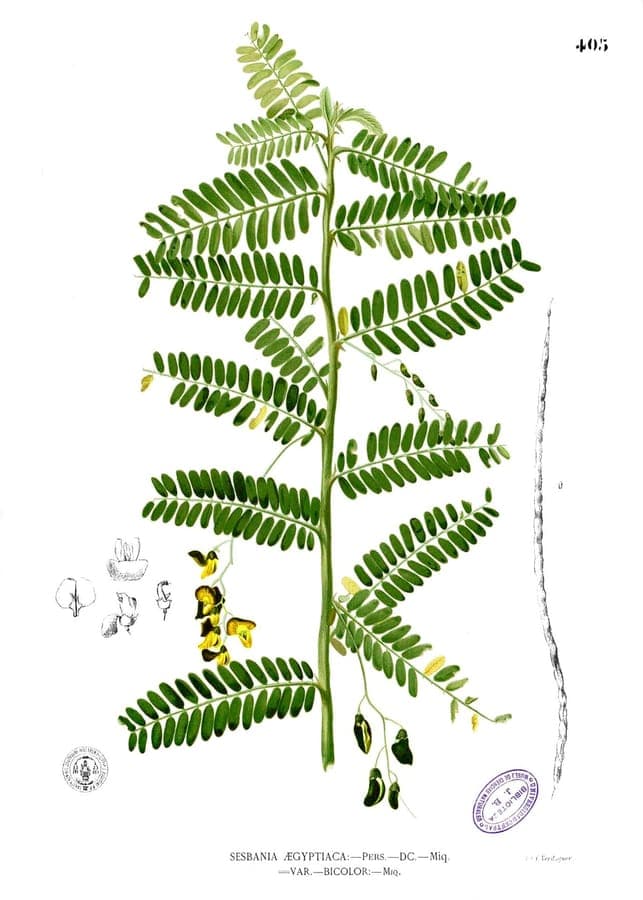
Francisco Manuel Blanco (O.S.A.) / Public domain, via Wikimedia Commons
Sesbania sesban: complete guide
Sesbania sesban
Want to see Sesbania sesban: complete guide in your garden?
Full design in HD: €7.99
Look after your Sesbania sesban with the GardenWorld app
Identify plants with your camera and get a care calendar with reminders for this plant.


Overview
Sesbania sesban, commonly called Egyptian sesban, is a fast-growing legume native to tropical Africa. This shrub is renowned for its impressive growth rate and beautiful flowers. In traditional agriculture, sesbania is valued as a cover crop.
Appearance and Bloom
Sesbania sesban grows into an upright, multi-branched shrub reaching 2-4 meters tall. The leaves are pinnate and delicate. Flowers range from yellow to orange and appear in clusters, typically blooming July to October. After flowering, distinctive seed pods develop.
Ideal Location
Place sesbania sesban in full sunlight. This plant performs best in open, warm locations receiving 6-8 hours of direct sun daily. In temperate climates, protection from strong northern winds is beneficial.
Soil
Sesbania sesban is not fussy about soil composition but grows best in well-draining earth. Heavy clay soils should be improved with sand and organic matter. The plant tolerates moisture-rich soil well.
Free preview
Want to see Sesbania sesban: complete guide in your garden? Make a free preview of your design.
Watering
At planting, sesban requires regular watering until roots establish. Once established, this plant tolerates dry conditions well. Water deeply and infrequently.
Pruning
Sesbania sesban responds well to pruning after flowering. Remove dead branches and shape the crown as desired. The plant regrows rapidly.
Maintenance Calendar
January-February: Remove dead branches. March-April: Soil preparation. May-June: Regular watering. July-October: Monitor. November: Heavy pruning. December: Frost protection.
Winter Hardiness
Sesbania sesban is frost-sensitive. In Mediterranean climates (zones 9-11), can overwinter outdoors with protection. In cold regions (zones 6-8), grow in containers indoors.
Companion Plants
Plant sesbania sesban with other drought-tolerant shrubs. The root nodules invite nitrogen-fixing bacteria. Avoid dense undergrowth.
Summary
Sesbania sesban is an excellent choice for rapid growth. With minimal care, these shrubs thrive abundantly. At gardenworld.app, discover inspiration for integration. Visit gardenworld.app for more advice.
Frequently asked questions about Sesbania sesban
Is Sesbania sesban winter hardy?
Sesbania sesban is frost-sensitive. In Mediterranean climates (zones 9-11), can overwinter outdoors with protection.
When and how do you prune Sesbania sesban?
Sesbania sesban responds well to pruning after flowering. Remove dead branches and shape the crown as desired.
How much water does Sesbania sesban need?
At planting, sesban requires regular watering until roots establish. Once established, this plant tolerates dry conditions well.
Where does Sesbania sesban grow best?
Place sesbania sesban in full sunlight. This plant performs best in open, warm locations receiving 6-8 hours of direct sun daily.
What soil does Sesbania sesban need?
Sesbania sesban is not fussy about soil composition but grows best in well-draining earth. Heavy clay soils should be improved with sand and organic matter.

See it in your garden
See Sesbania sesban in your garden
One photo of your garden and a few questions. You see the result in about a minute.
Try it with a photoIdentify this plant in your own garden. Identify a plant
Similar plants
Pineapple broom (Argyrocytisus battandieri): complete guide
Argyrocytisus battandieri
Everything about pineapple broom (Argyrocytisus battandieri), the Moroccan wall shrub with silver leaves and pineapple-scented flowers: site, pruning and hardiness.
Blue false indigo: complete guide
Baptisia australis
Everything about blue false indigo (Baptisia australis): position, soil, watering, cutting back, hardiness and toxicity. A long-lived prairie perennial with indigo flowers.
Warminster broom (Cytisus × praecox): complete guide
Cytisus × praecox
Everything about Warminster broom (Cytisus × praecox): position, poor soil, pruning after flowering, hardiness and what you need to know about its toxicity.
