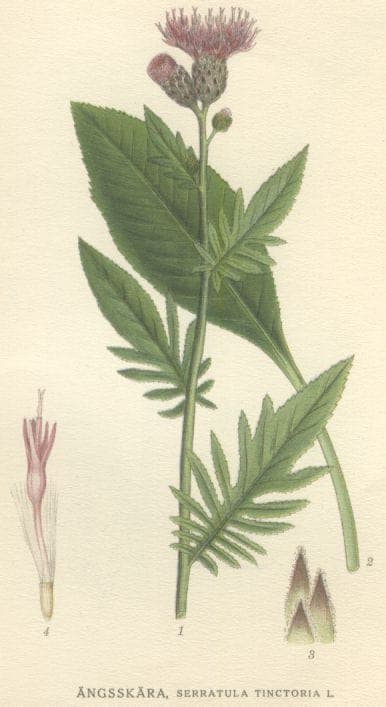
Carl Axel Magnus Lindman / Public domain, via Wikimedia Commons
Dyer's Plumeless Saw-wort: complete guide
Serratula tinctoria
Want to see Dyer's Plumeless Saw-wort: complete guide in your garden?
Full design in HD: €7.99
Look after your Dyer's Plumeless Saw-wort with the GardenWorld app
Identify plants with your camera and get a care calendar with reminders for this plant.


Overview
Dyer's plumeless saw-wort (Serratula tinctoria) is a remarkable European wildflower with a rich botanical history. This elegant herbaceous plant is renowned for its deep purple, almost blackish flowers and finely serrated foliage that inspired its botanical name.
It grows naturally in meadows and heathlands from Europe through northwestern Turkey. Saw-wort adds character and color to garden borders and perennial plantings. Its extended bloom period from July through October makes it a valuable addition to any landscape focusing on late-season color.
Appearance and Bloom
Dyer's saw-wort reaches approximately 50-90 centimeters in height with a slender, upright growth habit. Its finely serrated leaves are deep green with interesting texture that remains attractive even without flowers.
The flowers are the true highlight - dark purple to almost black, thistle-like buds opening into elegant, fluffy flower heads. These blooms attract butterflies and bees, making them ideal for pollinator-friendly gardens.
Ideal Location
Saw-wort thrives in sunny positions with at least 6 hours of direct sunlight daily. The plant can tolerate partial shade but blooms better in full sun. Ensure good air circulation to prevent fungal issues.
Plant saw-wort in borders or in groups of at least 3-5 plants for maximum visual impact. It works well in wildflower gardens and naturalistically planted gardens.
Soil Requirements
Saw-wort is unfussy about soil and grows well in lean to moderately fertile soil. The plant dislikes waterlogged conditions, so ensure well-draining soil. A pH between 6.5 and 7 is ideal.
You need not add rich compost - saw-wort actually thrives better in less fertile soil. This makes it an excellent choice for difficult spots where little else seems to grow.
Free preview
Want to see Dyer's Plumeless Saw-wort: complete guide in your garden? Make a free preview of your design.
Watering
Once established, saw-wort is fairly drought-tolerant. Water regularly during the growing season and especially during extended dry periods. However, do not allow soil to dry out completely.
Young plants require more consistent moisture until their root system develops well. Once established, the plant needs minimal supplemental watering.
Pruning
Deadhead spent flowers regularly to encourage more blooms and keep the plant neat and compact. Cut the plant back to approximately 15 centimeters from the ground in late autumn or early spring.
No other pruning is necessary. The plant will regrow from the base the following season.
Maintenance Calendar
Spring: Cut back previous season to approximately 15 centimeters. Summer: Water regularly and deadhead spent flowers. Autumn: Leave dried seed heads for winter interest and bird food. Winter: Add compost around the base for nutrition.
Winter Hardiness
Saw-wort is very cold-hardy and grows well in zones 4-8. The plant easily survives European winters without protection. Young plants may benefit from light protection in their first winter in very cold climates.
Companion Plants
Saw-wort works well alongside other flowering perennials such as daisies, lavender, and scabious. Combine with yellow flowers for contrast, or use purple tones for a monochrome garden.
It also works well between ornamental grasses that accentuate its elegant form. Plant saw-wort in the middle ground of borders for best visual effect.
Closing
Saw-wort is an excellent choice for natural, wild gardens and borders. With its beautiful purple flowers and extended bloom period, it adds genuine character to autumn gardens. Find quality plants at your local garden centres. More garden inspiration at gardenworld.app and gardenworld.app!
Frequently asked questions about Dyer's Plumeless Saw-wort
Is Dyer's Plumeless Saw-wort winter hardy?
Saw-wort is very cold-hardy and grows well in zones 4-8. The plant easily survives European winters without protection.
When and how do you prune Dyer's Plumeless Saw-wort?
Deadhead spent flowers regularly to encourage more blooms and keep the plant neat and compact. Cut the plant back to approximately 15 centimeters from the ground in late autumn or early spring.
How much water does Dyer's Plumeless Saw-wort need?
Once established, saw-wort is fairly drought-tolerant. Water regularly during the growing season and especially during extended dry periods.
Where does Dyer's Plumeless Saw-wort grow best?
Saw-wort thrives in sunny positions with at least 6 hours of direct sunlight daily. The plant can tolerate partial shade but blooms better in full sun.
What soil does Dyer's Plumeless Saw-wort need?
Saw-wort is unfussy about soil and grows well in lean to moderately fertile soil. The plant dislikes waterlogged conditions, so ensure well-draining soil.

See it in your garden
See Dyer's Plumeless Saw-wort in your garden
One photo of your garden and a few questions. You see the result in about a minute.
Try it with a photoIdentify this plant in your own garden. Identify a plant
Similar plants
Frikart's aster (Aster × frikartii): complete guide
Aster × frikartii
Everything about Frikart's aster (Aster × frikartii): position, soil, pruning and hardiness of the aster that flowers lavender-blue from July to October.
False aster (Boltonia asteroides): complete guide
Boltonia asteroides
False aster (Boltonia asteroides) covers itself in white daisies from late August to October. How to plant, cut back and combine this tough, tall perennial.
Daisy bush (Brachyglottis greyi): care guide
Brachyglottis greyi
Brachyglottis greyi, formerly Senecio greyi, pairs silver felted leaves with yellow summer daisies. Advice on position, soil, pruning, hardiness and companions.
