
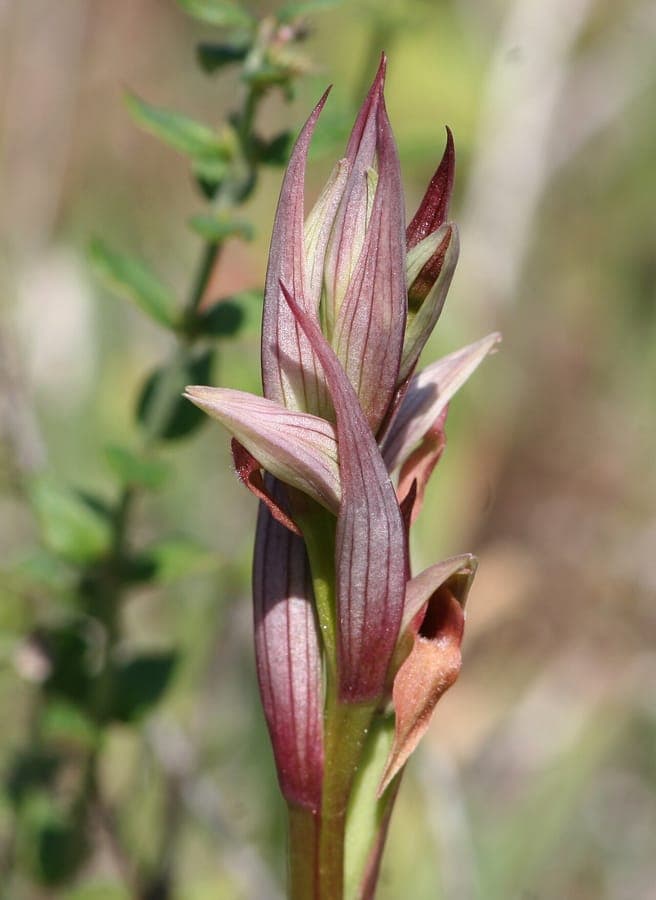
Luis nunes alberto / CC BY-SA 3.0, via Wikimedia Commons
Small-flowered serapias: complete guide
Serapias parviflora
Want to see Small-flowered serapias: complete guide in your garden?
1 minute, no credit card
Overview
Small-flowered Serapias (Serapias parviflora) is a delicate wild orchid from the Mediterranean region. This compact orchid blooms from April to June with fine, purple to brownish-red flowers. Like other Serapias species, this plant uses scent tricks and visual illusions to attract male bees for pollination.
Appearance and Bloom
The plant is more compact than its relatives, reaching only 15-35 cm in height. The flowers are smaller (approximately 1.5-2 cm) than S. cordigera. The dark lip (labellum) is narrower and more pointed. The plant forms 2-4 narrow, gray-green leaves. Flower color varies from light yellow to dark purple.
Ideal Location
Small-flowered Serapias naturally grows in dry, sunny habitats on steep slopes. Plant in sunny locations with minimal competition from other plants. Suitable for Mediterranean gardens, rocky slopes and dry mountain hillsides.
Soil
The plant grows on calcareous, well-drained soil. A mixture of 60% sand, 30% garden soil and 10% perlite provides optimal conditions. Avoid heavy clay or moist soils absolutely.
Watering
Serapias parviflora is very drought-tolerant. Water only in exceptional dry periods. Excessive water is harmful and causes rot. During growing season keep lightly moist, in summer absolutely dry.
Free design
Want to see Small-flowered serapias: complete guide in your garden? Make a free design now.
Pruning
No pruning needed. Remove spent flowers if desired. After blooming, leave stems with seed heads. Remove dead leaves only if necessary.
Maintenance Calendar
October: Plant tubers in dry location. November-March: Minimal watering during wet periods. April-June: Bloom period. May-June: Harvest seeds when ripe. July-September: Keep completely dry.
Winter Hardiness
Small-flowered Serapias is moderately hardy and tolerates frost days to approximately -5 degrees Celsius. As a Mediterranean species, the plant survives better in warmer gardens. In very cold regions, protection with leaf mulch may be needed.
Companion Plants
Plant Small-flowered Serapias alongside other Mediterranean wild orchids or xerophytic mountain plants. The plant thrives with minimal competition. Suitable for combination with Ophrys species and other dry mountain habitat plants. Visit gardenworld.app/en for more ideas.
Closing
Small-flowered Serapias is a fascinating orchid for lovers of rare wild plants. This species deserves protection due to its limited distribution. Purchase from specialized orchid nurseries. Available through mail order from reputable suppliers.
Want to see Small-flowered serapias: complete guide in your garden? Make a free design now.
Upload a photo, pick a style, and get a photorealistic design with plant list in under a minute.
No credit card required


Similar plants
Ram's-head lady's slipper: complete guide
Cypripedium arietinum
Everything you need to know about growing Cypripedium arietinum, a rare woodland orchid for cool, moist garden settings. Soil, care and planting tips.
Sparrow's-egg lady's slipper: complete guide
Cypripedium passerinum
Everything about growing Cypripedium passerinum, a cold-hardy subarctic orchid suited to cool, moist, shaded garden spots. Soil, care and companion plants.
Algerian Butterfly-orchid: complete guide
Platanthera algeriensis
Everything about Platanthera algeriensis, the rare Mediterranean orchid with greenish flowers native to Algeria, Morocco, Corsica and Spain.