
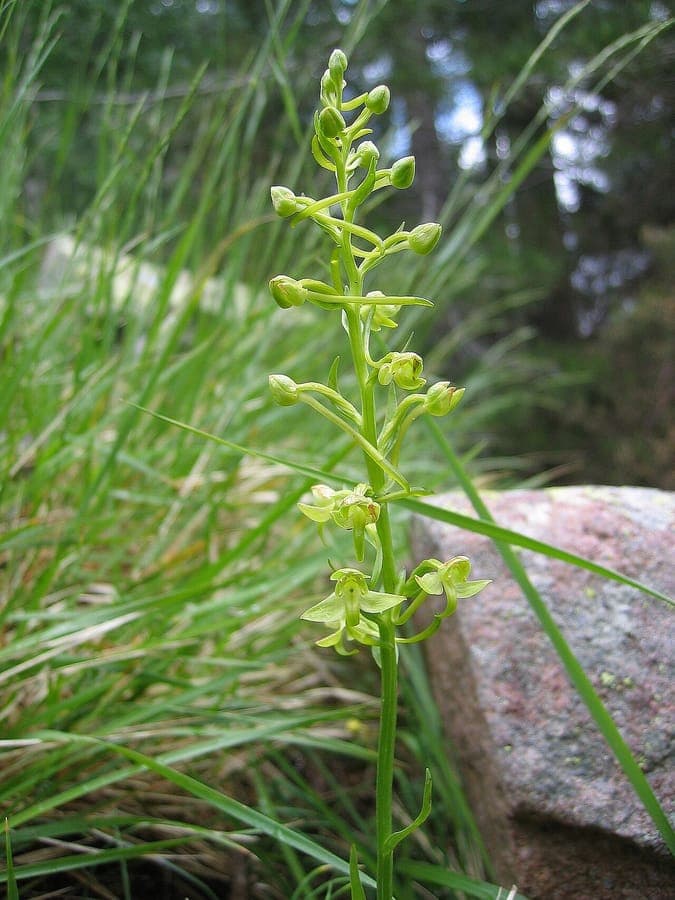
User:Tigerente / CC BY 3.0, via Wikimedia Commons
Algerian Butterfly-orchid: complete guide
Platanthera algeriensis
Want to see Algerian Butterfly-orchid: complete guide in your garden?
1 minute, no credit card
Overview
Platanthera algeriensis, known as the Algerian butterfly-orchid or green platanthera, is a rare terrestrial orchid with a distinctly restricted natural range around the western Mediterranean basin: Algeria, Morocco, the island of Corsica, Sardinia, and parts of eastern and southeastern Spain. It was described in 1892 by Battandier and Trabut, two French colonial botanists working in Algeria. For many years the species was treated as a subspecies of the greater butterfly-orchid (Platanthera chlorantha), but it is now recognised as an independent species. The flowers are a distinctive greenish to yellow-green colour - unusual for an orchid and giving the plant a quiet, botanical charm rather than the flamboyant displays of some orchid relatives. Growing wild orchids of this kind in a garden setting is extremely challenging because they depend entirely on specific mycorrhizal fungi in the soil to complete their life cycle. However, understanding this plant is valuable for botanical enthusiasts, conservationists, and those seeking to create habitats where Mediterranean flora can naturalise. At gardenworld.app you can design a botanically inspired garden that honours rare and specialist species.
Appearance and bloom cycle
The plant develops from underground tubers that remain dormant through summer and autumn, producing a basal rosette of two to three broad, oval, shining leaves in early spring. The flowering stem rises to 20 to 40 cm in height and carries a loose spike of green to yellow-green flowers. Each flower has the typical Platanthera structure: three outer sepals and three inner petals, with the lower petal modified into a narrow lip and a long hollow spur at the back that contains nectar. The spur is specifically adapted to pollination by moths with long tongues that can reach the nectar while transferring pollen between flowers. Bloom time spans from May to August depending on altitude and local climate. The greenish colour is highly unusual among orchids and provides effective camouflage in grass, but it is also part of the plant's quiet, refined beauty that appeals to anyone who looks closely.
Ideal location
In the wild, Platanthera algeriensis grows on calcareous, freely draining slopes, in open pine and oak woodland, on herb-rich montane hillsides, and in dry to semi-dry Mediterranean grasslands. It requires a strongly sunny to semi-shaded exposure and a distinctly alkaline soil, with recorded pH values between 7.5 and 8. In a garden, establishing wild orchids is nearly impossible without the specific mycorrhizal fungal partners present in the soil. Success has occasionally been reported in botanical gardens or on sites where related native orchid species already grow spontaneously. A dry, sunny calcareous grassland patch or a Mediterranean-style garden area with lime-rich, well-drained soil represents the best hope for naturalisation.
Soil
Platanthera algeriensis requires calcareous, lean, and freely draining soil, with a pH of 7.5 to 8. Wild orchids as a group cannot thrive in rich, fertilised garden soil; excess nutrients encourage rank competitive vegetation that outcompetes and shades out the orchid. The soil should be dry to moderately moist but never waterlogged. In its Algerian and Moroccan native range, the plant frequently grows on dry limestone and dolomite slopes with a thin humus layer. For any cultural attempt: use a mixture of coarse sand, fine gravel, and a small proportion of calcareous loam, with no added fertiliser.
Watering
As a Mediterranean plant, Platanthera algeriensis is adapted to dry summers and moderate winters. When attempting to grow it, less water is always better than more. The tubers of wild orchid species rot rapidly in sustained wet conditions. Winter is the most critical period: the soil should be dry to barely moist at this time. During the spring growing season the ground may be lightly moistened occasionally but must never be waterlogged. In northern European gardens, sheltering the plant from autumn and winter rainfall - for instance under a cold glass frame - is often necessary to prevent tuber rot during the dormant period.
Free design
Want to see Algerian Butterfly-orchid: complete guide in your garden? Make a free design now.
Cutting back
Wild orchids are not cut back or managed in the conventional garden sense. After flowering, the stems and leaves die off naturally as the plant retreats into its tubers. Leave the desiccated material to stand and fall naturally: the seed capsules of orchids contain thousands of dust-like seeds that disperse by wind, and removing the stems prematurely prevents seed dispersal. In a managed conservation meadow or grassland, cutting should only take place after late August or September to allow seeds to ripen and fall. Fertilising wild orchid sites is always counterproductive.
Maintenance calendar
January-February: Tubers dormant underground. Keep the site dry and protect from severe frost if growing in containers or in a cold frame.
March-April: Leaf rosette emerges. In lower-altitude sites this can begin quite early in spring.
May-June: Flowering begins at lower elevations. Moths pollinate at night. No intervention required.
July-August: Flowering continues at higher elevations. Seeds begin to ripen. Do not cut or mow if conserving in grassland.
September-October: Plant retreats to tubers. Leave dying stems for seed dispersal.
November-December: Full dormancy. No watering, no feeding.
Winter hardiness
Platanthera algeriensis is a Mediterranean species unaccustomed to hard northern European winters. USDA zones 8 to 9 are the most appropriate. In areas with mild, dry winters it can survive outdoors provided drainage is excellent. In Belgium and the Netherlands, outdoor cultivation without protection through winter is unlikely to succeed: the combination of cold and persistent winter moisture is lethal to the tubers. In a Mediterranean dry garden area with good shelter, or under a cold glass frame, overwintering is sometimes possible. In its core range along the North African coast and in southern Spain, the plant experiences mild winters with moderate rainfall and warm, dry summers.
Companion plants
In its natural habitat, Platanthera algeriensis grows alongside other Mediterranean dry-slope plants: cistus species (Cistus sp.), lavender (Lavandula angustifolia), thyme (Thymus vulgaris), rosemary (Salvia rosmarinus), and meadow clary (Salvia pratensis). In a botanically oriented Mediterranean garden, these species can provide a contextually appropriate setting. Other Platanthera species such as the greater butterfly-orchid (Platanthera chlorantha) or lesser butterfly-orchid (Platanthera bifolia) occupy broadly similar habitats in northern Europe and may be considered for conservation plantings in calcareous grassland. Gardeners wishing to support wild orchids in the garden can find inspiration and design tools at gardenworld.app to create a botanically rich planting scheme.
Closing thoughts
Platanthera algeriensis is a botanically fascinating plant that belongs first and foremost in its natural habitat along the western Mediterranean coast. As a garden plant it is very difficult to establish and maintain, requiring specific fungal partnerships in the soil that cannot be replicated simply by planting tubers. Its greatest value lies in conservation awareness: understanding where this orchid grows, what conditions it needs, and why its habitats are under pressure from land-use change and climate shifts. For gardeners interested in supporting wild orchids, native robust species like spotted orchid (Dactylorhiza fuchsii) or southern marsh orchid (Dactylorhiza praetermissa) offer more realistic prospects of establishment in a well-managed garden meadow.
Want to see Algerian Butterfly-orchid: complete guide in your garden? Make a free design now.
Upload a photo, pick a style, and get a photorealistic design with plant list in under a minute.
10,000+ gardens designed already
No credit card required


Similar plants
Ram's-head lady's slipper: complete guide
Cypripedium arietinum
Everything you need to know about growing Cypripedium arietinum, a rare woodland orchid for cool, moist garden settings. Soil, care and planting tips.
Sparrow's-egg lady's slipper: complete guide
Cypripedium passerinum
Everything about growing Cypripedium passerinum, a cold-hardy subarctic orchid suited to cool, moist, shaded garden spots. Soil, care and companion plants.
Serapias nurrica: complete guide
Serapias nurrica
A complete guide to Serapias nurrica, the rare Nurra tongue orchid native to Sardinia, Corsica and the western Mediterranean.