
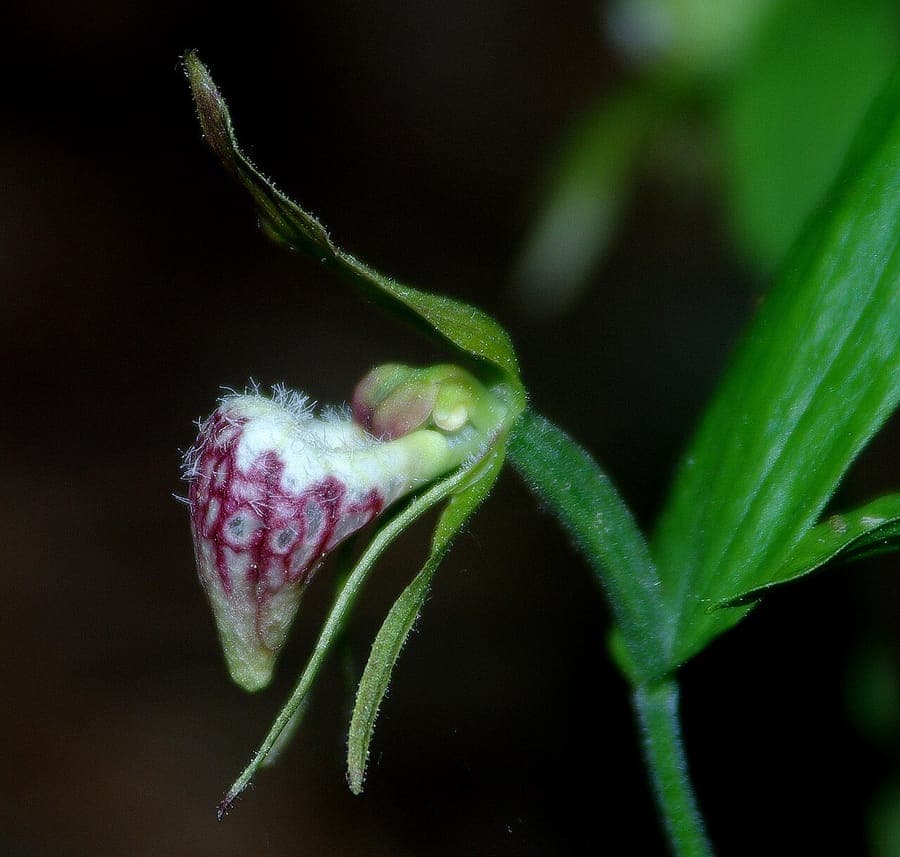
James Ellison from Canada / CC BY 2.0, via Wikimedia Commons
Ram's-head lady's slipper: complete guide
Cypripedium arietinum
Want to see Ram's-head lady's slipper: complete guide in your garden?
1 minute, no credit card
Overview
Cypripedium arietinum, commonly known as the ram's-head lady's slipper, is one of the most unusual and botanically distinctive orchids native to northeastern North America. First formally described by Robert Brown in 1813, this small terrestrial orchid has fascinated botanists and gardeners alike for over two centuries. Its natural range spans from the northeastern United States - Connecticut, Maine, New Hampshire, Vermont, New York, Massachusetts, Michigan, Wisconsin, and Minnesota - northward through the Canadian provinces of Ontario, Quebec, Nova Scotia, Manitoba, and Saskatchewan. Unlike its showier relatives, this species is subtle, even demure: a small plant with an extraordinary little flower. In cultivation, it remains one of the more challenging lady's slippers to establish, but for the dedicated gardener with the right conditions, it rewards patience with years of quiet beauty. Explore gardenworld.app to design a woodland garden that provides the cool, shaded conditions this orchid needs.
Appearance and bloom cycle
Cypripedium arietinum is a compact perennial, typically reaching 15 to 35 cm in height. The leaves are broad and elliptical, pale to medium green with prominent parallel veins, arranged in a whorl up the stem. The flower, which appears in May and June depending on your latitude and hardiness zone (USDA zones 3-6), is the plant's most striking feature. The lip - the distinctive slipper-shaped pouch - is small, white or pale pink with purple veining, and notably roughened or warty on its outer surface. This textured quality, combined with the reddish-brown sepals that arch upward and outward like a pair of ram's horns, gives the flower its common name. Most plants produce a single flower per stem; established specimens may produce two. The bloom lasts two to three weeks before fading and the stem dies back naturally.
Ideal location
In the wild, this species inhabits cool, shaded deciduous and mixed forests, often growing in moist, mineral-rich soils near stream banks or on north-facing slopes. In the garden, replicate these conditions as closely as possible. Choose a spot with dappled shade or half-shade - morning light with afternoon shade is ideal. Avoid full sun, which scorches the delicate foliage, and deep permanent shade, which suppresses flowering. A north or east-facing position under light-canopy trees such as birch, hazel, or sugar maple is excellent. Good air movement helps prevent fungal disease, but protect the plant from strong drying winds. Moisture retention is critical: this orchid does not tolerate drought. gardenworld.app can help you map the shade and moisture patterns of your garden to identify the best microclimate for this species.
Soil
Soil preparation is the single most important factor in successfully growing Cypripedium arietinum. In nature it grows in humus-rich, moist, well-drained soils with a pH between 5.5 and 7.0 - slightly acidic to neutral. Avoid heavy clay, which retains too much water, and very sandy soils, which drain too fast. Prepare a planting hole at least 30 cm deep and 25 cm wide and fill it with a blend of two parts leaf mould or composted bark, one part sharp horticultural sand, and one part sphagnum moss. This mix provides excellent moisture retention and drainage simultaneously. Never use peat-based composts, which can acidify too strongly, and avoid fresh manure or high-nitrogen fertilizers, which damage the plant's mycorrhizal associates that are essential for its nutrient uptake.
Free design
Want to see Ram's-head lady's slipper: complete guide in your garden? Make a free design now.
Watering
Keep the soil consistently moist but never waterlogged. During the active growing season from April through August, water with 8 to 12 litres per square metre weekly, split into two applications. Use collected rainwater where possible; hard tap water can raise soil pH over time and disrupt the mycorrhizal fungi the plant depends on. Apply a 3 to 5 cm mulch of pine needles or composted leaves to conserve moisture, keeping it clear of the crown by about 4 cm to prevent rot. In dry summers, check soil moisture at 5 cm depth twice weekly and water as needed. As autumn arrives and the plant begins to die back, reduce watering gradually to prevent root rot through the winter months.
Pruning
Cypripedium arietinum requires very little intervention. After flowering, allow the flower stem to die back naturally - do not cut it while it is still green. Remove dead and damaged foliage in autumn using clean, sharp scissors. Never cut into the rhizome or near its crown: any damage to the underground structure sets the plant back significantly and may cost it several years of growth. If new offsets appear around the base of an established clump, leave them in place to develop into new flowering shoots in subsequent seasons. Division should be avoided unless absolutely necessary and only attempted when the plant is dormant.
Maintenance calendar
- January: maintain mulch layer; check for frost heave
- February: no action required; plant is dormant
- March: remove old foliage; check soil moisture and drainage
- April: begin regular watering; inspect for slug damage
- May: flowers emerge; keep soil evenly moist; do not feed
- June: full bloom; watch for fungal spots in wet weather
- July: allow spent flowers and stems to wither naturally
- August: gradually reduce watering; ensure soil does not dry out completely
- September: stop all feeding; remove yellowed leaves
- October: apply fresh mulch layer of leaf compost or pine needles
- November: inspect for crown rot; ensure drainage is adequate
- December: dormant period; no action needed
Winter hardiness
Cypripedium arietinum is fully cold-hardy, tolerating temperatures to around -30 degrees Celsius (USDA zone 3). It survives harsh winters naturally across its Canadian range. The main risk in cultivation is not extreme cold, but freeze-thaw cycling in early spring, which can heave shallow rhizomes out of the ground. A light mulch of conifer branches placed over the crown in November provides adequate protection. Ensure there is no standing water over the planting site in winter: waterlogged frozen soil is far more damaging than dry cold. In USDA zones 4 to 6, no additional protection is typically needed beyond the standard mulch layer.
Companion plants
Pair this orchid with other cool woodland plants that share its preference for moist, humus-rich, lightly acidic to neutral soils and dappled shade. Excellent companions include Trillium grandiflorum (great white trillium, 20-40 cm), Dicentra canadensis (squirrel corn, 20-30 cm), Maianthemum canadense (Canada mayflower, 10-20 cm), Polystichum acrostichoides (Christmas fern, 40-60 cm), and Sanguinaria canadensis (bloodroot, 15-25 cm). Avoid aggressive spreaders such as Aegopodium podagraria or Petasites, which quickly overwhelm small orchids. Low-growing ferns used as groundcover must be planted well outside the immediate root zone of the orchid to avoid competition.
Closing
Ram's-head lady's slipper is a specialist plant for a specialist gardener, but the rewards are genuine. Few plants combine such ecological interest with such quiet floral beauty. Always purchase nursery-propagated specimens from reputable garden centres - never collect from the wild, where this species is protected and populations are fragile. With the right soil, the right shade, consistent moisture, and respect for the plant's slow pace, Cypripedium arietinum can become one of the most distinctive plants in a woodland garden. Use gardenworld.app to build a thoughtful planting plan that gives this rare orchid the best possible home.
Want to see Ram's-head lady's slipper: complete guide in your garden? Make a free design now.
Upload a photo, pick a style, and get a photorealistic design with plant list in under a minute.
10,000+ gardens designed already
No credit card required


Similar plants
Lady's-slipper: complete guide
Cypripedium calceolus
Everything you need to know about growing Cypripedium calceol游戏副本, a rare and beautiful orchid for shaded garden spots. Soil, light, and care tips included.
Sparrow's-egg lady's slipper: complete guide
Cypripedium passerinum
Everything about growing Cypripedium passerinum, a cold-hardy subarctic orchid suited to cool, moist, shaded garden spots. Soil, care and companion plants.
Cypripedium reginae: complete guide
Cypripedium reginae
Learn all about the queen lady's-slipper - a beautiful North American orchid. Care, cultivation, bloom time and interesting facts about this rare plant.