
Mg-K ((GFDL)) / CC BY-SA 3.0, via Wikimedia Commons
Lady's-slipper: complete guide
Cypripedium calceolus
Want to see Lady's-slipper: complete guide in your garden?
1 minute, no credit card
Overview
Cypripedium calceolus, commonly known as the lady's-slipper orchid, is a striking perennial that brings old-world charm to shaded garden corners. Native to woodlands across Europe and parts of Asia, this orchid thrives in cool, moist, alkaline conditions - quite unlike most of its tropical relatives. While it's protected in the wild, nursery-propagated plants are available for gardeners who want to grow this rare beauty legally and sustainably. It's not a fast grower, but with patience and proper care, it can establish long-lived colonies in the right setting. On gardenworld.app, you can design a woodland garden layout that aligns perfectly with the lady's-slipper's natural preferences.
Appearance & bloom cycle
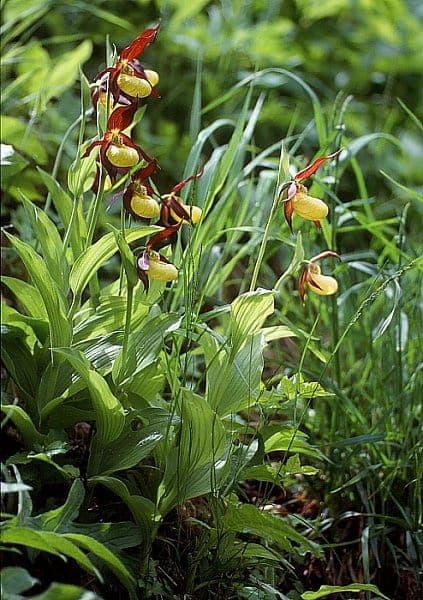
The most distinctive feature of Cypripedium calceolus is its unique flower: a bright yellow, slipper-shaped pouch about 4–5 cm wide, dangling from a stem 30–50 cm tall. The bloom appears between May and July, depending on your USDA hardiness zone (3–7). Surrounding the pouch are greenish-brown sepals and narrow, veined petals that arch backward, giving the flower an elegant, almost prehistoric look. The leaves are lance-shaped, dark green, and slightly hairy, arranged in a whorl along the stem. Each mature plant typically produces 1–3 flowers per season. Don't expect vigorous spreading - this orchid grows slowly, adding just a few centimetres per year.
Ideal location
This orchid prefers dappled shade, similar to its natural habitat at the edge of deciduous woodlands. A light level of 5 out of 10 is ideal - too much sun scorches the leaves, while deep shade reduces flowering. An east- or north-facing slope under light-canopy trees like birch or hazel works best. Avoid south-facing spots unless shaded by tall shrubs. Good air circulation is important to prevent fungal issues, but protect the plant from strong winds. If your garden lacks natural woodland cover, consider creating a shaded bed with tall ferns or shrubs to mimic these conditions. gardenworld.app offers shade-mapping tools to help you pinpoint the best microclimate.
Soil requirements
Cypripedium calceolus demands alkaline soil with a pH between 7.5 and 8.0. It will not survive in acidic or waterlogged conditions. Amend heavy clay with horticultural grit, crushed oyster shells, and well-rotted leaf mould. The ideal mix is two parts loam, one part leaf compost, and one part sand. Dig a hole 40 cm deep and wide, and backfill with this blend to ensure good drainage and root development. Avoid peat-based composts - they're too acidic and unsustainable.
Free design
Want to see Lady's-slipper: complete guide in your garden? Make a free design now.
Watering
Keep the soil consistently moist but never soggy. From April through August, provide 10–15 litres of water per square metre each week, preferably using rainwater to avoid lime buildup from tap water. During dry spells, increase frequency to twice weekly. Mulch lightly with pine needles or bark chips to retain moisture, but keep the mulch 5 cm away from the crown to prevent rot.
Pruning
No pruning is necessary. Allow spent flower stems to die back naturally. Only remove dead or damaged leaves in autumn with clean shears. Never cut into the rhizome - it's slow to recover. Leave old foliage in place over winter to insulate the crown.
Maintenance calendar
- Jan: Check for frost heave; maintain mulch layer
- Feb: No action needed
- Mar: Remove old foliage; apply thin layer of alkaline compost
- Apr: Begin regular watering; inspect for aphids
- May: Flowers emerge; keep soil evenly moist
- Jun: Peak bloom; monitor for fungal issues in wet weather
- Jul: Let flowers fade naturally
- Aug: Gradually reduce watering
- Sep: Stop feeding; allow plant to enter dormancy
- Oct: Cut back dead leaves; apply fresh mulch
- Nov: Check for crown rot; ensure drainage
- Dec: Dormant period; protect from extreme freeze-thaw cycles
Winter hardiness
Hardy in USDA zones 3–7, Cypripedium calceolus survives winter temperatures down to -34°C. In colder zones, a light mulch of straw or spruce branches helps protect the crown. Avoid heavy mulching - it can trap moisture and promote rot. The plant dies back completely in winter and re-emerges in spring.
Companion plants
Pair with other shade-tolerant, lime-loving perennials: Epimedium spp. (20–30 cm), Dictamnus albus (60–90 cm), and Heuchera spp. (30–50 cm). Avoid invasive groundcovers like ivy or mondo grass. Ferns such as Dryopteris filix-mas (45–60 cm) work well as backdrop plants without competing aggressively for nutrients.
Closing
Growing Cypripedium calceolus is a long game. It won't dazzle you in year one, but by year five, with proper care, it can become a treasured focal point. Always buy nursery-grown plants - never collect from the wild. Reputable garden centres in the UK and US increasingly stock ethically propagated specimens. With the right conditions and a thoughtful design, this orchid can thrive for decades. Use gardenworld.app to plan a low-maintenance, ecologically sound planting scheme that supports its growth.
Want to see Lady's-slipper: complete guide in your garden? Make a free design now.
Upload a photo, pick a style, and get a photorealistic design with plant list in under a minute.
No credit card required


Similar plants
Ram's-head lady's slipper: complete guide
Cypripedium arietinum
Everything you need to know about growing Cypripedium arietinum, a rare woodland orchid for cool, moist garden settings. Soil, care and planting tips.
Sparrow's-egg lady's slipper: complete guide
Cypripedium passerinum
Everything about growing Cypripedium passerinum, a cold-hardy subarctic orchid suited to cool, moist, shaded garden spots. Soil, care and companion plants.
Algerian Butterfly-orchid: complete guide
Platanthera algeriensis
Everything about Platanthera algeriensis, the rare Mediterranean orchid with greenish flowers native to Algeria, Morocco, Corsica and Spain.