
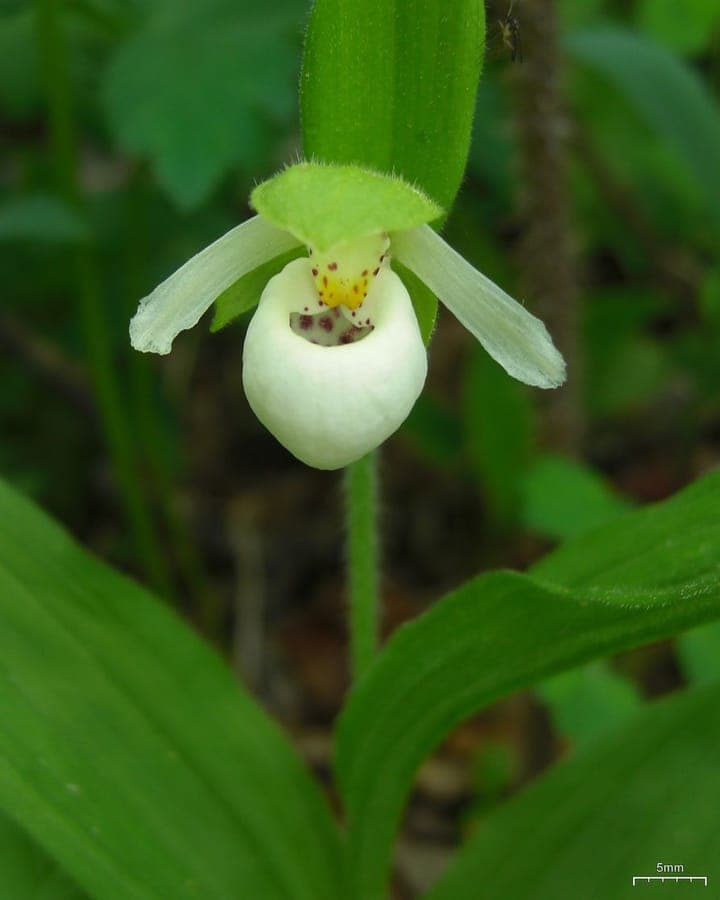
Jason Hollinger / CC BY 2.0, via Wikimedia Commons
Sparrow's-egg lady's slipper: complete guide
Cypripedium passerinum
Want to see Sparrow's-egg lady's slipper: complete guide in your garden?
1 minute, no credit card
Overview
Cypripedium passerinum, known by several common names - sparrow's-egg lady's slipper, Franklin's lady's slipper, northern lady's slipper, and small white lady's slipper - is one of the most cold-tolerant terrestrial orchids in the world. Botanist John Richardson described it formally in 1823, and its natural range extends from Alaska eastward through the Canadian north - British Columbia, Alberta, the Yukon, Northwest Territories, Nunavut, Saskatchewan, Manitoba, Ontario, and Quebec - reaching its southern limits in Montana. This is a plant of boreal forests, subalpine meadows, and cool stream banks, entirely at home in conditions that would challenge most garden plants. Its flowers are among the most restrained in the genus: small, creamy white with purple spotting on the inside of the lip, projecting an understated elegance that stands apart from the more flamboyant species. For gardeners with cool, shaded, moist conditions, this orchid is a rewarding and distinctive long-term addition. Visit gardenworld.app to explore how a woodland planting plan can be tailored to this species' specific needs.
Appearance and bloom cycle
Cypripedium passerinum is a compact perennial, typically 15 to 30 cm tall. The leaves are broad and elliptical, light to medium green, with clear parallel veins and soft fine hairs on the undersurface, arranged in a whorl along an upright stem. Flowers appear in June and July depending on latitude and USDA hardiness zone (zones 2-5). The lip - the characteristic pouch-shaped petal - is creamy white to soft pink, with reddish-purple dots on the interior that give the flower a spotted, egg-like pattern and lend it the sparrow's-egg common name. The surrounding sepals are broader and rounder than in most other Cypripedium species, giving the flower a softer, more rounded silhouette. Most plants bear a single flower per stem; established specimens occasionally produce two. Blooms last two to three weeks before the plant dies back to the rhizome for winter.
Ideal location
In nature this orchid grows in cool, moist boreal forests, often among mosses and leaf litter above mineral-rich subsoil, or along shaded stream banks. Replicate these conditions in the garden by selecting a position with half-shade to shade. A north or northeast-facing site, sheltered from direct midday and afternoon sun, is ideal. Dappled light filtered through a light tree canopy - birch, alder, or spruce at the garden margin - works well. Avoid deep permanent shade that prevents flowering, and equally avoid full sun, which scorches leaves and stresses the root system. The site should remain cool throughout summer: this species dislikes heat. Adequate air movement is helpful to reduce fungal risk, but strong drying winds are harmful. gardenworld.app provides shade analysis and microclimate mapping tools to identify the best position for this cool-loving orchid in your garden.
Soil
Soil preparation is critical for success with this species. It prefers moist, well-drained, humus-rich soil with a pH of 5.5 to 7.0 - from slightly acidic to neutral. Heavy clay soils that retain standing water are unsuitable, as are very chalky soils with a high pH. Prepare a planting hole 30 cm deep and 25 cm wide and fill it with a mix of two parts leaf mould or composted bark, one part coarse horticultural sand, and one part sphagnum moss or unfertilised peat. This blend provides good moisture retention alongside effective drainage. Never add high-nitrogen fertilizers or fresh manure: the plant depends on mycorrhizal fungi for nutrient uptake, and these fungi are damaged by excessive nitrogen. Slow-release, low-nutrient organic amendments such as composted leaves are the only appropriate feeding.
Free design
Want to see Sparrow's-egg lady's slipper: complete guide in your garden? Make a free design now.
Watering
Keep the soil consistently moist but not waterlogged from April through August. Water with 8 to 12 litres per square metre weekly, ideally using collected rainwater. Hard tap water with high calcium content can gradually raise soil pH and disturb the mycorrhizal partnership the orchid depends on. Mulch with 3 to 5 cm of pine needles or composted leaves, keeping mulch 4 cm clear of the crown. During dry spells, check soil moisture at 5 cm depth twice weekly and water as needed. From September onward, gradually reduce watering as the plant enters dormancy, to prevent root rot over winter.
Pruning
This orchid requires very little pruning. Allow flower stems and leaves to die back naturally after blooming. Remove dead plant material in autumn using clean, sharp scissors. Never cut into or near the rhizome. New small shoots emerging at the base of established plants should be left undisturbed - they will develop into flowering plants over subsequent seasons. Division is rarely necessary and should only be attempted when the plant is fully dormant, at least five years after initial establishment.
Maintenance calendar
- January: check and maintain mulch layer; inspect for frost damage
- February: no action required; plant is dormant in the rhizome
- March: remove old leaf debris; check soil moisture and drainage
- April: resume watering; watch for slug damage as new growth emerges
- May: new shoots appear; keep soil evenly moist
- June: flowers emerge; do not feed; monitor for fungal spots
- July: full bloom; watch for aphids; avoid drought stress
- August: blooming ends; gradually reduce watering
- September: stop all feeding; remove yellowed foliage
- October: apply fresh mulch of pine needles or leaf compost
- November: check for crown rot; ensure drainage is functioning
- December: dormant period; no action needed
Winter hardiness
Cypripedium passerinum is among the most cold-tolerant of all lady's slippers, surviving temperatures as low as -40 degrees Celsius, which places it in USDA zones 2 to 3. In most of northern and central Europe, winter cold is not a limiting factor for this species. The greater risk in cultivation is repeated freeze-thaw cycling in early spring, which can heave shallow rhizomes out of the soil. A light covering of conifer branches placed over the crown in November provides adequate protection. Avoid standing water over the planting site in winter, which is the most common cause of winter loss in cultivated specimens.
Companion plants
Choose companions that share this orchid's preference for cool, moist, humus-rich conditions in half-shade. Excellent partners include Cornus canadensis (bunchberry, 5-15 cm), Linnaea borealis (twinflower, 4-8 cm), Maianthemum bifolium (May lily, 10-20 cm), Coptis trifolia (goldthread, 5-15 cm), and small woodland ferns such as Gymnocarpium dryopteris (oak fern, 15-25 cm). Cushion mosses make excellent groundcover companions as they stabilise moisture around the orchid's roots without competing for space. Avoid vigorous spreading groundcovers such as Aegopodium or Petasites. gardenworld.app can help you visualise combinations of rare woodland plants in a complete, ecologically coherent planting plan.
Closing
Sparrow's-egg lady's slipper is a specialist plant that rewards careful preparation and patient long-term management. Its flower is subtle but genuinely beautiful - a small, precise creation that speaks to the richness of the boreal flora. Always purchase nursery-propagated stock from reputable specialist suppliers or established garden centres. Wild collection is illegal and ecologically damaging. With the right soil, the right cool shade, consistent moisture, and respect for the plant's slow pace, Cypripedium passerinum can thrive for decades. Use gardenworld.app to design a woodland garden that gives this rare northern orchid the conditions it deserves.
Want to see Sparrow's-egg lady's slipper: complete guide in your garden? Make a free design now.
Upload a photo, pick a style, and get a photorealistic design with plant list in under a minute.
10,000+ gardens designed already
No credit card required


Similar plants
Lady's-slipper: complete guide
Cypripedium calceolus
Everything you need to know about growing Cypripedium calceol游戏副本, a rare and beautiful orchid for shaded garden spots. Soil, light, and care tips included.
Ram's-head lady's slipper: complete guide
Cypripedium arietinum
Everything you need to know about growing Cypripedium arietinum, a rare woodland orchid for cool, moist garden settings. Soil, care and planting tips.
Cypripedium reginae: complete guide
Cypripedium reginae
Learn all about the queen lady's-slipper - a beautiful North American orchid. Care, cultivation, bloom time and interesting facts about this rare plant.