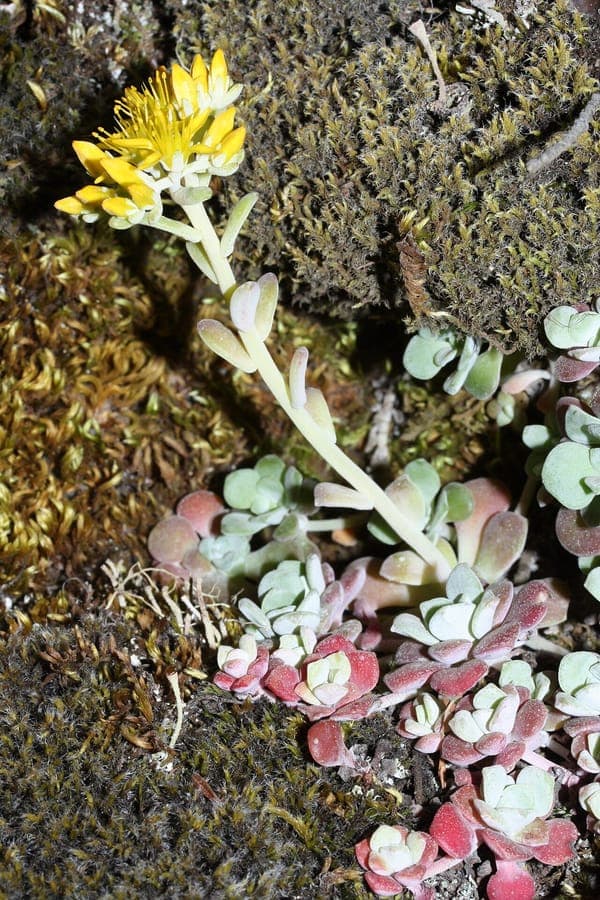
Walter Siegmund (talk) / CC BY-SA 3.0, via Wikimedia Commons
Sedum spathulifolium: complete guide
Sedum spathulifolium
Want to see Sedum spathulifolium: complete guide in your garden?
Full design in HD: €7.99
Look after your Sedum spathulifolium with the GardenWorld app
Identify plants with your camera and get a care calendar with reminders for this plant.


Overview
Sedum spathulifolium, the Colorado stonecrop, is a robust succulent from the Crassulaceae family. This North American plant is valued for its frost hardiness and extremely low water requirements. Perfect for green roofs, rock gardens and dry borders.
Appearance and Bloom
The plant forms dense rosette formations of 10 to 20 centimeters in diameter. The spoon-shaped leaves are blue-green to gray-green in color with reddish tints in winter. From June to July, yellow flowers appear on upright stems of 15 to 20 centimeters. Very attractive to bees.
Ideal Location
Sedum spathulifolium grows best in full sun with at least six hours of direct sunlight per day. The plant tolerates partial shade, but colors and blooms better in full sun. Highly suitable for roof plantings and walls.
Soil
Use very well-draining soil, preferably pure sharp sand or gravel mixture. Add some organic matter, but no more than 10 percent. Avoid water-retaining soils completely. For green roof use special sedum substrate.
Free preview
Want to see Sedum spathulifolium: complete guide in your garden? Make a free preview of your design.
Watering
After planting, water lightly until established. After that, water almost not at all. The plant stores water and moisture in the leaves. Water only during extremely dry periods. Excessive moisture leads to rot.
Pruning
Normally no pruning needed. Do remove dead rosette formations in spring. After flowering, stems can be removed. Plant naturally expands through offsetting rosettes.
Maintenance Calendar
May to June: peak growth period. June to July: flowering period. August to September: seed setting. October to March: dormant period with minimal activity.
Winter Hardiness
The plant is very winter hardy, down to about -20 degrees Celsius. No special frost protection needed. Leaf loss in extreme frost may occur, but plant recovers in spring.
Companion Planting
Combine with other succulents such as Sempervivum, Echeveria and Aeonium. Works well in alpine gardens, rock gardens and green roofs. Combine with grasses and loose gravel for a natural effect.
Closing
Sedum spathulifolium is essential for sustainable, water-smart gardens. Available at major garden retailers. Discover more succulents on gardenworld.app. Consult gardenworld.app for green roof design tips.
Frequently asked questions about Sedum spathulifolium
Is Sedum spathulifolium winter hardy?
The plant is very winter hardy, down to about -20 degrees Celsius. No special frost protection needed.
When and how do you prune Sedum spathulifolium?
Normally no pruning needed. Do remove dead rosette formations in spring.
How much water does Sedum spathulifolium need?
After planting, water lightly until established. After that, water almost not at all.
Where does Sedum spathulifolium grow best?
Sedum spathulifolium grows best in full sun with at least six hours of direct sunlight per day. The plant tolerates partial shade, but colors and blooms better in full sun.
What soil does Sedum spathulifolium need?
Use very well-draining soil, preferably pure sharp sand or gravel mixture. Add some organic matter, but no more than 10 percent.

See it in your garden
See Sedum spathulifolium in your garden
One photo of your garden and a few questions. You see the result in about a minute.
Try it with a photoIdentify this plant in your own garden. Identify a plant
Similar plants
Aeonium tabuliforme: growing the saucer plant
Aeonium tabuliforme
Aeonium tabuliforme, the saucer plant, forms a flat, hairy rosette like a green plate. How to grow this Tenerife succulent, tilt it, water it and overwinter it.
String of buttons (Crassula perforata): care guide
Crassula perforata
How to grow string of buttons, Crassula perforata: light, watering, compost, cuttings and overwintering for this succulent with leaf pairs stacked like beads on a stem.
Glaucous echeveria (Echeveria secunda): complete guide
Echeveria secunda
Echeveria secunda forms mats of blue-grey rosettes with red leaf tips and is one of the toughest echeverias. Light, watering, potting mix, propagation and pet safety.
