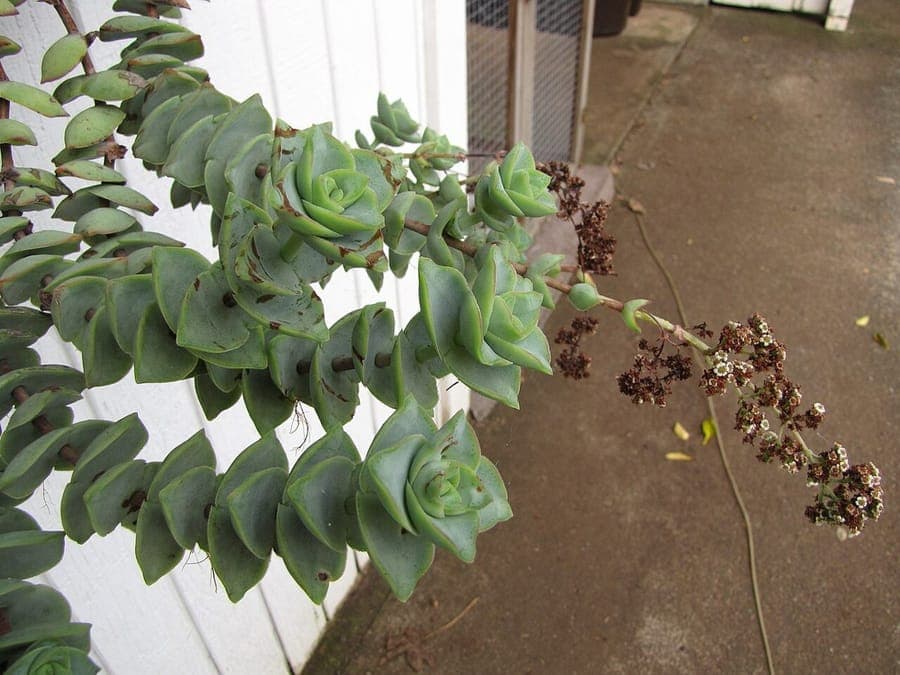
Forest and Kim Starr / CC BY 3.0 us, via Wikimedia Commons
String of buttons (Crassula perforata): care guide
Crassula perforata
Want to see String of buttons (Crassula perforata): care guide in your garden?
Full design in HD: €7.99
Look after your String of buttons with the GardenWorld app
Identify plants with your camera and get a care calendar with reminders for this plant.


Overview
Crassula perforata is a succulent you recognise at a glance. Its leaves grow in opposite pairs that are fused at the base, so the stem appears to have been threaded straight through them. Pair after pair, each turned a quarter of the way round from the one below, they stack into little columns that look like buttons or beads on a string. Hence the English name, string of buttons, which is how you will often find it labelled.
The species name perforata, meaning pierced, refers to exactly this arrangement. The plant comes from South Africa, chiefly the Eastern Cape and KwaZulu-Natal, where it grows among rocks and in scrub and copes easily with long dry spells. It is a relative of the familiar jade plant, Crassula ovata, yet looks completely different: no thick trunk or tree shape, just slender stems that start upright and later lean and trail.
This is a plant for anyone who enjoys structure and geometry. A young pot looks like a cluster of miniature towers. As the stems lengthen to around 40 to 60 cm, their own weight bends them over the rim, giving a loose, cascading plant like the one in the photo, where the stems tumble down and outwards against a white wall.
Appearance and flowering
The leaves are triangular to broadly oval, 1 to 2 cm long, fleshy and grey-green with a light waxy bloom. Their edges are often finely dotted with red or pink, and in plenty of sun whole leaf pairs take on a reddish flush. Older stems sometimes show brown marks or dried lower leaves; that is normal ageing rather than disease.
There is a variegated form, Crassula perforata 'Variegata', with creamy yellow stripes along the leaf margins. You will also come across hybrids such as 'Baby's Necklace', which stay more compact with smaller, rounder leaf pairs. These are sometimes sold under the species name, so it is worth reading the label carefully.
Flowering usually comes in spring or early summer. A branched spray of countless tiny, star-shaped flowers, pale yellow to creamy white, appears at the tip of a stem. They are hardly showy, but outdoors or in a conservatory they attract small insects. After flowering the spray dries out, as on the right of the photo. That stem tip will not grow any further, but the plant sends out new shoots lower down.
Position and light
Give Crassula perforata as much light as you can. A south or west-facing windowsill with a few hours of direct sun is ideal. In sun the leaf pairs stay tightly stacked and the margins colour up. In a dim spot the stems stretch, the gaps between leaf pairs widen and the plant loses its characteristic stacked look.
In summer the pot can happily go outdoors, from late May to late September. Let it acclimatise for a week in light shade before moving it into full sun, because sudden strong light causes scorch marks. A covered patio or a spot under the eaves is perfect: plenty of light but no days of rain soaking the pot. An ordinary houseplant position in the middle of a room is simply too dark.
Compost and repotting
The roots are fine and shallow, so a wide, fairly shallow pot suits it best. Use cactus and succulent compost, or mix multipurpose compost with at least a third coarse grit, pumice or lava rock. Terracotta keeps the roots drier than plastic and gives a sometimes top-heavy plant more stability.
Repot in spring every two to three years, or when the stems have grown so long that the pot topples over. Work gently, because the stems snap easily at the leaf joints. Do not throw broken pieces away; they make ready-made cuttings. After repotting, wait a week before watering. From April to August a half-strength succulent feed once a month is enough.
Free preview
Want to see String of buttons (Crassula perforata): care guide in your garden? Make a free preview of your design.
Watering and rest
Follow the soak and dry approach. Water thoroughly until it drains from the hole in the base, then wait until the compost is dry right to the bottom of the pot. During the growing season that usually works out at once every seven to ten days. In a summer heatwave growth slows down and the plant needs less than you might expect.
A thirsty plant shows it clearly: the leaves become thinner, duller and slightly wrinkled, and they plump up again within a day of watering. Overwatering is far more dangerous. The lower leaf pairs turn yellow and glassy and the stem rots at the base, often before anything shows from above.
From November to February keep the plant cool and bright, at 8 to 15 °C, and give just a small amount of water every three to four weeks. This rest produces sturdy new growth in spring.
Pruning and propagation
Pruning is not strictly necessary, but you can reshape a sprawling plant by shortening long or bare stems. Cut just above a leaf pair; one or two new shoots usually appear there, making the plant bushier. Trim spent flower sprays back to the first healthy pair of leaves.
Cuttings root remarkably easily. Take a stem tip 5 to 10 cm long, strip off the lowest two leaf pairs and let the cutting dry for a few days to a week. Then insert it in dry succulent compost and water for the first time a week later. Within a few weeks it will have rooted. Put three or four cuttings in one pot for a full look in a single season. Single leaves can root too, but more slowly than stem cuttings.
While you are at it, keep an eye out for mealybugs. They love to hide in the narrow gap between leaf pairs. Dab them off with a cotton bud dipped in surgical spirit and repeat a few times.
Maintenance calendar
March–April: More light and gradually more water. Repot and shape the plant; root the trimmed tips.
May–June: Move outdoors after the last frost, starting in light shade. Flowering time.
July–August: Water when completely dry, half-strength feed once a month. Remove spent flower sprays.
September–October: Stop feeding. Bring indoors before any frost and check for mealybugs.
November–February: Cool, bright rest with very little water.
The planting calendar on gardenworld.app can remind you of seasonal jobs like these, so repotting and bringing pots indoors never slip your mind.
Winter hardiness
Crassula perforata will not tolerate real frost. A dry plant may survive a brief night around 0 °C, but in a British or north-west European winter it belongs indoors. Bring the pot inside once nights fall below 5 °C. A cool, bright room, a landing or a frost-free conservatory is better than a warm sitting room, because warmth combined with weak winter light produces soft, stretched growth.
Little is recorded about the toxicity of this particular species. Its relative Crassula ovata is listed as mildly toxic to cats and dogs, typically causing vomiting, so it makes sense to keep Crassula perforata out of reach of pets and small children too.
Companion plants
String of buttons looks great in a hanging pot or a tall container, but it also works in a bowl with other succulents that share its rhythm. Crassula rupestris has a similar stacked leaf arrangement with thicker, rounder leaves, and the two together make a playful study in shape. Portulacaria afra adds a shrubby note with its reddish-brown stems and small round leaves. Burro's tail, Sedum morganianum, and the blue rosettes of Echeveria elegans complete the picture, while a jade plant at the back gives height.
If you would like your patio or garden to work better with your pots, you can have a garden design created on gardenworld.app with a sunny spot set aside for summer containers.
Final thoughts
Crassula perforata has an almost architectural character: leaf pairs strung like beads on a cord, and stems that stand upright at first before arching gracefully over. It needs no more than a bright spot, gritty compost, water once the pot has dried out and a cool winter. A few cuttings fill a pot in a single season, and every snapped stem is another chance to start a new plant.
Frequently asked questions about String of buttons
Is String of buttons winter hardy?
Crassula perforata will not tolerate real frost. A dry plant may survive a brief night around 0 °C, but in a British or north-west European winter it belongs indoors.
When and how do you prune String of buttons?
Pruning is not strictly necessary, but you can reshape a sprawling plant by shortening long or bare stems. Cut just above a leaf pair; one or two new shoots usually appear there, making the plant bushier.
How much water does String of buttons need?
Follow the soak and dry approach. Water thoroughly until it drains from the hole in the base, then wait until the compost is dry right to the bottom of the pot.

See it in your garden
See String of buttons in your garden
One photo of your garden and a few questions. You see the result in about a minute.
Try it with a photoIdentify this plant in your own garden. Identify a plant
Similar plants
Crassula rupestris: complete guide
Crassula rupestris
Rosary plant: South African succulent with rope-like stems. Perfect for dry locations. Water-minimal growing guide and heat tolerance info.
Jade plant: complete guide
Crassula ovata
Discover how to care for Crassula ovata: ideal lighting, watering, and seasonal care. A low-maintenance succulent perfect for homes and gardens on gardenworld.app.
Portulacaria afra: complete guide
Portulacaria afra
Discover the Elephant bush - a nutritious African succulent with dense, light green foliage. Ideal for arid gardens and indoor plant combinations.
