
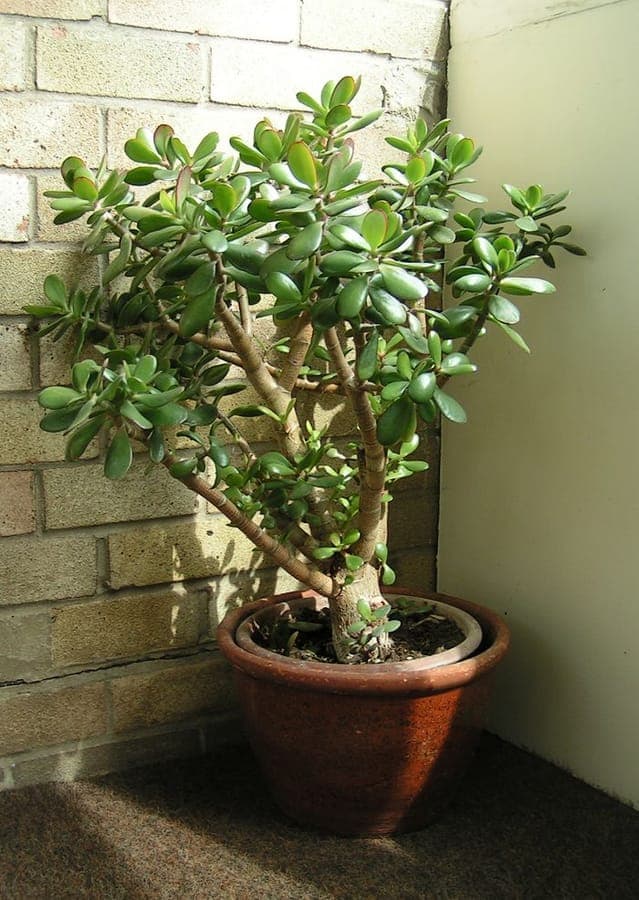
author is sannse. / CC BY-SA 3.0, via Wikimedia Commons
Jade plant: complete guide
Crassula ovata
Want to see Jade plant: complete guide in your garden?
1 minute, no credit card
Overview
The jade plant, scientifically known as Crassula ovata, is a staple in homes and offices around the world. Despite its common name 'Japanese rubberplant', it's native to the Cape Provinces, KwaZulu-Natal in South Africa, and parts of Mozambique. It belongs to the Crassulaceae family and thrives as a shrub with thick, fleshy leaves that store water. Revered for bringing good luck and prosperity, it's a favorite among plant lovers. Whether you're designing a cozy indoor corner or a drought-friendly garden, you can use gardenworld.app to create a layout that puts your jade plant front and center.
Appearance & bloom cycle
Crassula ovata has a compact, shrub-like habit and typically grows 60 to 90 cm tall indoors, but can reach up to 1.5 meters in optimal outdoor conditions. Its trunk becomes woody and gnarled with age, giving it an almost bonsai-like character. The leaves are smooth, oval-shaped, and glossy, measuring about 2 to 4 cm long and up to 2.5 cm wide. They grow in opposite pairs along sturdy stems and are a rich, dark green, sometimes developing a reddish edge when exposed to strong sunlight. Under the right conditions-cool nights and bright light-it may produce clusters of small, star-shaped pink or white flowers from late autumn to early winter, usually between October and December. However, flowering is rare in indoor settings unless the plant goes through a proper dormancy period with reduced watering and cooler temperatures.
Ideal location
Jade plants need bright, indirect light. A south- or east-facing window is ideal, providing 4 to 6 hours of direct sun daily. This keeps growth compact and prevents legginess. If placing it outside during summer, choose a spot with partial shade-like under a tree or covered patio-to avoid leaf scorch. It can stay outdoors from June to September as long as nighttime temperatures don't drop below 10°C (50°F). Rotate the pot every few weeks for even growth. If the stems stretch and leaves space out, it's a sign of insufficient light. For gardeners planning sun exposure, gardenworld.app offers tools to visualize light patterns and plant placement in your space.
Soil requirements
Use a fast-draining mix to prevent root rot. A blend of 2 parts potting soil and 1 part perlite or coarse sand works well. Pre-made cactus or succulent soil, available at most garden centres, is also suitable. Avoid moisture-retentive garden soil. Always use a pot with drainage holes. Add a 1 to 2 cm layer of gravel or pumice at the bottom to enhance drainage.
Free design
Want to see Jade plant: complete guide in your garden? Make a free design now.
Watering
Overwatering is the most common cause of death for jade plants. They're adapted to dry conditions and store water in their leaves. Follow the "soak and dry" method: water thoroughly only when the top 2.5 to 5 cm of soil is completely dry. In the growing season (April to September), this means watering every 10 to 14 days. In winter (October to March), reduce to once every 3 to 4 weeks. Use room-temperature water and water slowly until it drains from the bottom. Never let the plant sit in water. If leaves turn soft, yellow, or translucent, it's a sign of overwatering.
Pruning
Pruning isn't essential but helps shape the plant and encourage bushier growth. Use clean, sharp scissors and cut just above a leaf node or pair. Remove any dead or shriveled leaves at the base. Pruned stems can be used for propagation-let them callous for 1–2 days, then place in dry succulent mix. Roots usually form within 3 to 4 weeks.
Maintenance calendar
- January: Minimal watering. Check for pests like mealybugs.
- February: Keep dry. Ensure bright light exposure.
- March: Prepare for growth. Increase light and inspect for new shoots.
- April: Begin regular watering every 10–14 days. Watch for new growth.
- May: Water as needed. Move outdoors if temperatures allow.
- June: Keep in partial shade outside. Monitor for aphids.
- July: Maintain consistent care. Avoid wetting leaves.
- August: Final outdoor month. Ensure good airflow.
- September: Bring indoors before night temps drop below 10°C.
- October: Reduce watering. Flower buds may appear.
- November: Water sparingly. Maintain bright light.
- December: Rest period. Minimal care. Possible blooming.
Winter hardiness
Crassula ovata is not frost-hardy. It tolerates brief dips to 5°C (40°F) but performs best above 10°C (50°F). It's suitable for USDA zones 10–11 only. In temperate climates, grow it as a houseplant or in containers that can be moved indoors during winter. Avoid placing near radiators or cold drafts.
Companion plants
Pair jade plants with other succulents that share its care needs. Good companions include Echeveria, Sedum morganianum, and Haworthia. These thrive in the same bright, dry conditions and look stunning in mixed containers. Use shallow, wide pots with good drainage. A succulent bowl with varied textures and colors makes a bold statement on a coffee table or patio. For layout inspiration, explore garden designs on gardenworld.app that highlight succulent groupings.
Closing
The jade plant is forgiving, long-lived, and rewarding with minimal effort. With proper light, well-draining soil, and careful watering, it can live for decades. Watch for pests, prune for shape, and enjoy its slow, steady growth. Whether perched on a windowsill or featured in a garden plan, it's a timeless addition. For personalized care tips and layout ideas, visit gardenworld.app to design your ideal planting scheme.
Want to see Jade plant: complete guide in your garden? Make a free design now.
Upload a photo, pick a style, and get a photorealistic design with plant list in under a minute.
No credit card required


Similar plants
Sedum nevadense: complete guide
Sedum nevadense
Discover Sedum nevadense, the stunning alpine stonecrop from the Pyrenees. Expert care tips, growing requirements, and design ideas for rock gardens.
Aizoon stonecrop: complete guide
Phedimus aizoon
Everything about Phedimus aizoon - the frost-tolerant aizoon stonecrop from Siberia with bright yellow flowers. Planting, care and garden use.
Roseroot: complete guide
Rhodiola rosea
Everything about roseroot (Rhodiola rosea): a tough hardy succulent ideal for rock gardens, green roofs, and dry sunny positions.