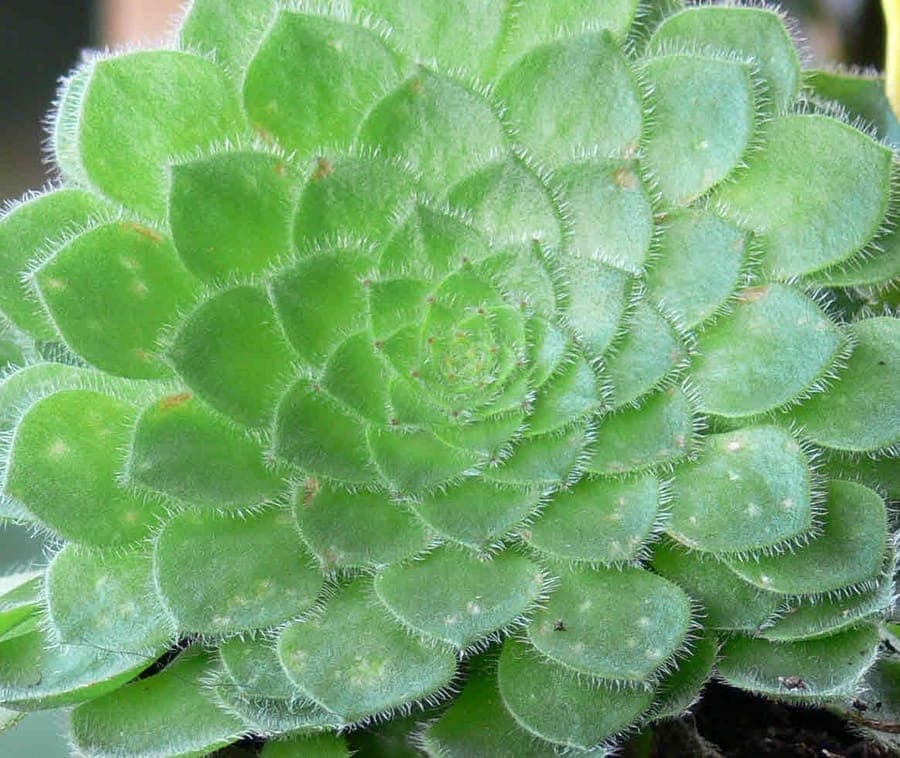
Peter Coleman / CC BY-SA 3.0, via Wikimedia Commons
Aeonium tabuliforme: growing the saucer plant
Aeonium tabuliforme
Want to see Aeonium tabuliforme: growing the saucer plant in your garden?
Full design in HD: €7.99
Look after your Aeonium tabuliforme with the GardenWorld app
Identify plants with your camera and get a care calendar with reminders for this plant.


Overview
Aeonium tabuliforme is one of the strangest succulents you can grow on a windowsill. Most aeoniums hold their rosettes aloft on sturdy stems, but this one lies flat like a green dinner plate. A mature rosette can carry well over a hundred leaves, packed so neatly that the whole thing looks like a carefully laid mosaic. Hence its English names, saucer plant and flat-topped aeonium.
The species is found only on Tenerife, the largest of the Canary Islands. It grows on damp, often north-facing cliffs and ledges in the lower coastal zone, where it clings almost vertically to the rock. Rain runs straight off the rosette in that position, and that simple fact is the key to growing it well indoors: the closer you copy its natural angle, the healthier it stays.
There is a second thing to know before you buy one. Aeonium tabuliforme is monocarpic, which means a rosette flowers once and then dies. It is part of the plant's life cycle rather than a failure on your part. It sets thousands of seeds as it goes, and it is one of the few aeoniums that can also be raised from a single leaf. If you would like to give it a permanent spot on a patio or in a conservatory display, you can have a garden design made on gardenworld.app that also plans the containers and pots.
Appearance and flowering
A mature rosette is usually 20 to 40 cm across, occasionally a little wider, and only a few centimetres high. The stem is so short you will barely see it. The leaves are obovate to spoon-shaped, pale to fresh green, and fringed with fine white hairs. In the photograph you can see that fringe as a silvery edge around every leaf. In the wild those hairs catch dew and mist, and they give the plant its soft look.
After several years, often four to six, a rosette may flower. The centre domes up and a conical flower spike rises from the middle, reaching around half a metre. It carries hundreds of small, pale yellow starry flowers, usually in late spring or summer. Afterwards the rosette slowly dries out. The plant rarely makes offsets, so if you want to keep it, sow seed or take leaf cuttings in good time.
Position and light
Give Aeonium tabuliforme plenty of light but not scorching midday sun behind glass. An east- or west-facing window is ideal, as is a bright conservatory with a little shade around midday. In its native habitat it grows on rock faces that are shaded for part of the day, and its pale leaves scorch more easily than those of tougher species such as Aeonium arboreum.
From May to September it can go outdoors in a sheltered spot with morning sun and light afternoon shade. Keep it under an overhang or somewhere heavy rain will not batter it. Give it a week in light shade first to adjust, or the leaves will develop brown patches.
The single most useful tip: grow the rosette at an angle. Tilt the pot slightly, or plant it in a bowl so it leans. Better still, tuck it into a gap in a dry stone wall or between rocks, where it can sit almost upright as it does on Tenerife. Water lying in the centre is the most common cause of rot.
Compost and repotting
Use an open, fast-draining mix. Cactus and succulent compost with an extra third of fine grit, pumice or perlite works well. A terracotta pot with a generous drainage hole helps the compost dry out quickly. Choose a pot slightly wider than the root ball: the rosette needs width rather than depth.
Repot in early autumn, at the start of the growing season, and only when the plant has genuinely outgrown its pot. Work carefully, because the leaves snap off easily and the rosette is awkward to hold. A strip of card wrapped around it gives you something to grip. Finish with a layer of grit so the lowest leaves do not rest on damp compost.
Watering
Aeoniums are winter growers. They grow mainly from autumn to spring and go semi-dormant in the hottest summer months, and that sets your watering rhythm. From October to April, water when the compost is mostly dry, usually every one to two weeks depending on light and temperature. In summer give less: a small drink when the leaves begin to feel soft.
Always water around the edge of the pot onto the compost, never over the rosette. If you prefer, stand the pot in a saucer for ten minutes to take up water from below, then tip away the excess. Never leave it standing in water. Overwatering shows as glassy, limp leaves and a soft brown centre. Underwatering shows as thinner leaves curling upwards. The second is easy to put right; the first often is not.
Free preview
Want to see Aeonium tabuliforme: growing the saucer plant in your garden? Make a free preview of your design.
Growth cycle and summer rest
Because it grows in the cool months, the plant needs its best light in winter. Move it to your brightest spot, ideally at 10 to 18 °C. A warm, dim room produces stretched, pale leaves, and a grow light above the plant is a sensible addition during our darkest months.
In summer, leave it alone: no feed, little water and good air movement. During the growing season you can give a half-strength succulent feed once a month, although it is not essential. An overfed rosette turns soft and more prone to rot.
Propagation
Seed is the traditional route. After flowering, collect the spent spikes in a paper bag. Sow the dust-fine seed in autumn or early spring on moist, fine seed compost, press it in lightly and do not cover it, as it needs light to germinate. Keep the tray at 18 to 22 °C under a clear lid and ventilate daily. Tiny rosettes appear within a few weeks.
Leaf cuttings also work with this species, which is unusual among aeoniums. Twist a healthy leaf sideways off the stem, let it dry for a few days and lay it on dry succulent compost. Roots and a small rosette follow after several weeks. It takes patience, but it means you do not have to wait for flowering to secure a new plant.
Care calendar
January and February: Brightest spot, moderate watering. Check between the leaves for mealybugs.
March and April: Strong growth. Water when the compost is dry and give a half-strength feed if you wish.
May: Harden off and move outdoors to a sheltered, lightly shaded spot.
June to August: Summer rest. Little water, no feed, protection from harsh midday sun and heavy rain.
September: Growth picks up again. Repot if needed and take leaf cuttings.
October: Bring indoors before nights drop below 5 °C. A good time to sow.
November and December: Keep bright and cool, and water when the compost feels dry.
To keep these jobs on track, add them to the plant calendar on gardenworld.app, which shows month by month what your plants need.
Hardiness
Aeonium tabuliforme is not frost hardy. It copes with cool nights, but frost damages the fleshy leaves. Treat roughly 5 °C as the minimum. A dry plant will sometimes survive a brief dip to around freezing, but combined with wet compost that is usually fatal. Overwinter it indoors or in a frost-free, bright greenhouse. An unheated spare bedroom with a large window often suits it better than a warm living room.
Toxicity to pets
Aeoniums are not known to be toxic to cats and dogs, and there are no reports of serious poisoning from this species. As with any plant, an animal that eats a lot of it may get an upset stomach. In practice the plant is more at risk than the pet: a cat jumping onto the windowsill will easily snap off leaves, so choose a spot where it can sit undisturbed.
Companion plants
The flat rosette looks best beside plants with a different shape. A branching Aeonium arboreum or Aeonium haworthii adds height, while a blue-grey Echeveria elegans gives a lovely colour contrast. Crassula ovata fits into the same group too, although it takes more sun. In a shallow gritty bowl you can pair it with small houseleeks such as Sempervivum arachnoideum, but bring that bowl inside for winter, since the houseleek is hardy and the aeonium is not. Make sure everything in the group enjoys the same dry treatment.
Final thoughts
Aeonium tabuliforme suits anyone who loves unusual shapes and has a bit of patience. Give it plenty of winter light, a tilted position so water runs off, fast-draining compost and a quiet summer, and it will grow into a green plate that stops visitors in their tracks. If it ever flowers, enjoy the yellow spire and catch the seed: that is simply how the cycle begins again.
Frequently asked questions about Aeonium tabuliforme
Is Aeonium tabuliforme winter hardy?
Aeonium tabuliforme is not frost hardy. It copes with cool nights, but frost damages the fleshy leaves.
How much water does Aeonium tabuliforme need?
Aeoniums are winter growers. They grow mainly from autumn to spring and go semi-dormant in the hottest summer months, and that sets your watering rhythm.

See it in your garden
See Aeonium tabuliforme in your garden
One photo of your garden and a few questions. You see the result in about a minute.
Try it with a photoIdentify this plant in your own garden. Identify a plant
Similar plants
Aeonium arboreum: complete guide
Aeonium arboreum
Learn all about tree aeonium. Cultivation advice for successful growing, maintenance tips and suitable for pots and dry borders. Subtropical accent.
Aeonium Haworthii: complete guide
Aeonium haworthii
The Haworth's aeonium is a beautiful succulent from the Canary Islands. Learn how to grow, care for, and propagate this rosette-forming cactus for years of green beauty at home.
Echeveria elegans: complete guide
Echeveria elegans
Echeveria elegans, known as Pearl Echeveria, is a beautiful rosette-forming succulent. Learn complete care guide, watering, soil and ideal locations.
