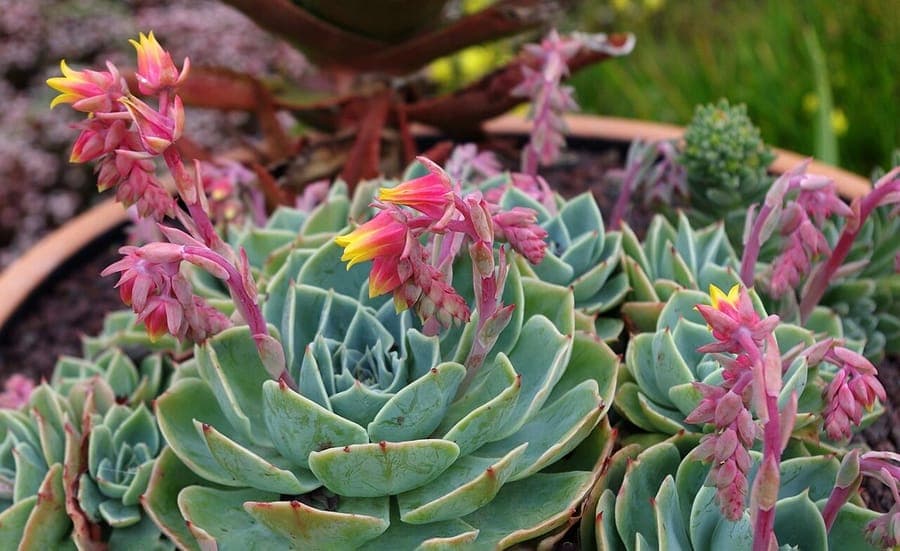
Dinkum / CC BY-SA 3.0, via Wikimedia Commons
Glaucous echeveria (Echeveria secunda): complete guide
Echeveria secunda
Want to see Glaucous echeveria (Echeveria secunda): complete guide in your garden?
Full design in HD: €7.99
Look after your Glaucous echeveria with the GardenWorld app
Identify plants with your camera and get a care calendar with reminders for this plant.


Overview
Echeveria secunda is one of the classic rosette succulents: small, neat rosettes in a cool blue-grey, each leaf finished with a red point. Where many echeverias stay solitary, this one keeps producing new offsets. After a few years you no longer have a single plant but a dense cushion of dozens of rosettes spilling over the edge of the bowl. It is known as glaucous echeveria, after the bluish waxy bloom on its leaves.
It comes from the highlands of central Mexico, where it grows on rocky slopes, often at considerable altitude. There it gets bright sun, cool nights and the occasional light frost, which makes it tougher than most of its relatives. In mild coastal parts of western Europe, such as Brittany, Cornwall and the Isles of Scilly, it grows outdoors all year in rockeries and walls. Further inland it is best kept in pots and troughs that you can protect over winter.
Botanically it is a slightly muddled species. Over the years many names were published for it, including Echeveria glauca, and these are now treated as synonyms or varieties. A well-known cultivar is 'Compton Carousel', with cream-edged leaves, which holds the RHS Award of Garden Merit. If you want to give it a permanent home in a dry, sunny corner or on your patio, you can have a garden design made on gardenworld.app that takes the sun and drainage of each spot into account.
Appearance and flowering
A rosette of Echeveria secunda is usually 5 to 10 cm across. The leaves are short, broadly spoon-shaped and fleshy, ending in a pointed tip that turns red, especially in strong sun and cool nights. The waxy coating gives them a blue-grey to sea-green tint. Try not to handle it too much: fingerprints stay visible, and once rubbed off the bloom does not grow back.
In spring and early summer the flower stems appear, 10 to 30 cm long and pinkish red. The bell-shaped flowers are red outside and yellow inside and at the tips. They all face one side of the stem, which is where the name comes from: secunda means "turned to one side". Bees and hoverflies visit them readily. After flowering only the stem dies back; the rosette itself carries on.
Light and position
Full sun is the key to a compact, well-coloured plant. Outdoors, give it the sunniest spot on the patio from May to October. Indoors it needs a south-facing window, and even there it tends to become looser and greener over winter. Too little light shows as stretched rosettes with leaves that bend downwards.
When a plant comes out of winter storage, let it adjust in light shade for a week first. The waxy layer protects it well, but sudden full sun after months indoors can still leave brown marks. Summer rain is fine as long as the pot drains freely. Raise the bowl on pot feet or tilt it slightly so water never sits underneath.
Watering and rest
During the growing season, water thoroughly and only again once the mix is completely dry. In a warm summer outdoors that may be weekly; in cooler spells every two to three weeks. Water the soil, not the centre of the rosettes: water trapped between the leaves can cause rot in cool weather.
From November to February the plant rests. Kept cool and bright, at around 5 to 10 °C, it needs hardly any water: a small drink once a month is enough, or nothing at all if the leaves stay firm. A dry plant copes with cold far better than a wet one. From March, gradually increase watering again.
Potting mix and repotting
Use a lean, very free-draining mix: half cactus compost and half mineral material such as coarse sand, fine gravel, lava rock or pumice. Because Echeveria secunda spreads sideways, a low, wide bowl or trough suits it better than a deep pot. A layer of fine gravel between the rosettes keeps the lower leaves dry and looks tidy.
Repot in spring when the rosettes are bulging over the rim. That is also the moment to divide the clump. Feed sparingly: two half-strength doses of cactus fertiliser per season are enough. Too much feeding makes the plant soft and less blue.
Free preview
Want to see Glaucous echeveria (Echeveria secunda): complete guide in your garden? Make a free preview of your design.
Grooming
No real pruning is needed. Snip off spent flower stems and remove dried lower leaves, which otherwise become hiding places for mealybugs and fungal problems. If the centre of the cushion gets too crowded, take out a few old rosettes in spring and let young offsets fill the space.
Propagation
Echeveria secunda is one of the easiest echeverias to propagate. Offsets often grow their own little roots while still attached to the mother plant. Cut or twist them off in spring, let them dry for a few days and set them on a dry mix of sand and cactus compost. After a week or two, start watering lightly.
Leaf cuttings work too. Twist a leaf off cleanly, including its base, let it callus and lay it on dry compost in good light. After a few weeks, roots and a tiny rosette appear, although it takes a year or two to look like a mature plant. Seed is possible but of limited use, since echeverias hybridise freely in cultivation.
Care calendar
March: gradually increase watering; repot and divide.
April to May: take cuttings. Once frosts are over, move outside, starting in light shade.
May to July: flowering. Full sun, water when the mix is dry.
August to September: remove spent stems; last light feed.
October: reduce watering; move under cover before heavy rain and frost.
November to February: overwinter cool, bright and dry.
To keep on top of these jobs, the plant calendar on gardenworld.app can send you a timely reminder.
Winter hardiness
Echeveria secunda tolerates more cold than most echeverias. Kept dry, it often survives a brief light frost of a few degrees below zero. Cold and wet together are another matter: a plant with soggy roots soon rots in a prolonged freeze. Across most of Britain and the Low Countries it is therefore not reliably hardy in open ground. From late October, move pots and troughs into a cold greenhouse, a bright garage with a window or against a south-facing wall under an overhang. Only in very sheltered, dry spots in mild coastal or town gardens is it worth trying it outdoors over winter, ideally with a pane of glass overhead to keep off the rain.
Toxicity for pets
Good news for cat and dog owners: the ASPCA lists echeverias as non-toxic to cats and dogs, and Echeveria secunda is considered safe. That does not mean your pet can graze on it freely: eating a lot of fleshy leaves can cause a mildly upset stomach. Being nibbled does the plant no favours either, so a spot out of reach is better for everyone.
Companion plants
Outdoors in a trough or rockery bowl, Echeveria secunda pairs well with hardy succulents that like the same dry, sunny conditions. Sempervivum tectorum and Sedum acre grow at a similar pace, though they can stay outside through winter. Delosperma cooperi adds bright pink flowers between the blue rosettes in summer. In a larger patio pot, Aeonium haworthii adds height, and Echeveria elegans shows how different two blue echeverias can be: elegans is rounder and more silvery, secunda more pointed with red tips.
Final thoughts
Echeveria secunda is the ideal echeveria for anyone who likes to grow succulents outside. It quickly builds a blue cushion, blushes red in the sun and flowers reliably every spring. Give it full sun, lean compost, water only when dry and a dry, frost-free or barely freezing winter home. In return you get a plant that almost propagates itself and that you can share with friends every year.
Frequently asked questions about Glaucous echeveria
Is Glaucous echeveria winter hardy?
Echeveria secunda tolerates more cold than most echeverias. Kept dry, it often survives a brief light frost of a few degrees below zero.
How much water does Glaucous echeveria need?
During the growing season, water thoroughly and only again once the mix is completely dry. In a warm summer outdoors that may be weekly; in cooler spells every two to three weeks.

See it in your garden
See Glaucous echeveria in your garden
One photo of your garden and a few questions. You see the result in about a minute.
Try it with a photoIdentify this plant in your own garden. Identify a plant
Similar plants
Houseleek: complete guide
Sempervivum tectorum
Houseleek is the classic succulent for roofs and rock gardens - hardy, drought-tolerant, and maintenance-free. Learn cultivation, propagation, and care.
Biting stonecrop: complete guide
Sedum acre
Biting stonecrop (Sedum acre) is an ultra-low-maintenance succulent with bright yellow flowers. Ideal for roofs, crevices, and sun-baked borders in any garden.
Delosperma cooperi: complete guide
Delosperma cooperi
Discover Delosperma cooperi, a hardy iceplant with rosy-magenta blooms. Full growing guide for this drought-tolerant succulent in your garden.
