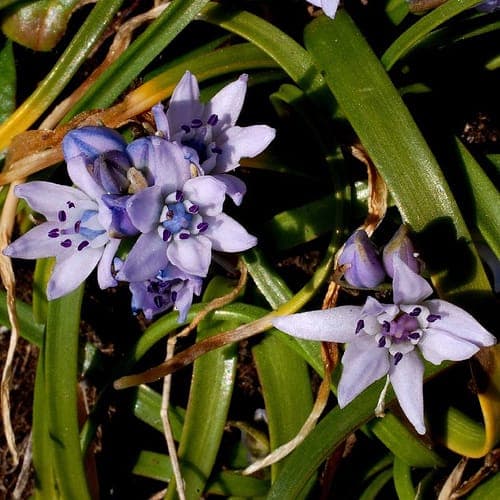
Andrew from Sheffield, UK / CC BY 2.0, via Wikimedia Commons
Spring squill: complete guide
Scilla verna
Want to see Spring squill: complete guide in your garden?
Full design in HD: €7.99
Look after your Spring squill with the GardenWorld app
Identify plants with your camera and get a care calendar with reminders for this plant.


Overview
Scilla verna, also known as spring squill or sea-onion, is a splendid spring-flowering bulb from the Asparagaceae family. This species naturally occurs in northwest Europe to the western Mediterranean, particularly in France, Great Britain, Ireland, Norway, Portugal, and Spain. The plant is renowned for its stunning bright blue flowers that appear as early as April and May. This is an essential component of early spring gardens and natural landscapes.
Appearance and bloom
Scilla verna is a small, elegant bulb plant that typically grows 10 to 20 centimeters in height. The plant forms narrow, grass-like leaves at the base. In April, May, and early June, the characteristic blue star-shaped flowers appear on slender stems. Each flower typically has six petals and creates a charming, striking display. The plant dies back completely after flowering.
Ideal location
Spring squill thrives best in full sun to lightly shaded locations. The plant prefers sunny locations when possible, though it can also flower under bare tree branches (because it blooms before trees leaf out). This makes it excellent for meadows, borders, under shrubs, and in natural groupings. It is ideal for early seasonal plantings.
Soil
The plant grows well on well-draining soils. It accepts most soil types as long as drainage is available. Heavy soils can be improved with sand or grit. The plant prefers neutral to slightly acidic soils. Add compost when planting bulbs. The plant is not fussy about nutrition, though moderate feeding helps growth.
Watering
Scilla verna requires regular watering during spring growth, especially if dry. Once established, the bulbs can rely on normal rainfall in temperate climates. After flowering and once the foliage disappears, the plant needs very minimal water. During the growing season, ensure the soil remains moist for optimal blooming.
Pruning
This plant requires minimal pruning. After blooming, you can remove spent flowers, but the foliage must remain uncut so it can return nutrients to the bulb. Once the foliage yellows and dies back, you can gently remove it. This process is critical for the following years' flowering.
Free preview
Want to see Spring squill: complete guide in your garden? Make a free preview of your design.
Maintenance calendar
Fall (September to October): Plant bulbs deeply (approximately 8-10 cm) in well-prepared garden soil. Winter (November to February): Bulbs rest underground. Light protection against extreme frost helps. Spring (March to May): Growth begins. Enjoy flowers in April-May. Provide water. Summer (June to August): Foliage dies back. Bulb rests. Minimal water.
Winter hardiness
Scilla verna is fully hardy and suitable for all Dutch and Belgian climates. The bulb plant withstands winters without protection. In severe winters, young bulbs can be protected, but adult bulbs are very resistant. This makes it a reliable choice for permanent plantings.
Companion plants
Spring squill combines beautifully with other early bulbs. Try it with snowdrops, crocuses, Iris reticulata, and other early-flowering shrubs. It works well under bare tree branches. For a more herbaceous effect, add it to groupings with other Scilla species and early perennials.
Extra Informatie voor Succes
Wanneer je deze plant aanplant, wees geduldig in het eerste seizoen. De plant heeft tijd nodig om sterke wortels te ontwikkelen. In het tweede en derde seizoen zul je een dramatische groei en bloei zien. Dit is volkomen normaal en toont aan dat de plant zijn energie-investeringen in ondergrondse structuren heeft compleet gemaakt. Regelmatige monitoring in het eerste seizoen helpt je eventuele problemen snel op te sporen. Let vooral op waterbehoefte en zorg dat de plant niet onder competitie van onkruiden lijdt.
Deze plant is ook uitstekend geschikt voor tuineigenaren die meer biologische, natuurlijke aanpakken prefereren. Het vereist geen chemische inputs en gedijt goed in geleintegreerde tuinsystemen. De plant trekt veel voordelige insecten aan die je tuin helpen beschermen tegen ongewenste plaaginsecten.
Scilla verna is an indispensable plant for anyone seeking early seasonal value and spring color. The bright blue flowers offer unparalleled charm in our gardens. Visitors to gardenworld.app will find this a valuable component of early garden planning. Explore gardenworld.app for more spring inspiration and bulb possibilities.
Scilla verna is an indispensable plant for anyone seeking early seasonal value and spring color. The bright blue flowers offer unparalleled charm in our gardens. Visitors to gardenworld.app will find this a valuable component of early garden planning. Explore gardenworld.app for more spring inspiration and bulb possibilities.
Frequently asked questions about Spring squill
Is Spring squill winter hardy?
Scilla verna is fully hardy and suitable for all Dutch and Belgian climates. The bulb plant withstands winters without protection.
When and how do you prune Spring squill?
This plant requires minimal pruning. After blooming, you can remove spent flowers, but the foliage must remain uncut so it can return nutrients to the bulb.
How much water does Spring squill need?
Scilla verna requires regular watering during spring growth, especially if dry. Once established, the bulbs can rely on normal rainfall in temperate climates.
Where does Spring squill grow best?
Spring squill thrives best in full sun to lightly shaded locations. The plant prefers sunny locations when possible, though it can also flower under bare tree branches (because it blooms before trees leaf out).
What soil does Spring squill need?
The plant grows well on well-draining soils. It accepts most soil types as long as drainage is available.

See it in your garden
See Spring squill in your garden
One photo of your garden and a few questions. You see the result in about a minute.
Try it with a photoIdentify this plant in your own garden. Identify a plant
Similar plants
Great camas (Camassia leichtlinii): planting and care
Camassia leichtlinii
Everything about great camas (Camassia leichtlinii): planting the bulbs, heavy wet soil, naturalising in grass, hardiness and the best partners for a flowering meadow.
Pineapple lily (Eucomis bicolor): planting, care and overwintering
Eucomis bicolor
Everything about the pineapple lily (Eucomis bicolor): planting the bulbs, watering and feeding, overwintering in pots or the ground, and the best border partners.
Pineapple lily (Eucomis comosa): growing and overwintering
Eucomis comosa
Eucomis comosa is the tallest and best-known pineapple lily, with creamy spikes topped by a leafy tuft in late summer. Planting, overwintering and leaf cuttings.
