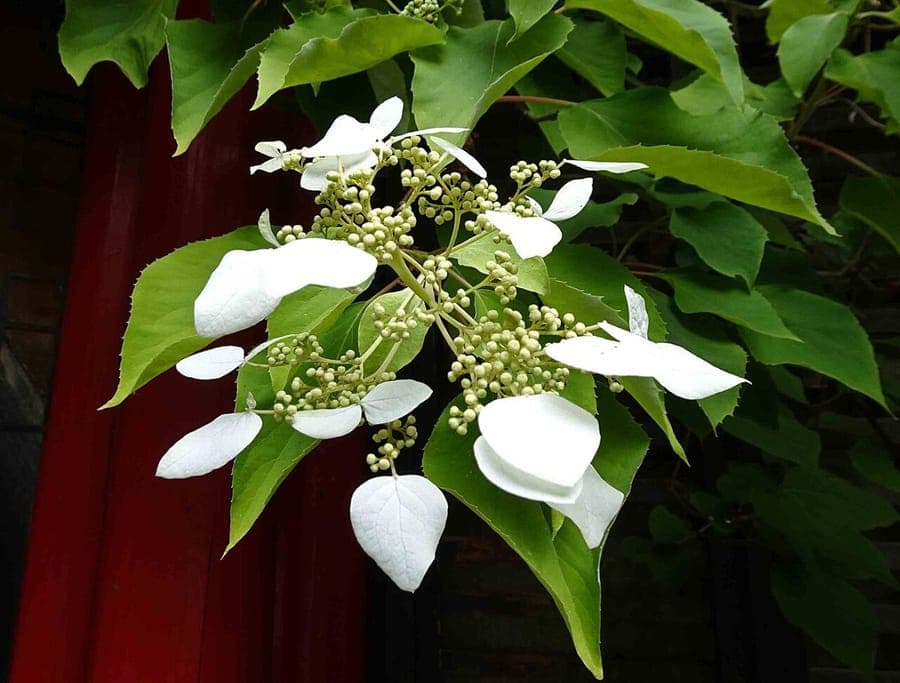
阿橋 HQ / CC BY-SA 2.0, via Wikimedia Commons
Japanese hydrangea vine (Schizophragma hydrangeoides): complete guide
Schizophragma hydrangeoides
Want to see Japanese hydrangea vine (Schizophragma hydrangeoides): complete guide in your garden?
Full design in HD: €7.99
Look after your Japanese hydrangea vine with the GardenWorld app
Identify plants with your camera and get a care calendar with reminders for this plant.


Overview
The Japanese hydrangea vine, Schizophragma hydrangeoides, is a deciduous climber from the mountain forests of Japan and Korea. It clings to walls, rocks and tree trunks with aerial roots and can eventually reach 8 to 12 metres. That makes it one of the few climbers that will properly clothe a shady, north-facing wall. Botanists have recently moved the species into Hydrangea, as Hydrangea hydrangeoides, but nurseries almost always sell it under its old name.
At first glance it resembles the familiar climbing hydrangea (Hydrangea petiolaris). The difference lies in the flowers: each sterile outer flower of Schizophragma hydrangeoides carries a single large, heart-shaped bract, whereas the climbing hydrangea has four smaller petal-like sepals. It also flowers a few weeks later, in July. Well-known selections include 'Roseum', with pink-flushed bracts, and 'Moonlight', with silvery marbled leaves.
Patience is part of the deal. For the first two or three years little happens above ground while the plant establishes its roots. After that it grows steadily into a green, flowering wall that lasts for decades.
Appearance and bloom cycle
The leaves are broadly oval to heart-shaped, 8 to 12 cm long, fresh green and coarsely toothed. The leaf stalks are often reddish. In autumn the foliage turns pale yellow before it falls, leaving a network of brown stems and aerial roots against the wall over winter.
In July flat heads 20 to 25 cm across appear. The centre consists of hundreds of tiny, creamy fertile flowers with a light scent. Around the edge, on long stalks, hang the striking white bracts of 3 to 4 cm, which last for weeks and slowly fade to parchment beige after flowering. Bees and hoverflies visit them readily.
The RHS notes that the plant can irritate the skin and is harmful to dogs and cats if eaten. Wear gloves when pruning and discourage pets from chewing the leaves.
Ideal location
Schizophragma hydrangeoides does best in partial shade. An east- or west-facing wall is ideal; a north-facing wall works too, although flowering will be a little lighter. It dislikes scorching afternoon sun on a south wall, where the leaves burn and the soil dries out too fast. A spot sheltered from cold easterly winds helps young plants get going.
Plant at least 30 cm away from the wall, because the soil right at the base of a house is dry from the eaves and foundations. Lean the plant towards the wall. It also looks wonderful climbing an old tree trunk, a brick garden wall or a sturdy fence. On walls with crumbling mortar or a smooth painted finish it clings less well, and the roots can leave marks if you ever remove it.
Providing support
In principle this plant climbs by itself, using clinging roots along its stems. In the early years, though, it needs a hand. At planting, set a few canes at an angle against the wall and tie the shoots loosely to them so they touch the surface. Only remove the ties once a stem has gripped.
On a timber fence or a wall where you would rather not have clinging roots, fix sturdy horizontal wires or mesh and tie the shoots in. Bear in mind that a mature plant becomes heavy, so the support must cope for many years.
Soil requirements
The ideal soil is humus-rich and moisture-retentive yet well drained, slightly acid to neutral. On sandy soil, mix plenty of leaf mould or well-rotted garden compost into the planting hole. Improve heavy clay with compost and some grit. Dry, chalky soil is less suitable.
Dig a hole about 50 by 50 cm and plant at the same depth as in the pot. A mulch of leaf mould or bark keeps the roots cool and moist, just as this woodland plant is used to in the wild. A light dressing of organic fertiliser in March is plenty.
Free preview
Want to see Japanese hydrangea vine (Schizophragma hydrangeoides): complete guide in your garden? Make a free preview of your design.
Watering
In the first and second year, water weekly in dry spells with a full can, around 10 litres. Little rain reaches the foot of a wall, so keep an eye on the soil even when the rest of the garden seems damp. An established plant usually copes on its own, but in long dry periods in July and August an extra soak is welcome, especially during flowering.
Pruning
Schizophragma hydrangeoides needs very little pruning. Flowers form on side shoots from older wood, so hard pruning costs you the display. Limit yourself to removing shoots that grow away from the wall, dead stems and growth that heads into gutters, windows or under roof tiles.
The best time is straight after flowering in August, or in late spring once new leaves show which stems are alive. You can leave the faded flower heads; the dried bracts are attractive in winter. An old, bare plant can be renovated by cutting a portion of the oldest stems low down over two or three years.
Maintenance calendar
March: Scatter organic fertiliser around the base and top up the mulch.
April–May: New growth. Tie in young shoots so they touch the wall. Start watering in dry weather.
June: Buds form. Keep the soil moist.
July: Full bloom, white lacecaps against the green.
August: Light prune after flowering. Remove shoots growing towards windows or gutters.
October–November: Yellow autumn colour and leaf fall. A good time to plant.
December–February: Dormancy. Give young plants a layer of leaf mould around the base in hard frost.
Want a reminder for these jobs? The plant calendar on gardenworld.app shows month by month what each plant in your garden needs.
Winter hardiness
This climber is very hardy. The RHS rates it H5, and in practice an established plant tolerates temperatures down to around -20 °C. It overwinters without protection throughout Britain. Only young plants in their first winter, or late spring frost on emerging buds, may suffer a little damage, from which the plant soon recovers.
Companion plants
At the foot of a shady wall, Schizophragma hydrangeoides makes a fine backdrop for shade plants. Hostas such as Hosta sieboldiana add large blue-green leaves, and ferns such as the soft shield fern (Polystichum setiferum) bring fine texture. Brunnera macrophylla flowers in spring with forget-me-not blue flowers, long before the climber gets going. Lenten roses (Helleborus orientalis) fill the winter with blooms in February and March.
For a longer flowering season on the same wall, pair it with the climbing hydrangea (Hydrangea petiolaris), which flowers in June. Together they give almost two months of white lacecaps.
Final thoughts
Schizophragma hydrangeoides is a quiet achiever: slow to start, but after a few years a flowering green wall in places where little else thrives. Give it a moist, humus-rich root run, help it find the wall in its early years and keep the secateurs away as much as possible.
Not sure which wall or fence suits a climber best? On gardenworld.app you can create a garden design that takes sun, shade and the planting at the foot of the wall into account. Plant this autumn and within a few years you will have your own white summer wall.
Frequently asked questions about Japanese hydrangea vine
Is Japanese hydrangea vine winter hardy?
This climber is very hardy. The RHS rates it H5, and in practice an established plant tolerates temperatures down to around -20 °C.
When and how do you prune Japanese hydrangea vine?
Schizophragma hydrangeoides needs very little pruning. Flowers form on side shoots from older wood, so hard pruning costs you the display.
How much water does Japanese hydrangea vine need?
In the first and second year, water weekly in dry spells with a full can, around 10 litres. Little rain reaches the foot of a wall, so keep an eye on the soil even when the rest of the garden seems damp.
Where does Japanese hydrangea vine grow best?
Schizophragma hydrangeoides does best in partial shade. An east- or west-facing wall is ideal; a north-facing wall works too, although flowering will be a little lighter.
What soil does Japanese hydrangea vine need?
The ideal soil is humus-rich and moisture-retentive yet well drained, slightly acid to neutral. On sandy soil, mix plenty of leaf mould or well-rotted garden compost into the planting hole.

See it in your garden
See Japanese hydrangea vine in your garden
One photo of your garden and a few questions. You see the result in about a minute.
Try it with a photoIdentify this plant in your own garden. Identify a plant
Similar plants
Japanese climbing hydrangea: complete guide
Hydrangea petiolaris
A full guide to growing Hydrangea petiolaris: ideal conditions, pruning tips, and long-term care for this shade-loving vine.
Hosta sieboldiana: complete guide
Hosta sieboldiana
Hosta sieboldiana growing guide: large blue-green shade plant from Japan. Complete care tips, placement and maintenance for shady gardens and woodland areas.
Soft shield-fern: complete guide
Polystichum setiferum
How to grow and care for Polystichum setiferum in your garden. Ideal for shady borders, with soft, arching fronds and year-round interest.
