
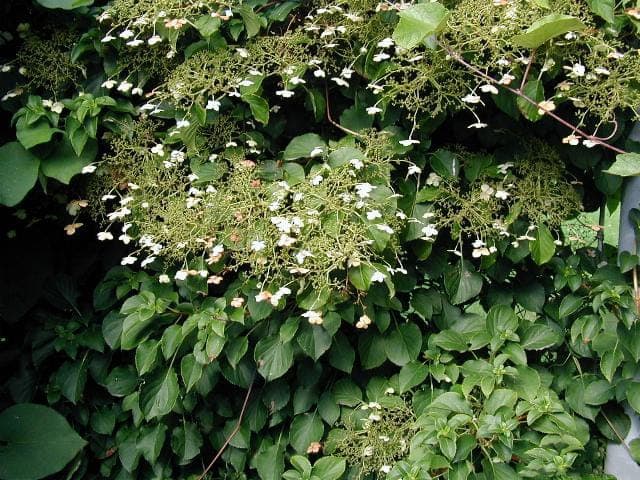
Sten at da.wikipedia / CC BY-SA 3.0, via Wikimedia Commons
Japanese climbing hydrangea: complete guide
Hydrangea petiolaris
Want to see Japanese climbing hydrangea: complete guide in your garden?
1 minute, no credit card
Overview
Hydrangea petiolaris, the Japanese climbing hydrangea, isn't your typical hydrangea. It doesn't sit politely in a border - it grabs hold and climbs, using adhesive discs at the tips of its stems to latch onto brick, stone, or rough wood. Native to Japan, Korea, and parts of eastern Russia, this deciduous climber thrives in cool, moist, partially shaded environments. It's a slow starter, often taking five to seven years to settle in and bloom well, but once established, it becomes a dense, woody vine that can reach 12 meters in height.
Unlike mophead hydrangeas, petiolaris doesn't rely on big color shifts based on soil pH. Its flowers are consistently creamy-white and appear in large, lacecap clusters. It grows upright at first, then spreads horizontally once it hits a support. This makes it ideal for covering blank walls, old tree trunks, or pergolas.
If you're planning where to place one, gardenworld.app lets you map your garden layout and simulate how the plant will grow over time. You can test different support structures and light conditions before committing to a spot.
Appearance & bloom cycle
The foliage is dark green, ovate, and 7–15 cm long, with a pointed tip and slightly serrated edges. In autumn, the leaves turn golden to pale red - not as showy as maples, but still a nice seasonal touch. The real show starts in early summer: from late June to late July, flat-topped clusters of white sterile flowers open, measuring 10–15 cm across. They start with a greenish tinge and fully whiten as they mature.
Don't expect blooms in the first few years. This plant focuses on root and structural development early on. Patience pays off: mature specimens produce abundant flowers without needing deadheading.
Ideal location
This climber loves partial to full shade. A north- or east-facing wall is perfect. Avoid hot afternoon sun, especially in USDA zones 7 and above, as it can scorch leaves and dry out stems. That said, it still needs some daylight - pitch-black corners won't cut it.
It needs a textured surface to cling to: rough stone, brick, or untreated wood. Smooth surfaces like vinyl siding or painted metal won't work. If you're using a trellis, choose one with a grid pattern and secure it firmly - mature vines are heavy.
Use gardenworld.app to assess microclimates in your garden. You can tag areas with shade levels and moisture retention to find the best spot for your climbing hydrangea.
Soil requirements
Hydrangea petiolaris prefers rich, moist, humus-rich soil with good drainage and a slightly acidic to neutral pH (5.5–7.0). It struggles in dry, sandy, or compacted soils. Before planting, amend the soil with compost or well-rotted manure. Dig a hole twice as wide as the root ball, but no deeper. Plant at the same depth as in the pot, water thoroughly, and mulch with leaf mold or bark.
Avoid lime-heavy soils - they can stunt growth. If your soil is alkaline, consider growing it near acid-loving companions like rhododendrons or using ericaceous compost in the planting hole.
Free design
Want to see Japanese climbing hydrangea: complete guide in your garden? Make a free design now.
Watering
Water deeply and regularly during the first 2–3 years. In dry spells (over 3 weeks without rain), give 10–15 liters per week. Established plants are more drought-tolerant but still perform best with consistent moisture. Use rainwater when possible - tap water with high calcium content can raise soil pH over time.
Mulching helps retain moisture and keeps roots cool. Replenish the mulch layer each spring.
Pruning
Pruning is rarely needed, but you can trim to control size or shape. Always prune after flowering - between August and early September. Never prune in spring or early summer, as you'll remove the current year's flower buds.
Cut back overlong stems or remove crossing branches. Limit cuts to one-third of the plant per year. Use sharp, clean secateurs. If you want to train it along a specific path, gently tie new shoots to supports in late spring.
Maintenance calendar
- January: Inspect for winter damage. Remove broken stems.
- February: No action needed.
- March: Apply a layer of compost around the base.
- April: Start light feeding. Check for new growth.
- May: Water regularly. Support young shoots.
- June–July: Peak bloom. Avoid pruning. Watch for slugs.
- August: Light pruning OK. Remove spent blooms.
- September: Final pruning window. Stop feeding.
- October: Leave fallen leaves - they act as natural mulch.
- November: No action.
- December: Protect young roots with straw if hard frosts are expected.
Winter hardiness
Hardy in USDA zones 4–8 (down to -34°C). In zone 7 and below, it survives without protection. Young plants may suffer in prolonged deep freezes (below -15°C for weeks). Mulch the base with straw or bark in harsh winters.
The plant loses its leaves in autumn - this is normal. The woody stems remain and will carry next year's growth.
Companion plants
Pair with shade-tolerant plants that won't compete aggressively:
- Ferns (e.g., Dryopteris spp.) – for texture
- Hostas – classic shade perennials
- Hellebores – early bloomers under the vine
- Ajuga reptans – ground cover
- Tiarella cordifolia – for woodland edges
Avoid invasive climbers like ivy or trumpet vine, which can overwhelm it.
Closing
The Japanese climbing hydrangea is a long-term investment. It won't wow you in year one, but by year six or seven, it transforms plain walls into living tapestries. It's low-maintenance once established, handles shade beautifully, and brings elegance to quiet corners. Buy a healthy specimen from garden centres like those at OBI or Hornbach, give it a good start, and let it grow at its own pace. And if you're unsure where it fits in your garden, gardenworld.app helps you visualize its future size and impact - no guesswork needed.
Want to see Japanese climbing hydrangea: complete guide in your garden? Make a free design now.
Upload a photo, pick a style, and get a photorealistic design with plant list in under a minute.
No credit card required


Similar plants
Cliff fendlerbush: complete guide
Fendlera rupicola
Everything about Fendlera rupicola, the rare rocky-slope shrub with fragrant white spring flowers that thrives on lean, dry, calcareous soils.
Fivepetal cliffbush: complete guide
Jamesia americana
Everything about Jamesia americana, the fivepetal cliffbush: rocky sites, white blooms, autumn colour, winter hardiness and garden care.
Deutzia parviflora: complete guide
Deutzia parviflora
Discover Deutzia parviflora, an elegant flowering shrub with white blossoms. Growing guide with tips for sunny placement, fertile soil, and regular pruning.