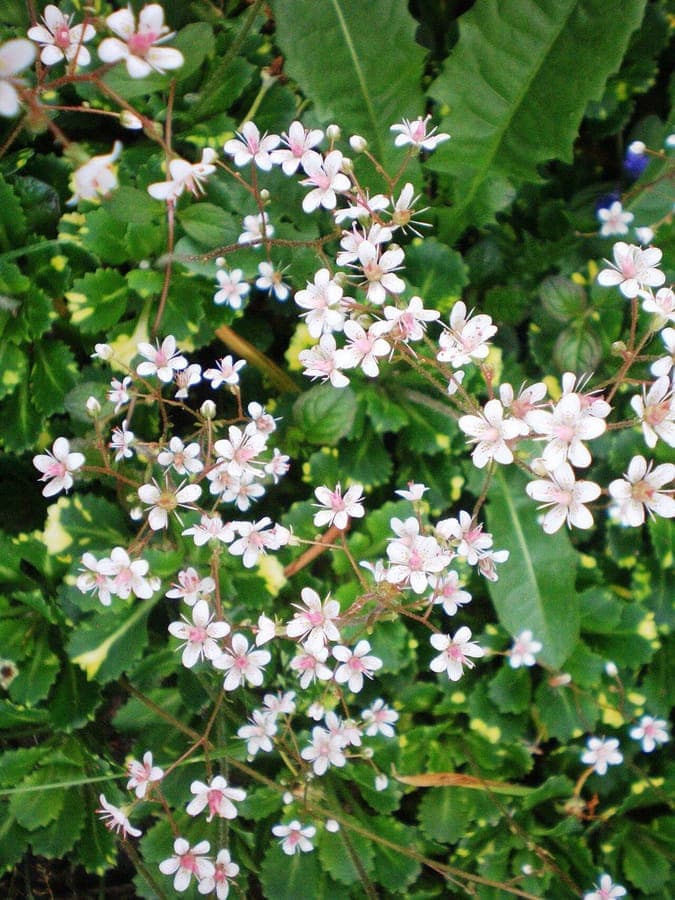
Hugo.arg / CC BY-SA 3.0, via Wikimedia Commons
London Pride: complete guide
Saxifraga × urbium
Want to see London Pride: complete guide in your garden?
Full design in HD: €7.99
Look after your London Pride with the GardenWorld app
Identify plants with your camera and get a care calendar with reminders for this plant.


Overview
London pride (Saxifraga × urbium) is one of the toughest and most rewarding ground covers for shade. It forms a dense, evergreen carpet of leathery leaf rosettes, above which clouds of tiny starry flowers float in May and June. It thrives where many plants give up: beneath shrubs, at the foot of a north-facing wall, between stones and in dry corners. It has been a fixture of British and Irish gardens for generations, often passed from neighbour to neighbour.
Botanically it is a hybrid between two western European saxifrages: Saxifraga umbrosa from the Pyrenees and Saxifraga spathularis, St Patrick's cabbage, from Ireland and north-west Iberia. The cross arose spontaneously in gardens and has been grown since at least the eighteenth century. Its common name reflects its popularity in London gardens, and the botanical epithet urbium means "of the towns". In Dutch it is called schildersverdriet, "painter's sorrow", because the hundreds of tiny red dots on every petal are a nightmare to paint.
Do not confuse it with the mossy saxifrages of the Arendsii group. Those form soft, moss-like cushions with larger, colourful flowers and need a cool, moist position. Saxifraga × urbium has firm, spoon-shaped leaves, modest pinkish-white flowers and a far tougher constitution.
Appearance and bloom cycle
The leaves grow in flat rosettes 5 to 10 cm across. Each leaf is spoon- to paddle-shaped, 3 to 6 cm long, thick and leathery, with a scalloped edge and often a reddish underside. Through short runners the rosettes knit into a solid mat 30 to 45 cm wide and 5 to 10 cm tall within a few years. The foliage stays green all winter.
In May and June reddish, slightly sticky-hairy flower stems rise 20 to 30 cm above the leaves. At the top they carry loose sprays of dozens of star-shaped flowers about 1 cm across. From a distance they look white with a pink haze; up close you see fine red spots and a pink to yellow-green centre. Flowering lasts three to four weeks and attracts hoverflies and small bees.
Variegated forms exist, such as 'Aureopunctata' (also sold as 'Variegata'), whose yellow-speckled leaves brighten shady corners. London pride is not toxic to people or pets. It has naturalised in parts of Britain and Ireland but is not considered invasive anywhere.
Ideal location
Partial to full shade suits it best. Under light-canopied trees and shrubs, against a north wall, beside a shady path or in the crevices of a shaded wall it is perfectly at home. It still flowers in deep shade, if a little less freely. It will take sun as long as the soil stays moist, but on a hot, dry south-facing site the leaves scorch.
London pride makes an excellent edging plant. Along a path or the front of a shady border it forms a crisp green edge that looks tidy all year. It also covers the ground under hedges, where soil is dry and poor. Space plants 25 to 30 cm apart, roughly 9 to 12 per square metre, for a closed mat within two seasons.
Soil requirements
This plant is not fussy. Any moderately fertile, well-drained soil will do, from sand to light clay. Soil pH matters little: it grows as happily on slightly acidic ground as on chalk. Only soil that stays waterlogged for long periods causes trouble, because the rosettes start to rot.
On heavy clay, work some garden compost and grit into the top layer. On thin sandy soil a handful of leaf mould at planting gives it a good start. After that it hardly needs feeding; a thin layer of compost in spring is plenty.
Free preview
Want to see London Pride: complete guide in your garden? Make a free preview of your design.
Watering
Water regularly for the first few weeks after planting, until the rosettes have rooted. After that London pride is remarkably drought tolerant in shade. The thick leaves store moisture, and even under shrubs with plenty of root competition it usually copes.
In sunnier spots or during long dry summers, give an occasional thorough soak, ideally in the morning and at the base. Limp or curling leaves are a clear sign of thirst. In pots and containers keep the compost lightly moist but never waterlogged.
Pruning
After flowering, in late June or early July, cut the spent flower stems back to just above the foliage. This keeps the mat neat and green and stops the plant wasting energy on seed.
In spring, remove any brown or dead rosettes. After three or four years the centre of the mat may open up. Divide it after flowering or in September: lift sections with several rosettes and replant them. Single rosettes with a short piece of stem also root easily as cuttings. Slugs usually leave it alone, though vine weevil larvae may feed on the roots, especially in pots.
Maintenance calendar
March-April: Remove dead rosettes and apply a thin layer of compost. Plant new specimens.
May-June: Flowering time. Enjoy the cloud of pinkish-white flowers and water only young plants in dry spells.
July: Cut spent flower stems back to just above the foliage.
August-September: Divide and replant old or patchy mats. Root loose rosettes as cuttings.
October-November: Clear thick layers of fallen leaves from the rosettes so they are not smothered.
December-February: Dormant period. The evergreen foliage keeps the border looking good even now.
The plant calendar on gardenworld.app lists these jobs month by month, matched to the plants in your own garden.
Winter hardiness
Saxifraga × urbium is very hardy and tolerates frost to about -25 °C. Across Britain, Ireland and the Low Countries it never needs protection. In severe frost the leaves may flush red or bronze, but they recover in spring. Real problems only arise on ground that sits under water for weeks in winter.
In pots and troughs the plant is slightly more vulnerable, because the root ball freezes through more quickly. A container at least 25 cm across with a layer of drainage material at the bottom will come through an ordinary winter without fuss. During prolonged frost below -10 °C, move smaller pots against a house wall or wrap them in hessian. That way north-facing courtyards, balconies and small town gardens stay green all year round.
Companion plants
London pride fits perfectly into a shady border. Siberian bugloss (Brunnera macrophylla) flowers sky blue in April and May and pairs beautifully with the pinkish-white haze. Lungwort (Pulmonaria officinalis) and foamflower (Tiarella cordifolia) share the same conditions and early flowering season.
For structure, combine it with ferns such as the soft shield fern (Polystichum setiferum) and with the tough, aromatic Geranium macrorrhizum, which tolerates dry shade just as well. Snowdrops (Galanthus nivalis) planted between the rosettes push up through the evergreen mat in February.
Final thoughts
Saxifraga × urbium proves that a shady spot need not be a problem spot. It is evergreen, tough, undemanding and flowers every spring with a delicate cloud of stars. If you want a crisp edge or a closed carpet under shrubs, you will struggle to find a more reliable plant. On gardenworld.app you can have a garden design made in which London pride, ferns, lungwort and Siberian bugloss fill a shady border that looks good all year. Ask a neighbour with a thriving mat for a few rosettes, or plant a row along your shady path this autumn.
Frequently asked questions about London Pride
Is London Pride winter hardy?
Saxifraga × urbium is very hardy and tolerates frost to about -25 °C. Across Britain, Ireland and the Low Countries it never needs protection.
When and how do you prune London Pride?
After flowering, in late June or early July, cut the spent flower stems back to just above the foliage. This keeps the mat neat and green and stops the plant wasting energy on seed.
How much water does London Pride need?
Water regularly for the first few weeks after planting, until the rosettes have rooted. After that London pride is remarkably drought tolerant in shade.
Where does London Pride grow best?
Partial to full shade suits it best. Under light-canopied trees and shrubs, against a north wall, beside a shady path or in the crevices of a shaded wall it is perfectly at home.
What soil does London Pride need?
This plant is not fussy. Any moderately fertile, well-drained soil will do, from sand to light clay.

See it in your garden
See London Pride in your garden
One photo of your garden and a few questions. You see the result in about a minute.
Try it with a photoIdentify this plant in your own garden. Identify a plant
Similar plants
Great forget-me-not: complete guide
Brunnera macrophylla
Brunnera macrophylla, also known as Great forget-me-not, is a shade-loving perennial with heart-shaped leaves and spring blue flowers. Learn care, soil and planting tips.
Rock crane's-bill: complete guide
Geranium macrorrhizum
Rock crane's-bill (Geranium macrorrhizum) is a tough groundcover thriving in sun or partial shade. Great for rock gardens and dry spots. Grows 20-30 cm tall.
Soft shield-fern: complete guide
Polystichum setiferum
How to grow and care for Polystichum setiferum in your garden. Ideal for shady borders, with soft, arching fronds and year-round interest.
