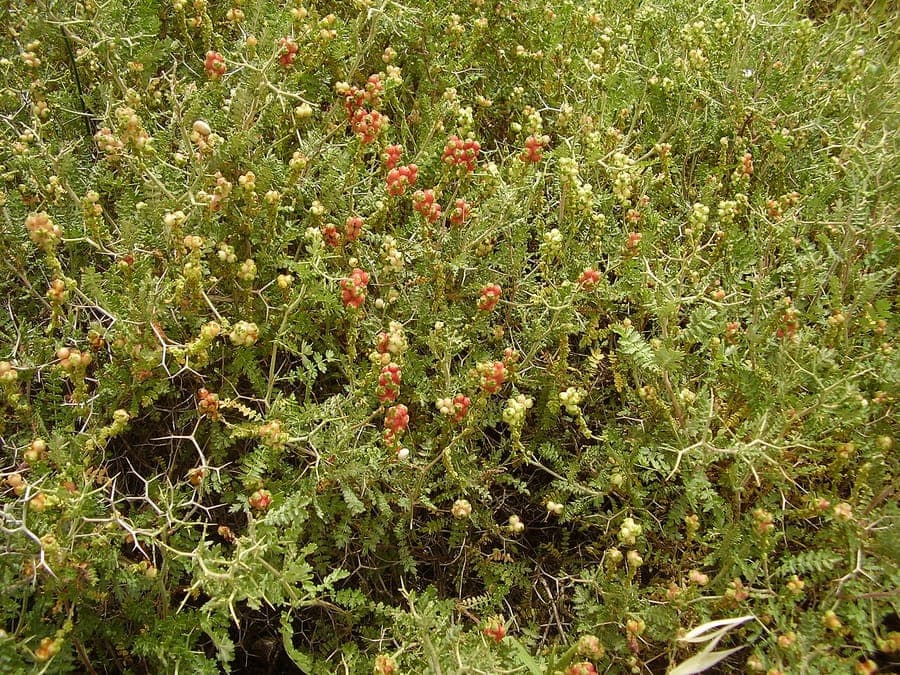
RickP / CC BY 2.5, via Wikimedia Commons
Thorny burnet: complete guide
Sarcopoterium spinosum
Want to see Thorny burnet: complete guide in your garden?
Full design in HD: €7.99
Look after your Thorny burnet with the GardenWorld app
Identify plants with your camera and get a care calendar with reminders for this plant.


Overview
Sarcopoterium spinosum, commonly called thorny burnet, is an extremely spiny shrub from the Rosaceae family. This species occurs naturally throughout the Mediterranean basin, with distribution ranging from North Africa to southeastern Europe. It represents an important landscape component in Mediterranean habitats and offers value for xeric garden designs.
First described in 1846, thorny burnet is now classified as an accepted rosaceous species. Its range extends across approximately fifteen countries bordering the Mediterranean Sea.
Appearance & bloom
Thorny burnet forms an extremely dense, compact mound covered with formidable sharp spines. Plants typically reach 50 to 80 centimeters tall with equal spread. The leaves are very small, grey-green, and densely crowded along wickedly-armed branches.
Flowers appear in spring, typically April through June, on short stalks. They are quite small, whitish to greenish in color, and relatively inconspicuous. Small fruits follow the flowers, providing additional textural interest.
The plant retains its foliage year-round in Mediterranean regions.
Ideal location
Thorny burnet thrives in full sun on steep, barren slopes. A minimum of six hours of direct sunlight daily is essential. The plant tolerates no shade.
Given its aggressively spiny nature, position the plant strategically where it poses no hazard. It proves exceptionally valuable for screening and barrier applications.
This plant excels in Mediterranean rock gardens, arid slopes and xeric planting schemes.
Soil
Thorny burnet grows in extremely poor, infertile soil with perfect drainage. Soil pH should range from 6.5 to 8.5. The plant tolerates calcareous soils without difficulty.
Add minimal organic matter at planting - coarse sand and gravel are preferred. This plant thrives in lean, rocky soils and even marginal conditions. Excess fertility promotes excessive growth at the expense of hardiness.
The plant demonstrates exceptional tolerance of rocky, leached soils.
Watering
Once established, thorny burnet is extremely drought-tolerant. During the first season, water moderately until deep rooting occurs, approximately once weekly.
After establishment, supplemental irrigation is rarely needed. The plant naturally survives on regional rainfall alone. Avoid overwatering at all costs.
During exceptional drought, occasional watering may provide benefit, but is not essential.
Free preview
Want to see Thorny burnet: complete guide in your garden? Make a free preview of your design.
Pruning
Thorny burnet requires minimal pruning or maintenance. Allow it to develop its natural, dense form. Remove only severely damaged or dead branches.
Given the formidable spines, safe pruning requires appropriate protective equipment. Wear gloves and long sleeves when working with this plant.
Following severe frost damage, the plant will typically respout from the root crown.
Maintenance calendar
Spring: Site preparation, transplanting in early spring. May-June: Observe growth and bloom, water rarely. July-August: No maintenance needed, arid conditions accepted. Autumn: Growth slows, no intervention required. Winter: No maintenance, plant dormant in cold climates.
Winter hardiness
Thorny burnet is hardy to approximately USDA zone 7, tolerating temperatures around -17 degrees Celsius. This limits it to Mediterranean regions and warmer parts of temperate zones.
In most northern regions, especially above 50 degrees north latitude, the plant is not reliably hardy and will likely succumb in hard winters. In warm microclimates in zones 6 and higher, occasional survival is possible.
Companion plants
Combine thorny burnet with other Mediterranean, ultra-drought-tolerant plants:
- Cistus spp (rockrose): Similar bloom period and water requirements
- Phyllirea spp (evergreen shrub): Comparable growth habit
- Rosmarinus officinalis (rosemary): Aromatic, similar conditions
- Helichrysum spp (straw flower): Silver foliage contrast
- Lavandula stoechas (French lavender): Spring bloom
Plant in rock gardens for maximum visual effect.
Closing
Sarcopoterium spinosum offers distinctive Mediterranean character for dry gardens. While its aggressive spines require careful placement, its exceptional drought tolerance and natural architectural form make it valuable for xeric designs.
This plant requires patience during establishment and provides decades of minimal maintenance. Discover thorny burnet in Mediterranean nurseries and specialized native plant suppliers. For more Mediterranean plants and xeric design inspiration, visit gardenworld.app.
Frequently asked questions about Thorny burnet
Is Thorny burnet winter hardy?
Thorny burnet is hardy to approximately USDA zone 7, tolerating temperatures around -17 degrees Celsius. This limits it to Mediterranean regions and warmer parts of temperate zones.
When and how do you prune Thorny burnet?
Thorny burnet requires minimal pruning or maintenance. Allow it to develop its natural, dense form.
How much water does Thorny burnet need?
Once established, thorny burnet is extremely drought-tolerant. During the first season, water moderately until deep rooting occurs, approximately once weekly.
Where does Thorny burnet grow best?
Thorny burnet thrives in full sun on steep, barren slopes. A minimum of six hours of direct sunlight daily is essential.
What soil does Thorny burnet need?
Thorny burnet grows in extremely poor, infertile soil with perfect drainage. Soil pH should range from 6.5 to 8.5.

See it in your garden
See Thorny burnet in your garden
One photo of your garden and a few questions. You see the result in about a minute.
Try it with a photoIdentify this plant in your own garden. Identify a plant
Similar plants
New Zealand bur (Acaena microphylla): care guide
Acaena microphylla
Acaena microphylla forms a low, bronze-green carpet with red spiny burs in summer. Advice on position, soil, trimming, hardiness and keeping its spread in check.
Apple serviceberry: complete guide
Amelanchier × grandiflora
Everything about apple serviceberry (Amelanchier × grandiflora): white April flowers, edible berries, autumn colour, position, pruning and cultivars such as 'Ballerina'.
Dwarf goat's beard (Aruncus aethusifolius): complete guide
Aruncus aethusifolius
Everything about dwarf goat's beard (Aruncus aethusifolius): position, soil, watering, pruning and hardiness. A compact perennial with lacy leaves for shade and rock gardens.
