
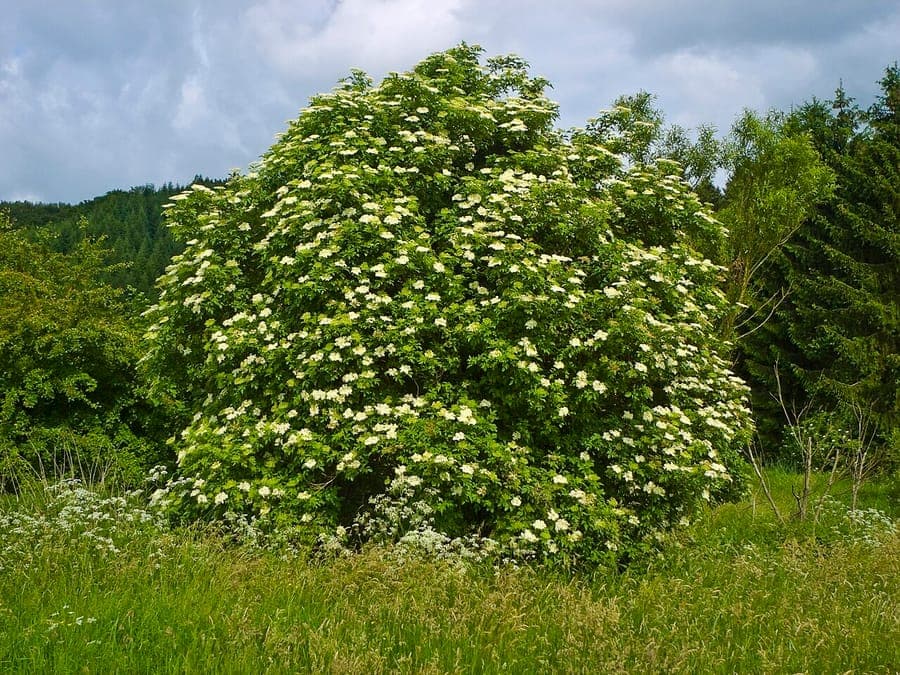
Willow / CC BY 2.5, via Wikimedia Commons
Elderberry: complete guide
Sambucus nigra
Want to see Elderberry: complete guide in your garden?
1 minute, no credit card
Overview
The Common Elder (Sambucus nigra) is one of the most versatile and underappreciated native trees of Europe. This deciduous shrub or small tree has been intertwined with human life for thousands of years - from Celtic druids who considered it sacred to the modern cook who prepares elderflower cordial. With its explosive spring growth, fragrant white flower umbels in June, and glossy black berries in August and September, the elder offers something remarkable in every season.
The elder grows rapidly and reaches a height of 4 to 10 metres, depending on location and pruning regime. On gardenworld.app you can create a garden design where the elder takes a starring role - as a specimen tree, in a mixed hedge, or as part of an edible garden. The plant has compound, pinnate leaves with 5 to 7 leaflets that are fresh green and turn yellow in autumn. Popular cultivars include 'Black Lace' (deep purple, finely dissected foliage), 'Black Beauty' (dark purple leaves, pink flowers), and 'Aurea' (golden-yellow foliage). The species belongs to the family Adoxaceae and occurs naturally throughout Europe, North Africa, and Western Asia.
Appearance and bloom cycle
The elder blooms in June with large, flat flower umbels that can reach 10 to 25 cm in diameter. Each umbel consists of hundreds of small, creamy-white florets that emit a sweet, musky fragrance. This scent is unmistakable and forms the basis of the famous elderflower cordial and elderflower champagne. The bloom attracts vast numbers of pollinators - bees, hoverflies, and small beetles crowd onto the flower heads.
From August onward, the berries ripen in drooping clusters. They begin green, turn red, and finally become glossy black. Each berry is 5 to 8 mm in diameter and contains 3 to 5 seeds. Important: the berries are mildly toxic when raw (they contain sambunigrin) but become delicious and perfectly safe once cooked. The bark is grey-brown and deeply furrowed on older specimens, giving the tree a characterful appearance. In winter, the elder reveals a striking structure with its arching branches and the soft, white pith inside the stems.
Ideal location
The elder is extraordinarily tolerant regarding location. It grows in full sun to partial shade, although full sun produces the most flowers and berries. In the wild, elders appear along woodland edges, in hedgerows, on waste ground, and even in cracks of old walls - a testament to its adaptability. The tree tolerates wind, air pollution, and even salt-laden coastal air without difficulty.
For the best results in your garden, choose a spot with at least 4 hours of sun per day. The elder grows broad, so allow for a canopy spread of 3 to 6 metres on a mature specimen. Therefore, do not plant it too close to property boundaries or delicate structures. The ornamental cultivars such as 'Black Lace' and 'Black Beauty' are more compact and better suited to smaller gardens - most well-stocked garden centres carry these coloured varieties as container plants.
Soil requirements
The elder makes remarkably few demands on soil. It grows in clay, sand, loam, and even in poor, stony ground. The ideal soil is moisture-retentive, nutrient-rich, and slightly alkaline with a pH of 6.0 to 8.0, but the elder adapts to virtually any soil type. In wet clay soil that floods in winter, it actually grows better than most other trees.
The only soil the elder dislikes is extremely dry, impoverished sand in full sun - even then it survives, but growth and flowering are less spectacular. If you truly want to pamper your elder, work a generous helping of compost or well-rotted manure into the soil at planting time. This gives a flying start and delivers an impressive display of flowers by the second year.
Watering
Mature elders are remarkably drought-tolerant thanks to their extensive, deep root system. In the first year after planting, it is advisable to water weekly during dry spells - roughly 10 litres at a time - so the roots establish well. From the second year onward, supplementary watering is only needed during prolonged drought exceeding three weeks.
The elder gives a clear signal when it is thirsty: the leaves wilt visibly. When this happens, water thoroughly at the base and cover the soil around the trunk with a 5 to 8 cm layer of mulch (wood chips, leaf compost, or straw) to retain moisture. Container cultivation is feasible for the more compact cultivars but requires more frequent watering - check every two to three days and never let the root ball dry out completely.
Pruning
The elder tolerates pruning exceptionally well and rebounds with renewed vigour after even drastic cuts. This makes it ideal for gardeners who want to control its size. Prune preferably in late winter, from February to early March, before the buds break. Remove dead, damaged, and crossing branches and, if desired, reduce the crown to the preferred height.
For a compact shrub form, you can cut the elder back to 30 to 50 cm above ground every year - it will recover completely in a single growing season. This technique is known as coppicing and produces particularly beautiful, fresh foliage on the coloured cultivars. 'Black Lace' and 'Black Beauty' benefit enormously from annual hard pruning: the new leaves are far more intensely coloured than the old. Bear in mind that hard pruning sacrifices flowers that year, since elder blooms on one-year-old wood.
Free design
Want to see Elderberry: complete guide in your garden? Make a free design now.
Edible uses
The elder is one of the few native trees whose flowers and fruit are both used in the kitchen. The blossoms are traditionally harvested in June, when the umbels are fully open but have not yet begun to discolour. Gently shake them to dislodge insects, but do not wash them - the pollen contributes to the flavour.
From the flowers you can make elderflower cordial, syrup, pancake batter, or fritters. The berries are harvested in August and September when they have turned fully black. Always cook them before consuming: raw berries cause digestive distress. Cooked berries form the basis for elderberry juice, jam, wine, and even vinegar. The berries are rich in vitamin C and antioxidants. In folk medicine, elderberry extract has been used for centuries to ease the symptoms of colds and influenza.
Maintenance calendar
February–March: Prune dead and crossing branches. Optionally carry out a rejuvenation prune by cutting the entire shrub back hard. Apply a layer of compost around the base.
April–May: The elder flushes rapidly with fresh green (or purple/gold in cultivars) foliage. Check for aphids - elders sometimes attract large numbers, but these are typically controlled swiftly by ladybirds and lacewings.
June: Flowering. Harvest flower umbels for culinary use. Leave enough umbels on the tree for the berry harvest later.
July: Berries begin to form. Watch for fruit flies and consider netting if birds discover the berries too early.
August–September: Berry harvest. Cut entire clusters with secateurs and process them promptly - berries spoil within a day of picking.
October–November: Leaf fall. The elder drops its leaves relatively early. Remove fallen foliage from borders to prevent fungal build-up.
December–January: Dormancy. Plan the February prune.
Winter hardiness
Sambucus nigra is extremely winter-hardy and withstands temperatures down to approximately -30 °C (USDA zones 4 to 8). Across the entire British Isles, the Netherlands, Belgium, and the rest of northwestern Europe, the elder overwinters without any protection. Even after a severe winter with prolonged frost, the elder reliably breaks bud in spring.
The coloured cultivars 'Black Lace', 'Black Beauty', and 'Aurea' are slightly less hardy than the wild species but still tolerate -20 °C without trouble. Young plants in pots are more vulnerable: place them in a sheltered spot for their first winter or wrap the pot in bubble wrap. Planted-out specimens require no winter protection whatsoever.
Wildlife value
The elder is an ecological powerhouse. Its flowers feed dozens of pollinator species, from honey bees to solitary bees and hoverflies. The berries serve as an important food source for more than 60 bird species, including blackbirds, song thrushes, robins, and finches. Butterflies use the leaves as a host plant, and small mammals seek shelter in the dense branch structure.
By planting an elder in your garden, you create a mini-habitat that attracts wildlife throughout the year. The elder produces more berries than virtually any other native tree or shrub, making it of exceptional value in late summer and autumn when birds are building reserves for winter.
Companion plants
The elder combines beautifully with other native and garden plants. As underplanting, shade-tolerant perennials such as foxglove (Digitalis), masterwort (Astrantia major), and ferns work excellently. The dark-leaved cultivars create a stunning contrast with light green or silver-toned plants.
For a mixed hedge, combine elder with hawthorn (Crataegus monogyna), blackthorn (Prunus spinosa), and dogwood (Cornus sanguinea). In an ornamental garden setting, the elder pairs well with serviceberry (Amelanchier lamarckii), butterfly bush (Buddleja davidii), and dogwood (Cornus kousa). The loose, natural growth habit of the elder forms a pleasing contrast with the clipped forms of box or yew.
Final thoughts
The Common Elder is a tree that gives generously while asking for little in return: fragrant blossom in June, edible berries in September, food for dozens of wildlife species, and a characterful presence throughout the year. It grows in virtually any soil, tolerates sun and shade, and rebounds from the hardest prune.
Choose the wild species for maximum ecological value or a cultivar such as 'Black Lace' for a dramatic colour accent. On gardenworld.app you can create a garden design that combines the elder with the right companions for your specific garden. Plant an elder this autumn and enjoy the first blossoms and berries as early as next year.
Want to see Elderberry: complete guide in your garden? Make a free design now.
Upload a photo, pick a style, and get a photorealistic design with plant list in under a minute.
No credit card required


Similar plants
Butterfly Bush: complete guide
Buddleja davidii
Everything about the Butterfly Bush (Buddleja davidii): planting, pruning, care and attracting butterflies. Practical tips for a blooming butterfly garden.
Juneberry: complete guide
Amelanchier lamarckii
Everything about the Juneberry (Amelanchier lamarckii): spring blossom, autumn colour, edible berries and care. Expert tips for this versatile four-season tree.
Japanese dogwood: complete guide
Cornus kousa
Everything about the Japanese dogwood (Cornus kousa): spectacular bracts, autumn colour, edible fruits and care. Expert tips for this elegant ornamental tree.