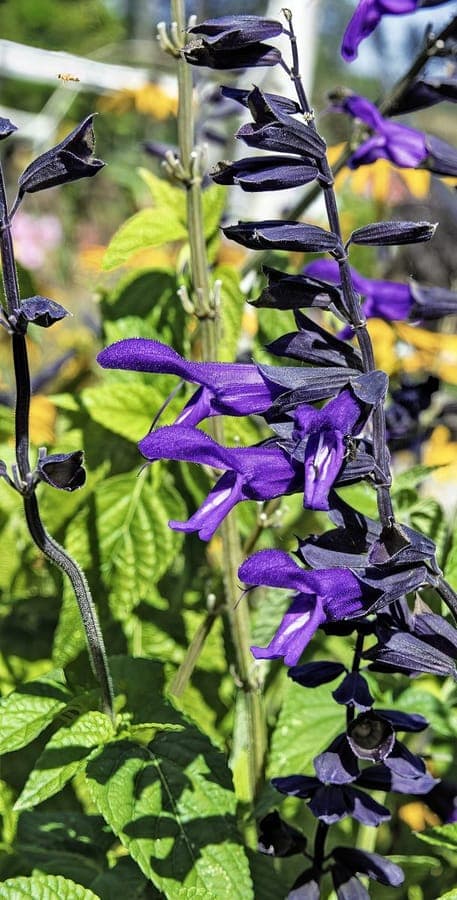
Didier Descouens / CC BY-SA 4.0, via Wikimedia Commons
Anise-scented sage (Salvia guaranitica): complete guide
Salvia guaranitica
Want to see Anise-scented sage (Salvia guaranitica): complete guide in your garden?
Full design in HD: €7.99
Look after your Anise-scented sage with the GardenWorld app
Identify plants with your camera and get a care calendar with reminders for this plant.


Overview
Anise-scented sage (Salvia guaranitica) is one of the most impressive salvias for the late summer and autumn garden. Every year sturdy stems up to 1.5 m tall rise from a tuberous root system, and from July until the first frost they end in spikes of large, deep blue tubular flowers. The blue is so intense that the plant stands out from across the garden, which is exactly why it is prized by anyone who wants colour in the border well into autumn.
The species comes from South America: southern Brazil, Paraguay, Uruguay and northern Argentina. Its name refers to the Guaraní, the indigenous people of that region. It belongs to the mint family (Lamiaceae), like common sage, lavender and thyme. The English name comes from the faint aniseed scent the leaves release when crushed.
The best-known cultivar is 'Black and Blue', with almost black calyces that make the cobalt flowers look even more vivid. 'Blue Enigma' has green calyces, slightly paler blue flowers and a more compact habit, and many nurseries consider it a little tougher in winter. 'Argentine Skies' flowers sky blue. There are also hybrids such as the popular Salvia 'Amistad', with purple flowers, which has Salvia guaranitica as one of its parents. To fit a tall, late-flowering plant like this into your garden, you can have a garden design made on gardenworld.app that takes height, flowering time and position into account.
Appearance and bloom cycle
The plant forms a loose, upright clump 1 to 1.5 m tall and 60 to 90 cm wide, sometimes taller after a warm summer on rich soil. The stems are square, as in all members of the mint family, and carry oval, fresh green leaves 5 to 10 cm long with lightly toothed edges.
Flowers appear from July to October, and in a mild autumn into November. They are 4 to 5 cm long, tubular and two-lipped, in deep indigo to cobalt blue. In their native range they are pollinated by hummingbirds. In European gardens bumblebees visit them, and carpenter bees sometimes bite a hole in the base of the tube to reach the nectar. Butterflies call in as well. Removing faded spikes regularly extends flowering considerably.
Ideal location
Give Salvia guaranitica a warm, sunny spot sheltered from wind. Partial shade is acceptable, especially where summers are hot, but flowering will be less generous and the stems floppier. A south- or west-facing border against a wall or hedge is ideal: the wall adds warmth and protects the roots in winter.
Space plants 60 to 80 cm apart. Because it grows tall, it belongs in the middle or back of a border. In an exposed position 'Black and Blue' can flop, so put in a few canes or a plant support in spring. It also does well in a large container of at least 30 litres, which makes overwintering easier.
Soil requirements
Unlike many Mediterranean salvias, Salvia guaranitica likes fertile, humus-rich soil that does not dry out in summer yet drains freely in winter. That balance matters: cold, wet soil in winter rots the tubers, while dry soil in summer checks flowering. Dig compost into the top 30 cm when planting. On heavy clay, add coarse grit or plant in a slightly raised bed. Neutral, slightly acidic or slightly chalky soil, pH 6 to 7.5, is fine.
Free preview
Want to see Anise-scented sage (Salvia guaranitica): complete guide in your garden? Make a free preview of your design.
Watering
Water regularly in the first year, particularly in dry spells. Established plants also appreciate a thorough soak during prolonged drought in July and August; without enough water the leaves droop and flowering stops. In containers you may need to water daily in summer. In autumn and winter give no extra water, and keep pots dry and frost-free.
A mulch of compost or bark keeps the soil cool and moist in summer and protects the roots in winter.
Pruning
Leave the stems standing over autumn. They protect the crown in winter and trap fallen leaves that act as extra insulation. Cut back only in spring, in April, once the worst frosts are over: remove all old stems to just above ground level.
Do not panic if nothing appears for a while. Salvia guaranitica is late to emerge, often not until May or even early June, so mark the spot to avoid digging it up by mistake. Pinching out the shoot tips by a few centimetres in June produces a bushier plant that is less likely to flop. Through summer, cut faded spikes back to a leaf so the plant keeps producing new flowers.
Maintenance calendar
- January to March: keep roots protected under mulch; store lifted tubers frost-free and barely moist.
- April: cut down old stems and add compost. Start potted tubers into growth indoors.
- May: new shoots appear; plant out after mid-May. Watch for slugs.
- June: pinch out for a bushier plant, add supports, water in dry weather.
- July to October: flowering; deadhead and water regularly.
- August: take cuttings as insurance for winter.
- November and December: apply a thick mulch, or lift the tubers in cold areas.
To keep track, add the tasks for this salvia to the plant calendar on gardenworld.app so pinching out in June and mulching in November are not forgotten.
Winter hardiness
Salvia guaranitica is only moderately hardy. The RHS rates 'Black and Blue' H3, meaning it tolerates a few degrees of frost but needs protection in severe winters. In practice the fleshy roots often survive down to about -10 °C in free-draining soil under a thick mulch, and waterlogging is a greater risk than cold itself.
In much of the UK, Belgium and the Netherlands it comes through mild winters in a sheltered spot, especially in towns and against a south-facing wall. In colder areas or on heavy soil it is safer to lift the tubers in November, just like dahlias, and store them in barely moist compost at 5 to 10 °C. Cuttings provide a second safety net: tip cuttings of 8 to 10 cm taken in August root quickly and overwinter as young plants in a bright, frost-free place.
On toxicity: Salvia guaranitica is not known to be toxic to people or pets. It is not a culinary herb, though, so do not use the leaves like common sage. The species is not invasive in Europe.
Companion plants
The deep blue pairs beautifully with warm colours. The golden flowers of Rudbeckia fulgida and the bold foliage of Canna indica make a classic combination. Dahlias (Dahlia pinnata and its cultivars) flower at the same time and need the same winter treatment. Verbena bonariensis floats its purple heads between the blue spikes, and Cosmos bipinnatus fills gaps with an airy touch. Ornamental grasses add movement and structure until late autumn.
Final thoughts
Salvia guaranitica is not for gardeners who want everything fully hardy, but give it a warm spot, rich soil and a little protection and you will have months of the finest blue of late summer. Prune late, be patient in spring and take a few cuttings in August as insurance, and this South American sage will flower year after year until the first frost.
Frequently asked questions about Anise-scented sage
Is Anise-scented sage winter hardy?
Salvia guaranitica is only moderately hardy. The RHS rates 'Black and Blue' H3, meaning it tolerates a few degrees of frost but needs protection in severe winters.
When and how do you prune Anise-scented sage?
Leave the stems standing over autumn. They protect the crown in winter and trap fallen leaves that act as extra insulation.
How much water does Anise-scented sage need?
Water regularly in the first year, particularly in dry spells. Established plants also appreciate a thorough soak during prolonged drought in July and August; without enough water the leaves droop and flowering stops.
Where does Anise-scented sage grow best?
Give Salvia guaranitica a warm, sunny spot sheltered from wind. Partial shade is acceptable, especially where summers are hot, but flowering will be less generous and the stems floppier.
What soil does Anise-scented sage need?
Unlike many Mediterranean salvias, Salvia guaranitica likes fertile, humus-rich soil that does not dry out in summer yet drains freely in winter. That balance matters: cold, wet soil in winter rots the tubers, while dry soil in summer checks flowering.

See it in your garden
See Anise-scented sage in your garden
One photo of your garden and a few questions. You see the result in about a minute.
Try it with a photoIdentify this plant in your own garden. Identify a plant
Similar plants
Orange Coneflower: complete guide
Rudbeckia fulgida
Everything about Rudbeckia fulgida (orange coneflower): planting, care, combinations and bloom time. Practical tips for months of golden-yellow flowers.
African arrowroot: complete guide
Canna indica
Everything you need to grow and care for Canna indica in your garden. Learn about sunlight, watering, winter care, and ideal planting partners.
Dahlia: complete guide
Dahlia pinnata
Everything you need to know about Dahlia pinnata: care, bloom time, ideal location and hardiness. Perfect for gardens in temperate climates.
