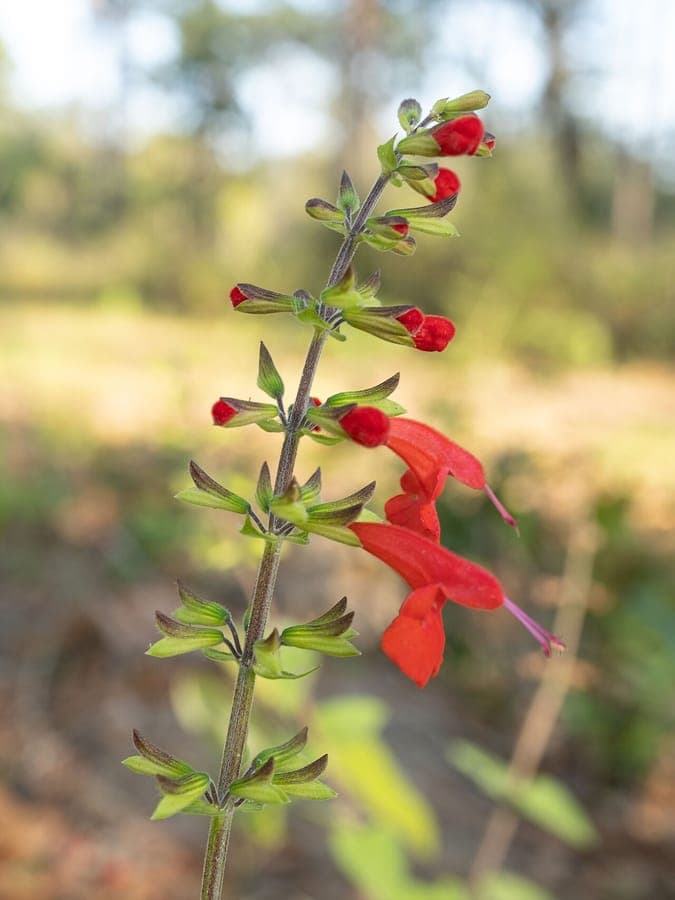
Alex Abair / CC BY 4.0, via Wikimedia Commons
Texas Sage: complete guide
Salvia coccinea
Want to see Texas Sage: complete guide in your garden?
Full design in HD: €7.99
Look after your Texas Sage with the GardenWorld app
Identify plants with your camera and get a care calendar with reminders for this plant.


Overview
Salvia coccinea, commonly known as Texas Sage, is a vibrant flowering plant from the mint family (Lamiaceae). This North and South American native produces stunning scarlet-red flowers throughout the growing season. In temperate regions, it thrives as a summer annual or perennial in containers.
The plant reaches 60-90 cm tall and maintains a compact growth habit. With a long blooming period from June to October and hummingbird-attracting flowers, Texas Sage is ideal for wildlife gardens. Its easy care requirements make it perfect for both beginner and experienced gardeners.
Appearance and bloom cycle
Texas Sage displays narrow, lance-shaped leaves that densely clothe the stems. The foliage is soft-textured and aromatic when crushed. The flowers are the showstopper: brilliant scarlet to coral-red, arranged in loose terminal spikes.
Bloom time extends from June through October, providing reliable color during late summer and fall. Each flower reaches about 2 cm long and attracts hummingbirds and pollinators consistently. The plant's compact form means it never gets leggy or overgrown.
Ideal location
Texas Sage performs best in full sun positions receiving at least 6 hours of direct sunlight daily. More sun equals more prolific flowering. In cooler climates, afternoon shade is tolerated but reduces bloom output.
The plant suits front borders, mixed beds, and containers on patios or balconies. It handles wind exposure well due to its sturdy stems. Urban gardens and exposed seaside locations pose no problems.
Soil requirements
Texas Sage demands well-draining soil. Heavy clay or waterlogged sites cause root rot, so amend with sand, perlite, or grit if necessary. A pH between 6.0 and 7.5 is optimal.
For container growing, use a 1:1 mix of garden soil and potting compost with added perlite for drainage. Incorporate compost for nutrients. Avoid pure sand or pure peat mixes.
Free preview
Want to see Texas Sage: complete guide in your garden? Make a free preview of your design.
Watering
Texas Sage is moderately thirsty. Water when the soil surface feels dry 2-3 cm down. During the growing season (May-October), water twice to three times weekly depending on weather and temperatures.
Overwatering is the primary killer. Check container plants daily during hot spells. In winter, reduce watering to minimal. Established plants tolerate short dry spells, especially if mulched.
Pruning
Texas Sage responds excellently to pruning. Cut back to 20 cm in spring (March-April) to encourage full, compact growth. During the season, deadhead spent flower spikes to stimulate continuous blooming.
Container-grown plants can overwinter indoors at temperatures above 10 degrees Celsius. Prune before winter dormancy to 30 cm height.
Maintenance calendar
FEBRUARY-MARCH: Prune and shape. Plant outdoors after frost danger passes. APRIL-MAY: Check irrigation setup, apply organic fertilizer. JUNE-OCTOBER: Water regularly, remove spent flowers. NOVEMBER-JANUARY: Reduce watering, protect from frost.
Winter hardiness
Texas Sage is not winter hardy in cold climates (USDA zones 9-11). In most temperate regions, plants are treated as annuals outdoors or overwintered indoors on a cool, bright shelf at 8-15 degrees Celsius. In containers, they can be brought inside after the first frost.
Companion plants
Pair Texas Sage with other summer bloomers: blue Salvia nemorosa, lavender, roses, purple Echinacea, golden Coreopsis, fine-textured Artemisia, and silvery-grey foliage plants. Works beautifully in mixed borders with sun-loving companions.
Final thoughts
Texas Sage delivers vibrant color with minimal effort. Perfect for gardeners wanting hummingbird-attracting plants without fuss. Find it at specialty garden centers and online retailers. Discover more garden design ideas at gardenworld.app.
Frequently asked questions about Texas Sage
Is Texas Sage winter hardy?
Texas Sage is not winter hardy in cold climates (USDA zones 9-11). In most temperate regions, plants are treated as annuals outdoors or overwintered indoors on a cool, bright shelf at 8-15 degrees Celsius.
When and how do you prune Texas Sage?
Texas Sage responds excellently to pruning. Cut back to 20 cm in spring (March-April) to encourage full, compact growth.
How much water does Texas Sage need?
Texas Sage is moderately thirsty. Water when the soil surface feels dry 2-3 cm down.
Where does Texas Sage grow best?
Texas Sage performs best in full sun positions receiving at least 6 hours of direct sunlight daily. More sun equals more prolific flowering.
What soil does Texas Sage need?
Texas Sage demands well-draining soil. Heavy clay or waterlogged sites cause root rot, so amend with sand, perlite, or grit if necessary.

See it in your garden
See Texas Sage in your garden
One photo of your garden and a few questions. You see the result in about a minute.
Try it with a photoIdentify this plant in your own garden. Identify a plant
Similar plants
Agastache rupestris: sunset hyssop for hot, dry borders
Agastache rupestris
Growing Agastache rupestris, sunset hyssop: salmon-orange flowers from July to October, aniseed foliage, drainage, pruning and getting it through a wet winter.
Beautyberry (Callicarpa bodinieri): complete guide
Callicarpa bodinieri
Everything about beautyberry (Callicarpa bodinieri) and 'Profusion': position, soil, pruning and hardiness for the shrub with vivid violet berries in autumn and winter.
Bluebeard (Caryopteris × clandonensis): complete guide
Caryopteris × clandonensis
Everything about bluebeard (Caryopteris × clandonensis): sunny position, well-drained soil, spring pruning and hardiness for this late summer, bee-friendly shrub.
