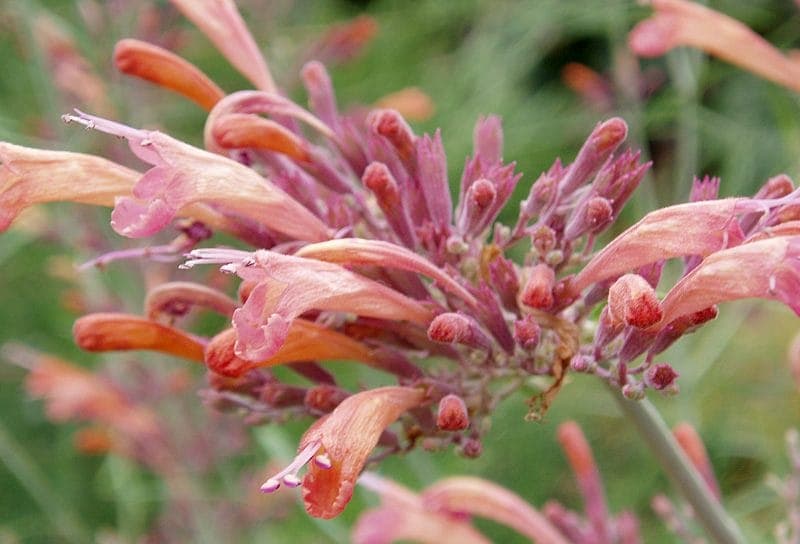
photo by Charlie McDonald; uploaded by Xiaphias / Public domain, via Wikimedia Commons
Agastache rupestris: sunset hyssop for hot, dry borders
Agastache rupestris
Want to see Agastache rupestris: sunset hyssop for hot, dry borders in your garden?
Full design in HD: €7.99
Look after your Agastache rupestris with the GardenWorld app
Identify plants with your camera and get a care calendar with reminders for this plant.


Overview
Agastache rupestris is a perennial in the mint family that tends to stop people in their tracks when it is in full flower. In the wild it grows on rocky slopes and in open pine woodland in the mountains of Arizona, New Mexico and northern Mexico, where summers are hot and winters are cold but dry. That background tells you almost everything about how to grow it: it loves sun, warmth and soil that drains in minutes, and it sulks in waterlogged ground.
It is widely known as sunset hyssop, and the name fits. The flowers blend salmon, apricot and soft orange above purplish calyces, rather like the sky just after the sun has gone down. You may also see it sold as rock anise hyssop or listed by the RHS as rocky giant hyssop. The narrow leaves smell strongly of aniseed and liquorice when brushed, which earns it a place in a herb garden as well as the border.
Plants usually reach 50 to 80 cm tall and 30 to 45 cm across, forming a loose, upright clump of many slim stems. Even out of flower it looks light, airy and fine-textured. If you want to see how it would sit in a dry border or gravel garden of your own, gardenworld.app can create a garden design that takes your aspect and soil into account, so you know straight away where a plant like this will thrive.
Appearance and bloom cycle
The foliage is the first thing to notice. Leaves are narrow, almost linear, 2 to 4 cm long and grey-green, giving the plant a fine, almost grassy texture that contrasts nicely with broader-leaved neighbours. Rub a leaf and you get a sweet scent of aniseed with a hint of mint.
Flowering usually starts in July and carries on into October, especially in a mild autumn. The blooms are carried in loose, whorled spikes at the tips of the stems. Each flower is a tube 2 to 3 cm long, salmon-orange to coral pink, held in a calyx that ranges from purplish pink to wine red. That mix of warm petal and cool calyx is what gives the plant its glow. The stamens protrude just beyond the flower mouth, which shows up well in a close-up photograph.
In its native range the flowers are visited by hummingbirds. In European gardens bumblebees, honeybees and butterflies take over, and bumblebees in particular will work the spikes all afternoon on a warm day. After flowering the calyces persist and slowly turn brown, giving a good winter outline that looks lovely with frost on it.
Ideal location
Give Agastache rupestris the hottest spot you have. Full sun for at least six hours a day is needed for strong flowering and compact growth; in part shade the stems flop and flowering falls away. A south-facing border, a gravel garden, the foot of a warm wall or a raised bed are all ideal.
Shelter from cold, wet westerly winds helps, but good air movement matters too. A spot where the soil dries quickly after rain is more important than a completely still one. Space plants 35 to 45 cm apart. It also does well in a large container, provided the compost is very fast-draining and the pot can be kept dry in winter.
Soil requirements
This is where success is won or lost. Agastache rupestris wants sharply drained, rather lean soil. Sandy, gravelly and stony soils are ideal; heavy clay that stays wet in winter is usually fatal. If in doubt, work plenty of coarse grit or gravel (roughly a third by volume) into the top 30 cm, or plant on a slight mound so water runs away from the crown.
A neutral to slightly alkaline pH suits it. It needs little or no feeding: rich soil produces long, floppy stems, fewer flowers and a plant that is less likely to survive winter. A mulch of gravel or grit is better than bark, because gravel keeps the base of the stems dry and holds on to warmth.
Free preview
Want to see Agastache rupestris: sunset hyssop for hot, dry borders in your garden? Make a free preview of your design.
Watering
Once established, this species is very drought tolerant. In the first summer, water roughly once a week in dry spells so the roots can establish. After that, extra water is only needed during a prolonged heatwave, and even then sparingly. Water at the base and let the soil dry out well between soakings.
Containers dry out faster, so check them every few days in summer. From October, cut back on watering. In winter the plant wants to be as dry as possible; cold and wet roots together are the main cause of losses.
Pruning
Do not cut Agastache rupestris back in autumn. The old stems protect the crown from cold and wet, the seed heads look good through winter and they offer shelter to insects. Wait until April, when you can see new shoots at the base, then cut the old stems down to just above that fresh growth, at around 10 to 15 cm.
In summer you can snip off spent spikes now and then to prolong flowering, although it is not essential. For a more compact plant, pinch out the tips by a few centimetres in late May; flowering starts a little later, but the plant branches more.
Maintenance calendar
March: Leave the old stems in place. Check that the soil around the crown is not staying wet.
April: Cut back old stems once new growth appears at the base. Plant new specimens from mid-April as the soil warms.
May: Pinch out tips for bushier growth if you wish. Weed around young plants.
June: Water only young plants and only in prolonged dry weather.
July to September: Peak flowering. Remove spent spikes occasionally. Take cuttings from non-flowering shoots as insurance.
October: Stop watering. Leave the plant standing.
November to February: Dormancy. Move pots under cover or against a wall, dry and sheltered.
If you would rather not keep track of all this yourself, the plant calendar on gardenworld.app sets out the jobs month by month.
Winter hardiness
Sources disagree sharply about how hardy Agastache rupestris is, and there is a good reason for that. In its dry home range it shrugs off hard frost, and American growers rate it to USDA zone 5. In Britain and the Low Countries the problem is not cold but winter wet. The RHS therefore gives it a cautious rating and recommends a sheltered, sunny position.
In practice it overwinters well in really sharply drained soil, especially on sand and in gravel gardens. On heavy, wet ground it often disappears after one or two years. It is not a particularly long-lived species in any case; three to five years is a fair expectation. Take a few cuttings from non-flowering shoots in summer and overwinter them in a cold frame or on a cool windowsill, and you will always have replacements.
Companion plants
Agastache rupestris is a natural fit for a dry, sunny border or gravel garden. Good partners include Perovskia atriplicifolia, with its silvery stems and blue haze, and Salvia greggii, which flowers in similar warm tones and wants the same dry conditions. Kniphofia uvaria adds a vertical accent in related orange shades.
For structure, Euphorbia characias and English lavender (Lavandula angustifolia) work beautifully; their grey foliage sets off the warm flower colour. Low grasses such as Stipa tenuissima or Festuca glauca fill the gaps between clumps and move in the breeze. Avoid moisture-loving, hungry plants such as hydrangeas or border phlox, whose needs are the opposite of this agastache.
Final thoughts
Agastache rupestris is a plant for anyone with a hot, dry corner and a love of late-summer colour. It gives months of flowers in shades you rarely find in a border, draws in bumblebees and butterflies and smells of aniseed every time you brush past. In return it asks for very little: sun, lean and well-drained soil, and no pruning before April.
The one thing to watch is winter. Get the drainage right, leave the old stems standing and keep a few cuttings in reserve. Do that, and this colourful mountain plant from the American south-west will return to your garden year after year.
Frequently asked questions about Agastache rupestris
Is Agastache rupestris winter hardy?
Sources disagree sharply about how hardy Agastache rupestris is, and there is a good reason for that. In its dry home range it shrugs off hard frost, and American growers rate it to USDA zone 5.
When and how do you prune Agastache rupestris?
Do not cut Agastache rupestris back in autumn. The old stems protect the crown from cold and wet, the seed heads look good through winter and they offer shelter to insects.
How much water does Agastache rupestris need?
Once established, this species is very drought tolerant. In the first summer, water roughly once a week in dry spells so the roots can establish.
Where does Agastache rupestris grow best?
Give Agastache rupestris the hottest spot you have. Full sun for at least six hours a day is needed for strong flowering and compact growth; in part shade the stems flop and flowering falls away.
What soil does Agastache rupestris need?
This is where success is won or lost. Agastache rupestris wants sharply drained, rather lean soil.

See it in your garden
See Agastache rupestris in your garden
One photo of your garden and a few questions. You see the result in about a minute.
Try it with a photoIdentify this plant in your own garden. Identify a plant
Similar plants
Perovskia atriplicifolia: complete guide
Perovskia atriplicifolia
Russian sage is a semi-shrub with purple-blue flowers and grey-green foliage that blooms from July to October. Perfect for dry gardens and landscape design.
Salvia greggii: complete guide
Salvia greggii
Discover the benefits of Salvia greggii, a vibrant autumn sage with attractive flowers and minimal maintenance needs. Perfect bird plant for Mediterranean gardens.
Kniphofia uvaria: complete guide
Kniphofia uvaria
Learn about red-hot poker (pokerplant) - exotic summer bloomer, full sun requirements, drainage, frost protection, and vibrant color.
